
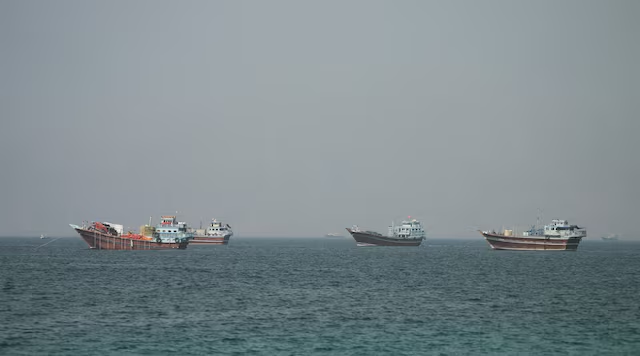
Ship traffic through the Strait of Hormuz dropped on Friday, hours after a Taiwanese-operated cargo vessel was reportedly struck near the Omani coast. Ship-tracking data showed fewer crossings than earlier in the week, as shipping operators pulled back from one of the world’s busiest oil and gas corridors.
Tanker Strike Near Oman Rattles Shipping Industry
The vessel belonged to Taiwan’s Evergreen Marine. The company said it was hit by an “unknown object” near Omani waters. U.S. officials told Reuters that Iranian forces may have fired on the ship. Tehran denied responsibility and said maritime safety in the area depends on coordination with Iranian authorities.
The strike happened near the entrance to the Strait, a stretch of water where military patrols already overlap with heavy commercial shipping. Jakob Larsen, chief safety and security officer at the shipping association BIMCO, called the incident a setback for efforts to normalize traffic and said it points to the need for clear, enforceable agreements between regional powers on safe passage.
Vessel Transits Fall Sharply in a Single Day
Tanker movements through the Strait, including crude carriers, refined product ships, and chemical tankers, fell to 13 transits on Friday. That’s down from 24 on Thursday and 27 on Wednesday. Those midweek numbers had been the highest since tensions escalated earlier this year, so Friday’s drop reversed a recovery that had only just started. Before the recent round of conflict-related disruptions, the Strait handled around 125 transits a day. Some ships kept moving despite the drop, so traffic didn’t stop completely.
UN Suspends Evacuation Coordination for Stranded Crews
The United Nations’ maritime agency paused its voluntary evacuation coordination system for stranded ships and crews in the Gulf after the attack. The program had helped hundreds of vessels and thousands of seafarers caught up in earlier disruptions. Officials cited the heightened security risk near the Omani side of the Strait as the reason for the pause. Analysts say halting the program can add to congestion, since shipping companies tend to wait for clearer signals before resuming normal schedules.
Iranian Crude Shipments Keep Moving
Oil cargoes kept moving despite the disruption. Two supertankers entered the Strait on Friday to load crude at Iranian terminals, and another large vessel left carrying roughly two million barrels of crude, according to energy intelligence firm Kpler. Those movements show that oil trade hasn’t been fully cut off, even with security concerns running high. They also reflect ongoing attempts by regional producers and buyers to keep supply chains steady after months of volatility.
Oil Prices Slide as Supply Fears Ease
Global oil prices fell more than 3% on Friday, adding to losses for the week as fears about a prolonged supply disruption eased. Part of that drop came from signs that regional producers are ramping up exports. Saudi Arabia, one of the largest crude exporters in the world, resumed oil loadings through its Gulf terminals, which helped boost market confidence that supply would hold up. Analysts pointed to the combination of higher output and partial shipping normalization as the main reason prices eased, though they warned that volatility could return if more security incidents hit the Strait.
Tehran Ties Safe Passage to Regional Coordination
Diplomatic tension still shapes maritime security in the region. Iranian officials have said safe passage through the Strait can’t be guaranteed without coordination with Tehran, pointing to Iran’s role in managing traffic in nearby waters. That position runs into ongoing disagreements over jurisdiction, security responsibility, and naval presence in the Gulf. Shipping companies and insurers are watching political developments closely, since even small escalations can move freight costs and change route planning.
Traffic Still Well Below Last Year’s Levels
Some numbers point to a partial recovery, but analysts say the broader picture is still unstable. AXSMarine data showed 62 total vessel crossings through the Strait on June 24, in both directions combined, the highest single-day count since the conflict began earlier this year. That figure is still only 53% of the traffic recorded on the same date last year. AXSMarine noted that while traffic has improved from its lowest points, it hasn’t returned to anything close to normal.
A Chokepoint That Still Drives Global Markets
The Strait of Hormuz carries a large share of the world’s crude oil and liquefied natural gas, which keeps it at the center of global energy logistics. Any disruption there, whether from military action, political friction, or maritime incidents, tends to show up quickly in commodity prices and supply chains elsewhere. Security analysts say continued uncertainty in the region could keep shipping operators from returning to full capacity even if no further attacks happen.
A Recovery That Remains Fragile
Friday’s drop in vessel traffic shows how easily the recovery in the Strait can stall. Oil flows have resumed in part and markets have started to settle, but the latest incident is a reminder of how fast conditions can change in this part of the Gulf. For now, shipping activity sits at reduced levels while operators weigh commercial demand against security risk. Analysts say normalization will likely stay gradual, and only continue if tensions stay contained and maritime security arrangements get stronger in the coming weeks.