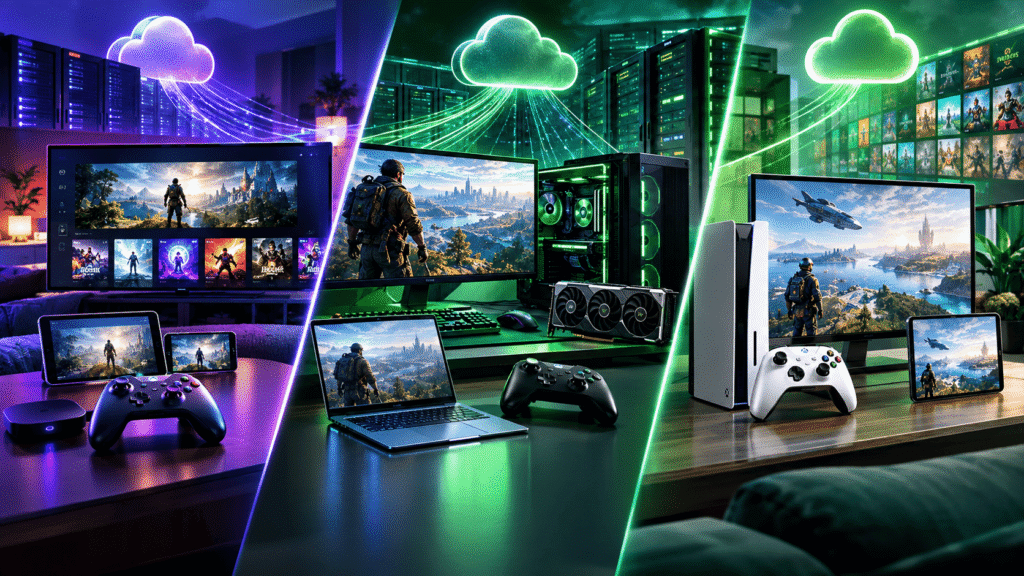
Amazon Luna vs GeForce NOW vs Xbox Cloud Gaming at a Glance
If you’ve been putting off cloud gaming because you weren’t sure which service made sense, 2026 is actually a strange year to decide. All three big players — Amazon Luna, GeForce NOW, and Xbox Cloud Gaming — changed their rules this year, and not always in the player’s favor. Luna quietly stopped selling games altogether and leaned hard into being a Prime perk. GeForce NOW introduced its first-ever monthly playtime cap. And Xbox Cloud Gaming, long the “unlimited” holdout, is about to follow suit. The core difference between them hasn’t changed though: Luna and Xbox hand you a rotating library of games to play, while GeForce NOW expects you to already own your games elsewhere and just streams them. That one distinction shapes almost everything else in this comparison.
Quick Comparison of Pricing and Playtime
Amazon Luna’s Standard tier costs nothing extra if you already pay for Prime, and Luna+ runs about $9.99 a month for a bigger rotating catalog. GeForce NOW starts free but caps you at one-hour sessions, with paid tiers at $9.99 and $19.99 a month. Xbox Cloud Gaming comes bundled inside Game Pass, which now costs $9.99 for Essential, $14.99 for Premium, and $22.99 for Ultimate.
Game Library and Ownership Models
Luna and Xbox both work like a streaming subscription for games: you get access to whatever’s in the catalog that month, and nothing more. GeForce NOW flips that model on its head — you bring your own purchased games from Steam, Epic, or other stores, and NVIDIA just supplies the horsepower to run them.
What Changed for Amazon Luna in 2026
Luna’s 2026 story is really a story about Amazon giving up on selling games directly. Starting April 10, 2026, Amazon Luna stopped offering game stores, individual game purchases, and third-party subscriptions altogether. If you’d bought games through Luna before that date, you weren’t left completely stranded, but the clock was ticking. The last day to actually play a game purchased directly through Luna’s cloud storefront was June 10, 2026.
Luna Remote Play and New Service Changes
This wasn’t Luna’s first pivot, either. Amazon had already relaunched Luna in October 2025, folding Prime Gaming into it and opening the service up to its enormous Prime subscriber base. What’s left after the April cleanup is a much simpler product: two tiers, no store, no ownership.
Monthly Gaming Hours and Membership Changes
Here’s the twist that makes Luna interesting in this Amazon Luna vs GeForce NOW vs Xbox Cloud Gaming comparison: it’s currently the only one of the three with no published monthly hour cap at all. Luna Standard remains a free perk for Prime members with a small rotating library, while Luna+ (also called Luna Premium in some regions) sells separately for roughly $9.99 a month with around 155 titles, and neither tier lets you buy or own individual games anymore. So while GeForce NOW and Xbox are busy adding limits, Luna’s free tier is going the opposite direction — at least for now.
Amazon’s Changing Gaming Strategy
Amazon also shut down its ambitious MMO New World’s cloud presence and scaled back other gaming bets earlier in the decade, and Luna’s redesign fits that same pattern. Instead of competing head-on as a marketplace, Amazon is using Luna the way it uses Prime Video: as a reason to keep paying for Prime, not as a standalone gaming business.
Amazon Luna Features, Games and Performance
Game Library and Prime Benefits
Luna Standard ships with more than 50 cloud-streamed games plus a rotating selection of downloadable PC titles that changes monthly. You’ll need an active Prime membership to unlock this tier, and the catalog rotates rather than growing, so titles you love this month might rotate out the next.
Devices and Controller Support
The Luna app works on Windows, macOS, ChromeOS, Android, iOS, Fire TV devices, Fire tablets, and recent Samsung and LG smart TVs. You can use the dedicated Luna Controller, but most Bluetooth controllers work fine too.
Streaming Quality and Latency
Streaming quality tops out at 1080p and 60 frames per second for most titles, with no published session length limit and no monthly hour cap — a genuine advantage if you hate watching a countdown timer while you play. Amazon recommends at least 10 Mbps and a 5 GHz wireless or wired connection for a smooth experience.
GeForce NOW in 2026: Plans, Performance and Game Ownership
Free and Paid Membership Options
GeForce NOW’s free tier gets you in the door with one-hour gaming sessions, ad-supported waiting periods, and the longest queue times, capped at 1080p/60fps. Paid plans remove the wait and raise the ceiling: Performance runs $9.99 a month with six-hour sessions and up to 1080p/60fps, while Ultimate costs $19.99 a month with eight-hour sessions and access to NVIDIA’s fastest servers.
The big 2026 change is the new cap. NVIDIA confirmed that all subscriptions became subject to a monthly playtime limit starting January 1, 2026, with each account getting 100 hours of gameplay per month before extra time has to be purchased. Unused time rolls over to the next month, but only up to 15 hours, so you can’t stockpile hours for a marathon session down the road.
Bring Your Own Game Library
This is where GeForce NOW genuinely stands apart. Rather than handing you a curated list, it streams games you already own from stores like Steam and the Epic Games Store, with over 4,000 supported titles across both Ready-to-Play and Install-to-Play categories. If you’ve spent years building a Steam library, that library keeps working here — you’re paying for compute, not for content.
Performance Advantages
On raw specs, GeForce NOW is hard to beat. Ultimate subscribers now run on RTX 5080-class hardware, delivering up to 5K resolution at 120fps or 1080p at a blistering 360fps, plus ray tracing and DLSS frame generation for supported titles.
Xbox Cloud Gaming and Game Pass in 2026
How Xbox Cloud Gaming Works With Game Pass
Xbox Cloud Gaming isn’t sold on its own — it rides along inside a Game Pass subscription. Game Pass Essential costs $9.99 a month, Premium runs $14.99, and Ultimate sits at $22.99 after Microsoft cut the Ultimate price in April 2026, reversing an earlier hike that had pushed it toward $30.
Game Library and Usage Limits
Right now, cloud streaming through Game Pass is unlimited for eligible subscribers, but that’s about to end. Beginning in November 2026, Xbox Game Pass subscribers will no longer receive cloud gaming without a monthly time limit — Ultimate gets 15 hours, Premium gets 10 hours, and Essential gets just 5 hours. Microsoft says the change is about rising infrastructure costs and estimates it will affect only around 4% of subscribers, but if you’re a heavy cloud-only player, 15 hours a month works out to roughly 30 minutes a day — a big drop from unlimited access.
Supported Devices
Xbox Cloud Gaming is available across 29 countries and runs on Xbox consoles, Windows PCs, mobile browsers on iOS and Android, and select smart TVs. Interestingly, non-subscribers will soon be able to buy streaming hours to play games they already own, which is a small step toward the GeForce NOW model.
Full Amazon Luna vs GeForce NOW vs Xbox Cloud Gaming Comparison
| Feature |
Amazon Luna |
GeForce NOW |
Xbox Cloud Gaming |
| Starting Price |
Free with Prime |
Free (limited) |
$9.99/mo (via Game Pass) |
| Free/Bundled Access |
Yes, with Prime |
Yes, capped sessions |
No standalone free tier |
| Monthly Hours |
None published |
100 hrs (paid tiers) |
Unlimited now; 5–15 hrs from Nov 2026 |
| Game Model |
Rotating subscription library |
Bring your own games |
Rotating subscription library |
| Game Ownership |
Not supported |
Required (Steam, Epic, etc.) |
Not supported |
| Maximum Resolution |
1080p/60fps |
Up to 5K/120fps (Ultimate) |
Up to 1440p on Ultimate |
| FPS Support |
Up to 60fps |
Up to 360fps (1080p mode) |
Up to 60fps typical |
| Device Support |
Fire TV, smart TVs, PC, mobile |
PC, Mac, mobile, smart TVs, browsers |
Console, PC, mobile, browsers |
| Controller Support |
Luna Controller, Bluetooth pads |
Most controllers via USB/Bluetooth |
Xbox controllers, Bluetooth pads |
| Main Advantage |
No hour cap, bundled with Prime |
Highest performance, own your games |
Deep first-party catalog |
Pricing and Value
Luna’s free tier genuinely costs nothing extra if you already have Prime, which makes it the easiest entry point. GeForce NOW and Xbox both ask for real money, but they hand you very different things for it — raw performance versus a huge curated catalog.
Game Library and Ownership
If you’ve already sunk hundreds of dollars into a Steam library, GeForce NOW lets that investment keep paying off. If you’d rather rent access to a rotating catalog and not think about ownership at all, Luna or Xbox suits you better.
Playtime Limits
This is quickly becoming the deciding factor for heavy users. Once Xbox’s caps land in November, only Luna will be left offering genuinely unlimited access on its free tier.
Cloud Gaming Performance and Internet Requirements
Latency and Input Response
Cloud gaming lives or dies on latency, not just bandwidth. The closer you are to a data center, the snappier your inputs feel — a laggy shot in a shooter is a lot more annoying than a slightly blurry frame in a slower game.
Internet Speed and Bandwidth
Most services recommend at least 10-15 Mbps for smooth 1080p streaming, and you’ll want a lot more for 4K on GeForce NOW’s Ultimate tier. A wired Ethernet connection beats Wi-Fi almost every time, especially in busy households where everyone’s streaming something.
Resolution and Streaming Quality
Expect quality to dip automatically when your network gets congested — that’s the service protecting your session from stuttering rather than a sign something’s broken.
Which Cloud Gaming Service Fits Different Players
For Casual and Budget Gamers
Luna’s free Prime tier is hard to beat if you just want to dabble occasionally without adding another bill.
For PC Gamers With Existing Libraries
GeForce NOW makes the most sense once you already own a decent Steam or Epic library — no other service lets that collection travel with you like this.
For Game Pass Subscribers
If you’re already paying for Game Pass for console or PC gaming, cloud streaming is a nice bonus, though it’s worth watching those new November limits closely.
For High-Performance Cloud Gaming
GeForce NOW Ultimate’s RTX 5080 servers put it well ahead on raw specs, especially for fast-paced competitive titles.
What the 2026 Changes Mean for Cloud Gaming
Why Monthly Gaming Limits Matter
Running thousands of GPU servers isn’t cheap, and all three companies are clearly feeling that cost. Playtime caps are essentially a way to manage server capacity without raising sticker prices outright.
Subscription Bundles vs Game Ownership
The industry seems to be splitting into two camps: services that bundle a curated catalog, and services that just rent you compute for games you already bought. Neither approach is objectively better — it depends entirely on how big your existing library is.
Amazon, NVIDIA and Microsoft Competition
Watching how differently Amazon, NVIDIA, and Microsoft are approaching this shows there’s no consensus yet on the “right” cloud gaming business model, and that competition should keep benefiting players in the long run.
Key Things to Check Before Choosing a Cloud Gaming Service
Check These Before Subscribing
- Your existing game library and whether you’d rather own or rent
- Monthly gaming hours you actually realistically use
- Your internet connection’s speed and stability
- Which devices you’ll actually stream on
- Resolution and FPS requirements for your favorite genres
- Total monthly cost across any bundled services
- Whether games are included in the price or need separate purchase
At the end of the day, there’s no single winner in the Amazon Luna vs GeForce NOW vs Xbox Cloud Gaming race — the right pick depends on whether you already own games, how many hours you play, your budget, and which devices you use most.
Frequently Asked Questions About Cloud Gaming
Is Amazon Luna better than GeForce NOW?
Luna wins on price and simplicity for casual Prime members; GeForce NOW wins on performance and letting you use games you already own.
Is GeForce NOW better for games you already own?
Yes — it’s built specifically around streaming your existing Steam, Epic, and other library games.
Does Xbox Cloud Gaming require Game Pass?
Currently yes, though non-subscribers will soon be able to buy hours to stream games they own.
How many hours can you play cloud games each month?
It varies: Luna currently has no published cap, GeForce NOW caps paid tiers at 100 hours, and Xbox will cap Game Pass tiers at 5-15 hours starting November 2026.
Which cloud gaming service has the best performance?
GeForce NOW Ultimate, thanks to its RTX 5080-class servers supporting up to 5K/120fps.
Can you play cloud games on a phone or smart TV?
Yes, all three services support mobile devices and many smart TVs, though exact model support varies by brand and region.
Does cloud gaming use a lot of internet data?
Yes, streaming games consumes significantly more data than downloading them once, so keep an eye on data caps if you’re not on unlimited broadband.