
Ukraine’s expanding use of medium-range drone strikes is increasingly reshaping the battlefield, creating new challenges for Russian forces and disrupting military logistics, air defenses and critical infrastructure far behind front lines.
While long-range drone attacks on Russian oil depots and refineries have attracted international attention, Ukrainian military commanders and defense analysts say a less visible capability — mid-range strike operations — is now playing a decisive role in the war.
These drone operations, typically targeting areas between 30 and 180 kilometers behind combat zones, are designed to weaken Russian battlefield support systems and open corridors for deeper strikes on strategic assets.
Military observers say the approach reflects Ukraine’s growing ability to innovate under pressure as the conflict enters another intense phase.
Mid-Range Drone Attacks Expanding Across the Battlefield
Ukrainian officials say resources devoted to medium-range strike operations have increased significantly in recent months.
The objective is not simply to hit isolated targets but to systematically degrade Russia’s operational capacity.
Targets include radar systems, air-defense networks, communications infrastructure, logistics hubs, fuel depots and large military vehicles operating behind front lines.
According to Ukrainian military sources, these attacks are aimed at what analysts describe as “operational depth” — the zone supporting combat troops but located outside conventional artillery range.
The strategy has allowed Ukrainian forces to attack positions that were previously difficult to reach.
President Volodymyr Zelenskyy recently stated that Ukraine had doubled its medium-range strike activity compared with earlier months, highlighting the growing importance of the capability.
Field commanders say the expansion has involved more drone crews, greater platform diversity and improved coordination.
Air Defense Systems Becoming Priority Targets
One of the central goals of Ukraine’s drone campaign has been weakening Russian air defenses.
Military commanders say systems such as Buk, Tor and Pantsir units have become high-priority targets because their destruction creates openings for broader operations.
By removing radar coverage and defensive layers, Ukraine increases the likelihood that long-range drones can penetrate deeper into Russian territory.
According to Ukrainian commanders, this tactic has helped facilitate attacks against energy facilities and industrial infrastructure.
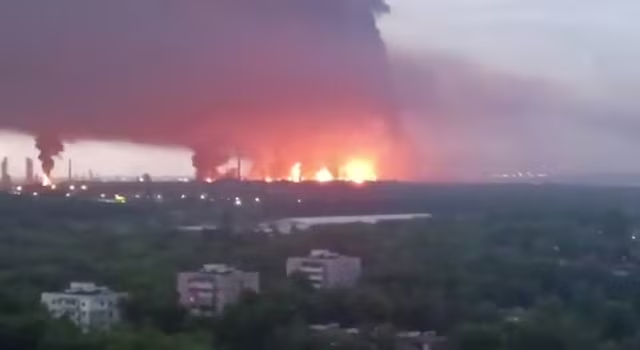
Recent strikes have reportedly affected several Russian oil facilities, including installations near the Black Sea and inland refining centers.
Defense analysts note that such attacks have placed additional pressure on Russian energy infrastructure at a time when fuel production and exports remain strategically important.
Oil Infrastructure Faces Mounting Pressure
Ukraine’s long-range attacks on oil infrastructure have intensified in recent months, with several facilities reportedly forced to reduce operations or temporarily suspend activity.
Analysts say mid-range strikes indirectly support these operations by compelling Russia to reposition air defenses away from key energy assets.
As a result, long-distance drones face fewer obstacles when targeting refineries and logistics facilities.
Recent attacks have reportedly disrupted operations at major oil installations and affected export routes.
The pressure on energy infrastructure has also contributed to broader economic concerns inside Russia, particularly regarding fuel supply chains and refining capacity.
Military experts note that damaging energy assets does not immediately alter front-line conditions but can gradually affect war sustainability.
Stretching Russian Logistics Networks
Another major objective of Ukraine’s mid-range drone campaign is logistics disruption.
Commanders say pushing Russian support systems farther from combat zones increases the burden on supply operations.
Fuel depots, ammunition stores, transport hubs and command posts are increasingly being targeted.
“The farther support units move from front lines, the more complicated logistics become,” one Ukrainian commander explained.
Longer supply routes require additional transport, more protection and greater coordination.
Analysts say this creates inefficiencies that slow battlefield operations.
Ukraine’s Ministry of Defense reported a significant rise in medium-range operations earlier this year, with hundreds of strikes conducted across expanded distances.
Such attacks are increasingly seen as a method of gradually weakening Russian operational tempo rather than achieving immediate territorial gains.
Innovation Driven by Battlefield Necessity
Defense specialists say Ukraine’s rapid development of drone warfare reflects necessity as much as strategy.
Facing a larger military force and persistent equipment shortages, Ukraine has increasingly relied on domestic drone production and technological adaptation.
Commanders say close cooperation between drone manufacturers and battlefield units has accelerated innovation.
Feedback from frontline operators is reportedly integrated into systems within days rather than months.
Engineers working with drone brigades say many platforms now arrive nearly combat-ready, requiring minimal modifications before deployment.
This rapid cycle of testing and adaptation has transformed drones from supplementary tools into central components of military planning.
What began as limited capabilities early in the war has evolved into a structured operational system.
Battlefield Momentum Shows Signs of Shifting
While analysts caution that drone strikes alone are unlikely to decisively change the course of the war, many agree they are influencing battlefield dynamics.
The pace of Russian advances has slowed in several sectors compared with earlier phases of the conflict.
Military observers attribute this to multiple factors including terrain, fortifications and increasing drone pressure.
Ukraine’s drone operations have also provided a morale boost following periods marked by heavy attacks on its own infrastructure.
The ability to strike deep into Russian-held territory has become symbolically and strategically important.
Experts say the campaign forces Russia into costly adjustments — dispersing defenses, relocating assets and adapting logistics networks.
The Future of Drone Warfare
Defense analysts believe medium-range drone warfare remains in an early stage of development.
As technologies improve, capabilities could expand further.
Analysts say both Ukraine and Russia are likely to continue investing heavily in unmanned systems as drones increasingly shape modern combat.
Some experts argue the conflict is becoming a testing ground for future warfare models where autonomous and remotely operated systems play central roles.
For Ukraine, mid-range drone operations have become more than tactical tools.
They now represent a strategic effort to offset disadvantages in manpower and equipment while imposing costs far beyond the front line.
As the conflict evolves, these strikes may continue to influence not only battlefield operations but the broader trajectory of the war itself.