


Cocoa farmers across Ivory Coast say their trees are showing strong early growth this season, but several warned that the crop’s fate over the coming weeks will depend heavily on whether they can apply fertilizer and pesticide in time and whether rainfall in September stays within a manageable range.
Ivory Coast, the world’s largest cocoa producer, is currently in the middle of its rainy season, which typically runs from April through mid-November. Farmers interviewed across multiple growing regions described a season that has been promising so far, but one that remains vulnerable to both disease and cold stretches if conditions shift in the wrong direction over the next month.
Soil moisture holds, but treatment window is narrowing
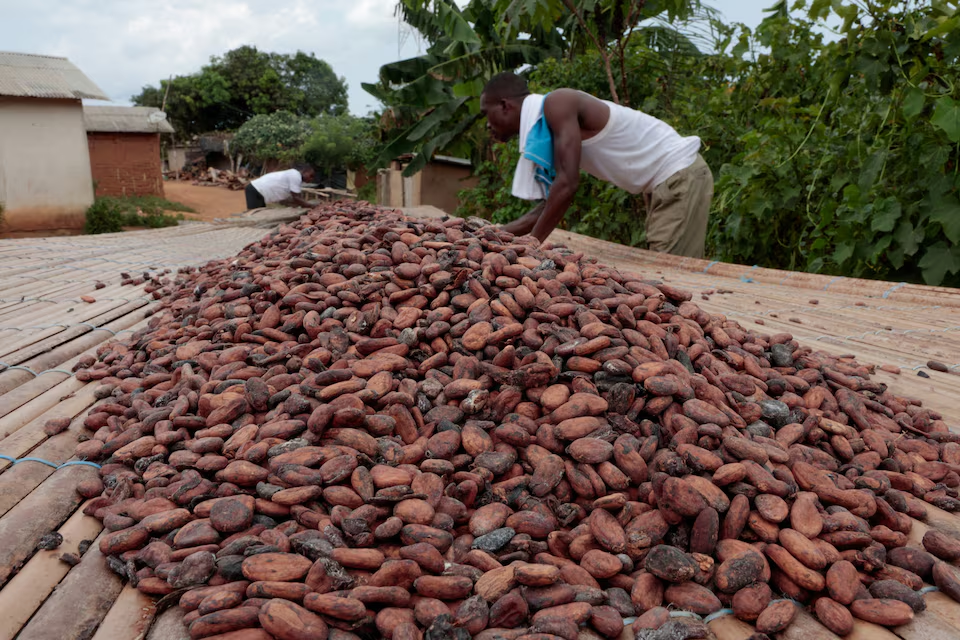
Several farmers said soil moisture levels remain high enough to support tree development for several more weeks, even in areas where rainfall has come in below the five-year average. That moisture has kept trees growing, but farmers stressed that growth alone will not guarantee a strong harvest without proper crop treatment in the coming weeks.
Kouassi Kouame, who farms near Soubre in the western region, said the temperature swings this season have made timely treatment more urgent than usual. “It can get very cold at times. Now is the time to treat the crops, otherwise there will be significant losses,” Kouame said. His region received just 0.6 millimeters of rain last week, 11.6 millimeters below the five-year average for that period.
Kouame’s warning points to a recurring theme among farmers this season: strong current conditions do not eliminate the need for active management. Fertilizer and pesticide application this month, farmers said, will determine whether the fruit currently developing on the trees survives to harvest or dies before it can be picked.
Southern and eastern regions report abundant fruit
In the southern regions of Agboville and Divo, and in the eastern region of Abengourou, farmers reported plenty of fruit still developing on the trees despite below-average rainfall in those areas. The consistency of fruit growth across regions with different rainfall totals suggests the moisture reserves built up earlier in the season have so far been sufficient to carry trees through drier stretches.
Farmers in these regions said that if weather conditions stay favorable through September, the harvest for the main crop should become abundant starting in mid-October and continuing through December at a minimum. That timeline lines up with the typical harvest window for Ivory Coast’s main cocoa crop, though farmers were careful to frame it as dependent on what happens in the weeks ahead rather than a guaranteed outcome.
Central and west-central regions flag a different risk: too much rain
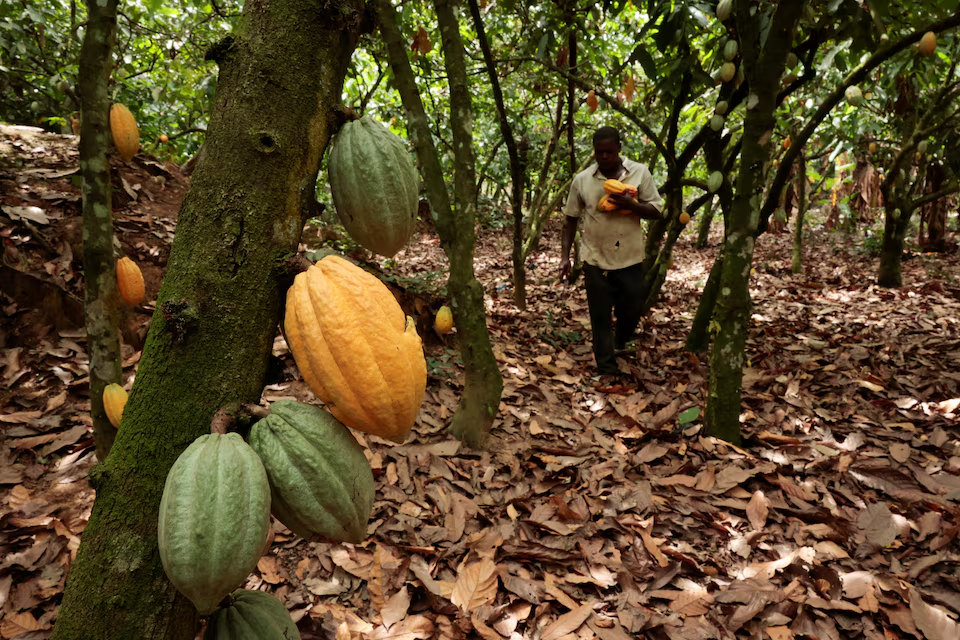
The picture shifts somewhat in Daloa, in the west-central region, and in Bongouanou and Yamoussoukro in central Ivory Coast. Farmers in these areas, which have also seen below-average rainfall this season, said their plantations have yielded well so far. But unlike farmers further south, they are more concerned about the opposite problem: too much rain arriving in September.
Albert N’Zue, who farms near Daloa, described fruit that is currently growing well in size, but he warned that a wet September could undo that progress. “Many fruits are growing in size, promising a bountiful harvest. However, if there is heavy rain in September, there will be a risk of disease in the plantations,” N’Zue said. His area recorded just 2.4 millimeters of rain last week, 17 millimeters below the five-year average.
The concern in these regions centers on disease, which tends to spread more easily in cocoa plantations when heavy rainfall follows a drier stretch, creating the kind of humid conditions that allow fungal infections to take hold in the pods. Farmers in Daloa, Bongouanou and Yamoussoukro appear to be watching the same weather pattern that farmers further south are hoping continues, but from the opposite angle: for them, the current dry conditions are actually protecting the crop, and a sudden increase in rainfall next month is the bigger threat.
A season defined by regional contrasts
Taken together, the reports from across Ivory Coast’s growing regions describe a crop that is developing well overall, but one where the specific risks vary significantly by location. In the west, near Soubre, the concern is cold temperatures and the need for timely fertilizer and pesticide treatment. In the south and east, around Agboville, Divo and Abengourou, the outlook is largely positive, with farmers expecting a strong main crop harvest if conditions hold. In the west-central and central regions, including Daloa, Bongouanou and Yamoussoukro, the worry is reversed: farmers there need the current dry pattern to continue, at least through September, to avoid a spike in plantation disease.
Weekly temperatures across the country ranged between 24.4 and 27.4 degrees Celsius, or 75.9 to 81.3 degrees Fahrenheit, a range that farmers in cooler areas like Soubre say is already testing crop resilience even without accounting for further swings later in the season.
What comes next
The next several weeks will likely determine how this season’s main crop turns out. Farmers who need treatment applied, like those near Soubre, are racing against the calendar to get fertilizer and pesticide into their plantations before cold snaps or fruit loss set in. Farmers watching rainfall patterns in central and west-central regions are hoping September stays dry enough to avoid disease outbreaks that could undercut what has so far been a productive growing season. If both groups get the outcomes they are hoping for, the main crop harvest starting in mid-October is expected to be strong. If not, the abundance farmers are currently describing on the trees may not fully translate into the volumes reaching market by December.