
Mojtaba Khamenei, the man chosen to succeed his father as Iran’s supreme leader, was absent from this week’s state funeral ceremonies for Ayatollah Ali Khamenei, an absence that has fueled speculation about his health and his ability to project authority at a critical moment for the Islamic Republic.
Three of his brothers appeared publicly to mourn their father, who was killed in the U.S.-Israeli war against Iran in February. Mojtaba did not. Authorities have pointed to security concerns to explain why the new supreme leader stayed out of view during the week-long mourning events.
His father dominated Iranian public life for nearly four decades. Mojtaba has taken a very different path. The 56-year-old cleric kept a largely hidden profile in the years before a powerful clerical assembly selected him as supreme leader in March.
Mojtaba was severely wounded in the same strike that killed his father. Since then, he has not appeared in public, delivered a speech or given an interview. His communication with the Iranian public has come through a small number of written statements.
Two Iranian officials told Reuters that Mojtaba remains actively involved in state decision-making and that his wounds are healing quickly. Iranian President Masoud Pezeshkian said in May that he had personally met with the new supreme leader.
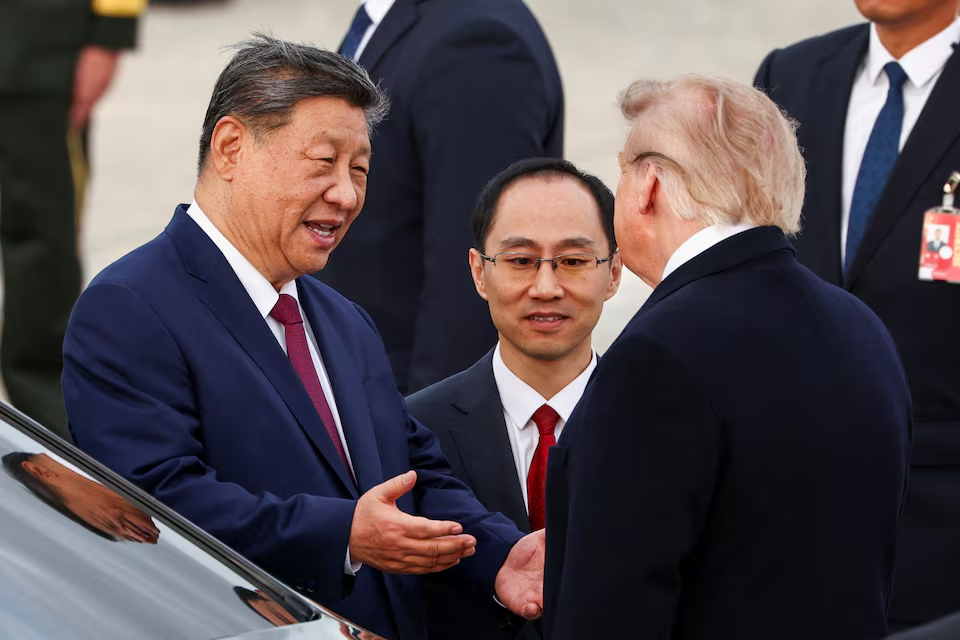
In one of his few public interventions since taking office, Mojtaba gave cautious backing to a memorandum of understanding signed last month by the Iranian and U.S. presidents, an agreement aimed at ending the war.
A power base built through the security services
Mojtaba built his influence under his father as a senior figure closely tied to Iran’s security forces and the business empire they control. His relationship with the Islamic Revolutionary Guard Corps gave him reach across Iran’s political and security establishment. Sources familiar with his role describe him as his father’s behind-the-scenes gatekeeper, a position that let him control access to the supreme leader for years.
Senior Iranian sources told Reuters in March that the Guards pushed hard for Mojtaba’s elevation to supreme leader, viewing him as a more compliant version of his father who would back their hardline agenda. According to those sources, the Guards had to overcome resistance from senior political and clerical figures. Some objected because Mojtaba lacks the religious credentials traditionally required for Iran’s highest office. Others worried about how it would look for a son to succeed his father as supreme leader in a republic founded on the overthrow of a hereditary monarchy.
When Mojtaba was named Iran’s third supreme leader, he was simultaneously promoted from the clerical rank of Hojjatoleslam to ayatollah. Authorities gave no official explanation for the sudden promotion.
A senior Iranian official described Mojtaba as very close to Parliament Speaker Mohammad Baqer Qalibaf, who also serves as Iran’s lead negotiator in talks with the United States. Kasra Aarabi, director of IRGC research at the U.S.-based advocacy group United Against Nuclear Iran, said Mojtaba’s support runs deep within the Guards.
“He has strong constituency and support within the IRGC, in particular amongst the younger radical generations,” Aarabi said.
As supreme leader, Mojtaba now holds final authority over Iran’s biggest decisions, including foreign policy, national security and the country’s nuclear program. He may still face pushback from Iranians who have repeatedly taken to the streets demanding greater social and political freedom, despite crackdowns that have often turned violent.
From Mashhad to Qom
Mojtaba was born in 1969 in Mashhad, a Shi’ite holy city, at a time when his father was helping lead the opposition movement against the U.S.-backed shah. As a young man, he served during the Iran-Iraq War.
He went on to study under conservative clerics in the seminaries of Qom, Iran’s center of Shi’ite religious scholarship, where he reached the rank of Hojjatoleslam. Despite his influence throughout his father’s rule, Mojtaba never held a formal government position. He occasionally appeared at pro-establishment events but rarely spoke in public.
Sanctioned by the U.S. Treasury
The U.S. Treasury sanctioned Mojtaba in 2019, stating that he represented the supreme leader in an official capacity despite never being elected or appointed to any government role beyond his work in his father’s office.
The Treasury said Ali Khamenei delegated certain responsibilities to Mojtaba, who worked closely with commanders from the IRGC’s Quds Force and the Basij militia to advance his father’s regional and domestic objectives. Mojtaba became a target of public anger during the nationwide protests that followed the 2022 death of a young woman in police custody, after she was arrested for allegedly violating Iran’s mandatory dress code.
In 2024, a video that circulated widely online showed Mojtaba announcing the suspension of Islamic jurisprudence classes he had been teaching in Qom. The move sparked speculation about what prompted it, though no clear explanation followed.
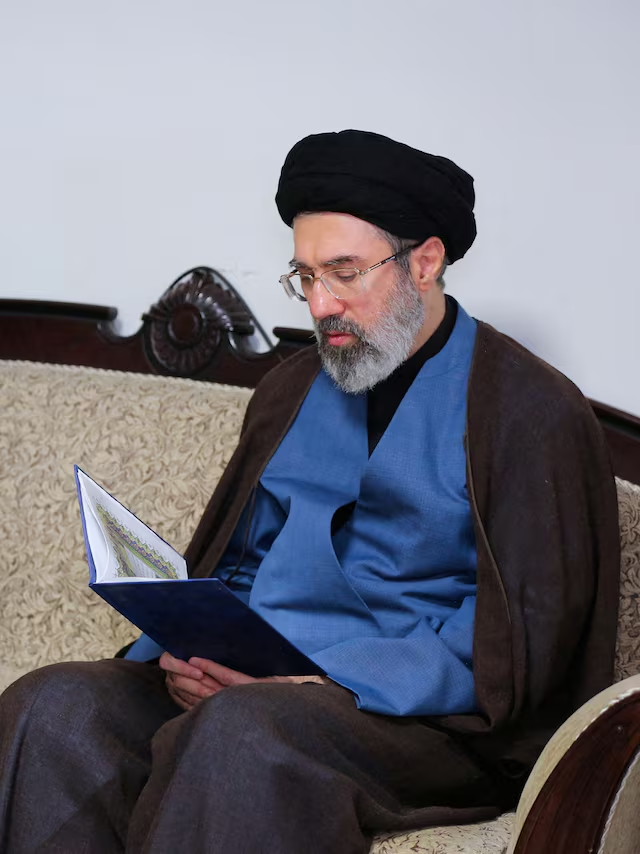
Mojtaba closely resembles his father in appearance and wears the black turban of a seyyed, a title denoting descent from the Prophet Mohammad. A 2007 U.S. diplomatic cable released by WikiLeaks cited three Iranian sources who described Mojtaba as a key channel for anyone seeking access to his father.
His wife, who was killed in the February 28 attack, was the daughter of Gholamali Haddad-Adel, a prominent hardline politician and former parliament speaker. The marriage further cemented Mojtaba’s ties to the upper ranks of Iran’s political establishment.