Clicxpost

Africa

Heavy rains lead to Senegal floods, government reports several deaths

Senegal floods

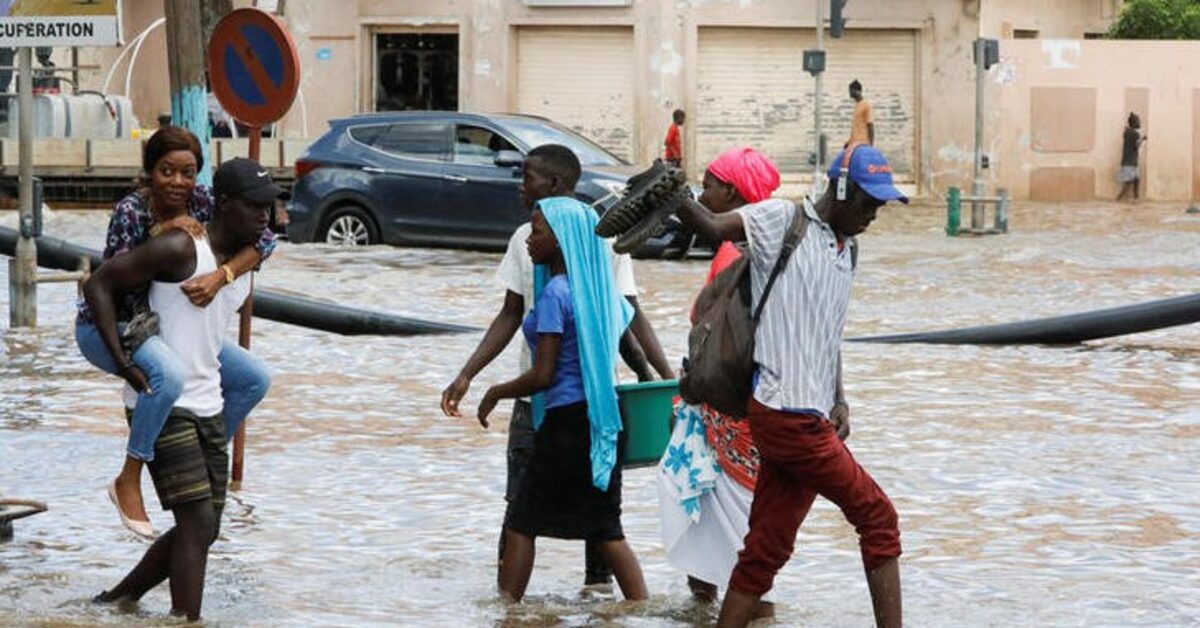
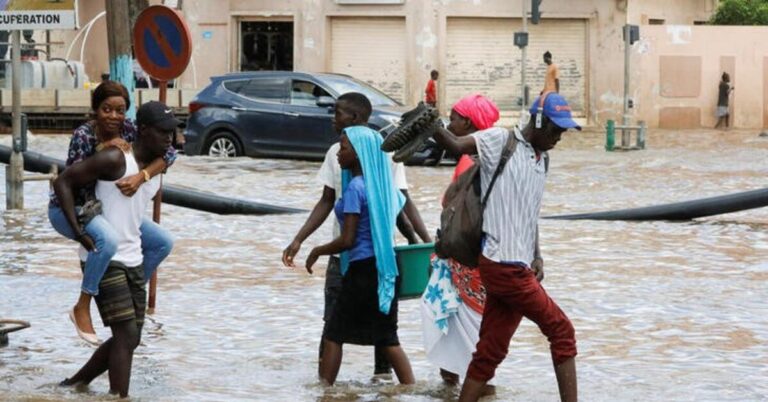
Heavy rain flooded roads and destroyed buildings across Senegal over the weekend, and the government said several people were killed and that more rain is coming. Flash floods in the capital, Dakar, and other areas disrupted traffic, and Prime Minister Ahmadou Al Aminou Lo warned that the school year, due to start this week, could be postponed if the water does not recede.

The floods come less than four weeks before Dakar hosts the 2026 Summer Youth Olympics, which start on October 31.

Deaths reported in Dakar and Matam

Senegal’s Interior Ministry reported deaths and injuries in Dakar and in Matam, a town in the northeast. It said a building collapsed in Kaolack, a town in the south. The reports did not give a death toll.

Local media reported that a mother and her child died in the Parcelles Assainies area of Dakar after their home flooded.

More rain forecast for Monday to Wednesday

Lo said there is a high probability of more rain on Monday, Tuesday and Wednesday. The forecast covers the same days on which many families would be preparing children for the start of term.

He said the school year could be postponed if floodwaters have not receded. The government has not yet announced a new date.

How much rain fell

Senegal’s meteorological agency, ANACIM, published rainfall totals for 24 hours. Rufisque, a town just outside Dakar, and Ranerou, in the Matam region, each recorded 142 mm. Dakar’s Yoff district recorded 138 mm.

The two places with the highest totals are about as far apart as two parts of the country can be, which suggests the rain covered a wide area and was not limited to the capital.

For comparison, after floods in Dakar in 2020, then-Water Minister Serigne Mbaye Thiam said 124 mm of rain had fallen, about what the city normally gets over the whole rainy season from July to September. The measuring stations and years differ, so the figures are not an exact match. Even so, both totals reported this weekend are above that 2020 number, and they were recorded within one day.

The Youth Olympics clock

Senegal is preparing to host the first Youth Olympic Games ever held in Africa. The event runs from October 31 to November 13, 2026.

The government expected flooding to be a risk for the event. On July 3, Lo chaired an interministerial meeting on flood preparedness and management, and the government approved measures to protect the venues and infrastructure. A dedicated task force was set up to handle flooding and waste at competition and accommodation sites, according to Ecofin Agency

That work followed Law No. 2026-381 of May 19, 2026, which strengthens the role of local authorities in flood prevention and management. The law is not specific to the Games. The task force works with the organising committee and the International Olympic Committee’s coordination commission.

This weekend’s rain is the first major test of those plans. The reports so far do not say whether any Olympic venues were affected, so that question remains open.

A problem that comes back each year

Floods in Dakar are not new. In 2020, the government faced criticism over a slow response to flooding that killed at least six people. A local resident told FRANCE 24 at the time that every flood brings food rations, but that what residents need is drainage and sanitation.

Dakar has a record of flooding after heavy local downpours, according to a European Space Agency hazard map, which classes the risk using flood events over the past 10 years. This weekend adds another event to that record.

What happens next

Three things will show how serious the situation is. The first is the rainfall on Monday, Tuesday and Wednesday, and whether floodwater drains from the streets of Dakar and Matam. The second is the government’s decision on the start of the school year. The third is whether the Interior Ministry publishes a full death toll and the number of damaged buildings.

With the Youth Olympics less than four weeks away, how quickly Dakar’s roads reopen will also be watched by organisers, athletes and visitors planning to travel.
RECOMMENDED
Africa

Ethiopia Retakes Mekelle Airport as Tigray Fears War’s Return

By George Mensah 4 min read

Ethiopia’s federal military has recaptured the main airport in Mekelle, the capital of the northern Tigray region, three sources told Reuters on Saturday, October 3. If confirmed, the move is a major setback for an opposition alliance in its stronghold. Reuters could not verify the claim, and the region’s ruling party, the Tigray People’s Liberation Front (TPLF), could not be reached for comment.

The airport is Alula Aba Nega Airport, about 10 km (6 miles) from the centre of Mekelle. It was one of three airports in Tigray that opposition forces seized when fighting began on September 23. That fighting is the most serious escalation of violence in northern Ethiopia since the 2020-2022 civil war.

What the three sources said

One source with knowledge of events in the city and a humanitarian source told Reuters that troops from the Ethiopian National Defence Forces had regained control of the airport. A third source, a Mekelle resident who asked not to be named for security reasons, confirmed that government forces took it. This resident said gunfire could be heard outside the city centre.

The resident also described scenes inside the city. Some Tigrayan Defence Force fighters were leaving their posts and heading home, the resident said, and government facilities were being looted.

A source close to the TPLF told Reuters that government troops and allied militias had encircled the city.

AFP, citing a local journalist and residents, reported that TPLF fighters and leaders were seen leaving Mekelle. The journalist told AFP that federal forces had not yet been seen inside the city. Al Jazeera reported that media access in Ethiopia is heavily restricted and that communications blackouts have limited reporting. Those limits are the context for why the accounts so far rest on anonymous sources.

How the fighting reached Mekelle

Last month, rebels announced a seven-party coalition led by the TPLF, the same group that fought federal forces in the 2020-2022 war, according to Al Jazeera. The coalition began an offensive that seized three airports in Tigray. It also engaged in fighting on the borders with the Amhara and Afar regions.

The government is now mounting a counteroffensive, Al Jazeera reported, citing the Critical Threats Project at the American Enterprise Institute. That project says federal forces are pushing into Tigrayan territory along three routes toward Mekelle. Al Jazeera’s bureau chief in Ethiopia, Mohammed Taha Tawakel, reported on Friday that forces loyal to the federal government had taken several towns and were closing in on the city.

Al Jazeera reported that fighting is also raging in the Amhara and Afar regions, so the conflict is not confined to Tigray. AFP photographed TPLF members walking along a main road in Mekelle on September 23, the first day of the fighting.

A wider regional dispute

The fighting has raised fears of a wider conflict that could draw in neighbouring countries in the Horn of Africa and the Gulf, Reuters reported. The federal government in Addis Ababa cut diplomatic ties with Eritrea this week. It accused Eritrea of backing the rebel alliance, along with Sudan and Egypt. All three countries deny the accusation. Reuters published an analysis this week on why renewed fighting in Tigray risks a regional war.

The accusation matters because of what the 2022 Pretoria peace agreement required. That deal, which ended the earlier war, obliged the TPLF to disarm. It also called for the withdrawal of Eritrean and other non-federal forces from Tigray and for humanitarian access to the region, according to Newsy Today. The accusation against Eritrea therefore touches the terms of the agreement that ended the last war.

What history suggests

Analysts told Reuters that taking Mekelle would be unlikely to end the conflict on its own. The 2020 war shows why. Federal forces captured Mekelle within the first month of that war, and the TPLF took it back seven months later.

Taking the airport is also a different step from holding the city. AFP’s local journalist reported that federal forces had not yet entered Mekelle, and the resident who spoke to Reuters heard gunfire at its edges. The resident also said looting of government facilities was already under way, which points to a security gap in the city.

What to watch next

Three things will show how far the airport’s recapture changes the fighting. The first is whether federal troops enter Mekelle itself or stay at its edge. The second is whether the TPLF confirms or denies the loss, since it had not commented when Reuters reported. The third is how Eritrea, Sudan and Egypt respond to the accusations after Ethiopia’s break with Eritrea.

Reuters said it could not verify the reports, and it and AFP are the main sources for updates. Until the government or the TPLF speaks publicly, the picture in Mekelle rests on anonymous sources.

Africa

France Steps Up Ebola Fight in Congo as Deaths Pass 4,000

By George Mensah 4 min read

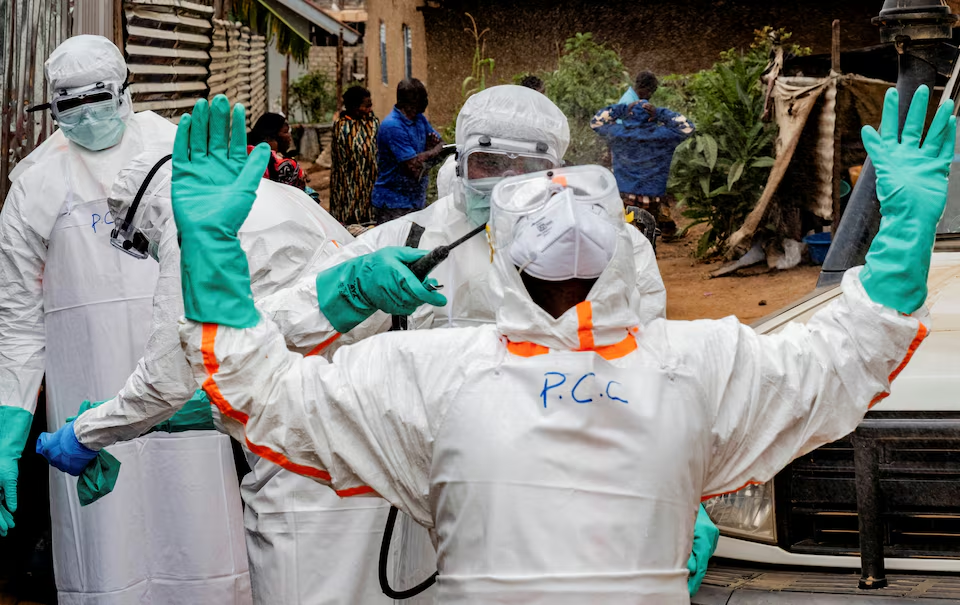
France will increase its support for efforts to end Ebola in eastern Democratic Republic of Congo, Foreign Minister Jean-Noel Barrot said on Saturday, October 3, during a visit to Bunia, a city in a region the virus has hit. He warned that the disease could come back quickly if vigilance slips. Congolese officials said on Friday that the outbreak has killed more than 4,000 people out of more than 8,000 confirmed cases, which Euronews described as the worst Ebola outbreak in the country’s history.

Reuters reported that Barrot’s trip to Bunia, the capital of Ituri province according to Euronews, was a rare one for a Western leader. “Ebola may seem far away to some people or political leaders,” he told reporters, but “it can return very quickly.” He added: “Our responsibility is to prevent those resurgences.”

What France has pledged

European Arctic Summit in Rovaniemi

France allocated €13.4 million ($15.1 million) to the fight against Ebola between January and July. Barrot said he will propose additional humanitarian funding for Ebola during the coming French budget discussions. He did not give an amount, and a proposal is not yet a commitment. Euronews reported before the visit that there was no sign France would offer fresh aid on the trip.

France’s response so far has come through humanitarian aid, medical research and the PRISM programme, which was launched during President Emmanuel Macron’s 2023 visit. A national humanitarian conference is scheduled in Paris on October 6, and Ebola is on the agenda. That is three days after the Bunia visit, so the conference is the first place where any new figure could be announced.

Praise for responders, and a harsh toll

Barrot praised Congolese authorities, UN agencies, humanitarian organisations and medical workers. In his view, they contained the epidemic and stopped it spreading to major urban centres in Congo and beyond.

The numbers show how large the task remains. The outbreak was officially detected in mid-May, and Euronews reported that violence and a shortage of resources have slowed the response. A transit centre for Ebola patients burned down on Tuesday in the same province after soldiers entered a site for displaced people, who then fled, according to the UN. A contractor who detected cases was also killed in an attack, Euronews reported.

The disease has also reached areas held by the anti-government group M23 in North Kivu province, according to the group’s own statement. It reported four deaths among six cases there.

The case in France

A reporter asked Barrot whether the virus could spread after a case was reported in France. “There is no need to fear or worry,” he said. “First and foremost, we must fight the epidemic where it emerges.”

France confirmed its first Ebola case on June 24. The patient was a doctor returning from a humanitarian mission in Congo, who flew from Kinshasa to Paris on an Air France flight, according to France 24. The French health ministry said the patient had headaches during the flight and was isolated on arrival. CNN reported that the patient was in stable condition.

The World Health Organization said the patient worked for the NGO Alliance for International Medical Action, known as ALIMA, according to Mongabay. The French health ministry said that the European Centre for Disease Prevention and Control rates the risk to the general European population as very low, CNN reported.

Dr Daniela Manno of the London School of Hygiene & Tropical Medicine said at the time that a case in Europe was “not entirely unexpected” while transmission continues in eastern Congo. WHO Director-General Tedros Adhanom Ghebreyesus said on June 24 that almost 80 health workers had been infected, and he called the risk to the rest of the world low.

The outbreak involves the Bundibugyo strain of Ebola. CNN reported that this strain has no vaccine and no specific treatment, which separates it from outbreaks caused by the Zaire strain, where both exist. Barrot’s answer fits that picture, since he said the fight has to happen where the epidemic emerges.

Mpox adds a second concern in Bunia

Bunia is also dealing with a second disease. Reuters reported that a laboratory-confirmed case of mpox was identified in the city in mid-September. Barrot’s visit therefore took him to a city handling an Ebola outbreak and a separate infection at the same time.

What comes next

Barrot will take the funding proposal into French budget talks, and the October 6 conference will show whether France puts a figure on it. The outbreak is still active, and officials in eastern Congo are working in areas where attacks have interrupted health work. France’s earlier spending of €13.4 million covered the first seven months of the year. Any new allocation would cover a period in which deaths have passed 4,000.

ADVERTISEMENT
Scroll to Top