Clicxpost

Africa

France Steps Up Ebola Fight in Congo as Deaths Pass 4,000

DR Congo Ebola deaths

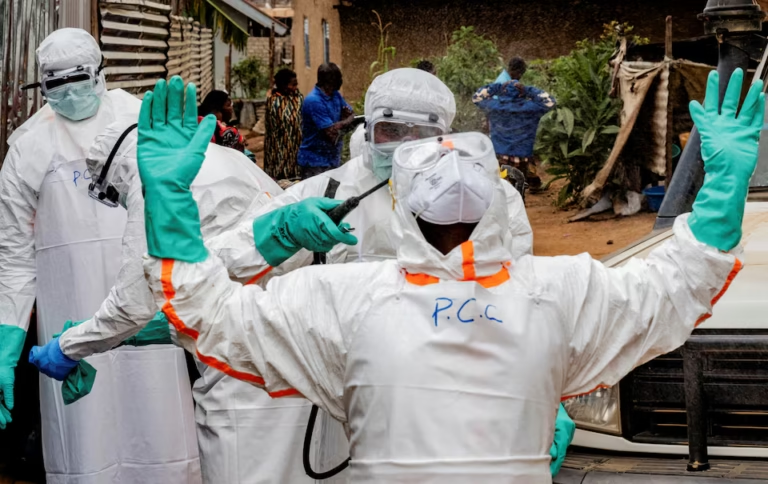
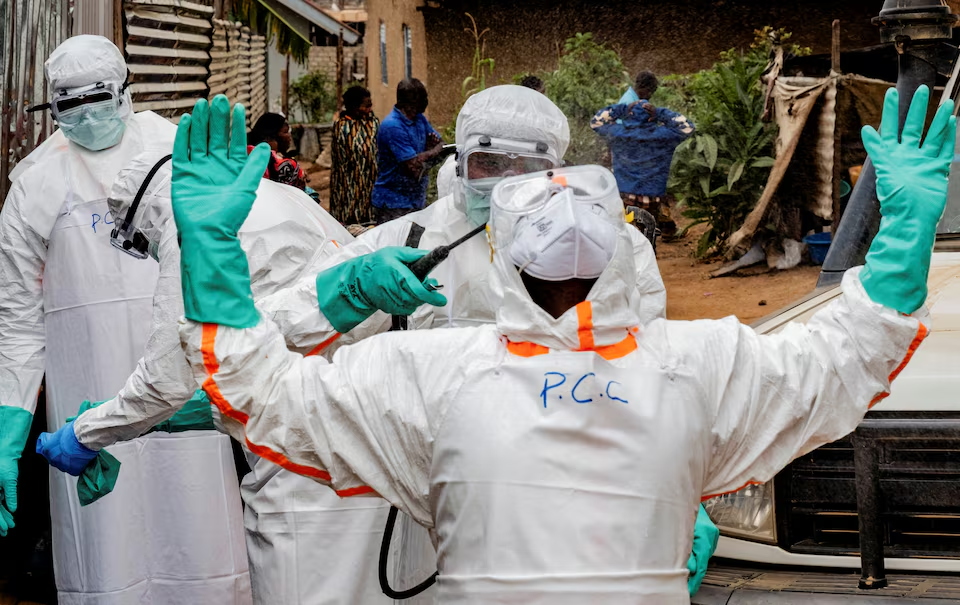
France will increase its support for efforts to end Ebola in eastern Democratic Republic of Congo, Foreign Minister Jean-Noel Barrot said on Saturday, October 3, during a visit to Bunia, a city in a region the virus has hit. He warned that the disease could come back quickly if vigilance slips. Congolese officials said on Friday that the outbreak has killed more than 4,000 people out of more than 8,000 confirmed cases, which Euronews described as the worst Ebola outbreak in the country’s history.

Reuters reported that Barrot’s trip to Bunia, the capital of Ituri province according to Euronews, was a rare one for a Western leader. “Ebola may seem far away to some people or political leaders,” he told reporters, but “it can return very quickly.” He added: “Our responsibility is to prevent those resurgences.”

What France has pledged

European Arctic Summit in Rovaniemi

France allocated €13.4 million ($15.1 million) to the fight against Ebola between January and July. Barrot said he will propose additional humanitarian funding for Ebola during the coming French budget discussions. He did not give an amount, and a proposal is not yet a commitment. Euronews reported before the visit that there was no sign France would offer fresh aid on the trip.

France’s response so far has come through humanitarian aid, medical research and the PRISM programme, which was launched during President Emmanuel Macron’s 2023 visit. A national humanitarian conference is scheduled in Paris on October 6, and Ebola is on the agenda. That is three days after the Bunia visit, so the conference is the first place where any new figure could be announced.

Praise for responders, and a harsh toll

Barrot praised Congolese authorities, UN agencies, humanitarian organisations and medical workers. In his view, they contained the epidemic and stopped it spreading to major urban centres in Congo and beyond.

The numbers show how large the task remains. The outbreak was officially detected in mid-May, and Euronews reported that violence and a shortage of resources have slowed the response. A transit centre for Ebola patients burned down on Tuesday in the same province after soldiers entered a site for displaced people, who then fled, according to the UN. A contractor who detected cases was also killed in an attack, Euronews reported.

The disease has also reached areas held by the anti-government group M23 in North Kivu province, according to the group’s own statement. It reported four deaths among six cases there.

The case in France

A reporter asked Barrot whether the virus could spread after a case was reported in France. “There is no need to fear or worry,” he said. “First and foremost, we must fight the epidemic where it emerges.”

France confirmed its first Ebola case on June 24. The patient was a doctor returning from a humanitarian mission in Congo, who flew from Kinshasa to Paris on an Air France flight, according to France 24. The French health ministry said the patient had headaches during the flight and was isolated on arrival. CNN reported that the patient was in stable condition.

The World Health Organization said the patient worked for the NGO Alliance for International Medical Action, known as ALIMA, according to Mongabay. The French health ministry said that the European Centre for Disease Prevention and Control rates the risk to the general European population as very low, CNN reported.

Dr Daniela Manno of the London School of Hygiene & Tropical Medicine said at the time that a case in Europe was “not entirely unexpected” while transmission continues in eastern Congo. WHO Director-General Tedros Adhanom Ghebreyesus said on June 24 that almost 80 health workers had been infected, and he called the risk to the rest of the world low.

The outbreak involves the Bundibugyo strain of Ebola. CNN reported that this strain has no vaccine and no specific treatment, which separates it from outbreaks caused by the Zaire strain, where both exist. Barrot’s answer fits that picture, since he said the fight has to happen where the epidemic emerges.

Mpox adds a second concern in Bunia

Bunia is also dealing with a second disease. Reuters reported that a laboratory-confirmed case of mpox was identified in the city in mid-September. Barrot’s visit therefore took him to a city handling an Ebola outbreak and a separate infection at the same time.

What comes next

Barrot will take the funding proposal into French budget talks, and the October 6 conference will show whether France puts a figure on it. The outbreak is still active, and officials in eastern Congo are working in areas where attacks have interrupted health work. France’s earlier spending of €13.4 million covered the first seven months of the year. Any new allocation would cover a period in which deaths have passed 4,000.

RECOMMENDED
Africa

Ethiopia Retakes Mekelle Airport as Tigray Fears War’s Return

By George Mensah 4 min read

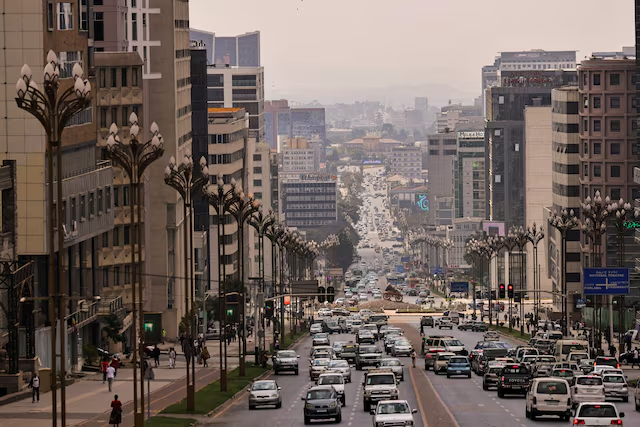
Ethiopia’s federal military has recaptured the main airport in Mekelle, the capital of the northern Tigray region, three sources told Reuters on Saturday, October 3. If confirmed, the move is a major setback for an opposition alliance in its stronghold. Reuters could not verify the claim, and the region’s ruling party, the Tigray People’s Liberation Front (TPLF), could not be reached for comment.

The airport is Alula Aba Nega Airport, about 10 km (6 miles) from the centre of Mekelle. It was one of three airports in Tigray that opposition forces seized when fighting began on September 23. That fighting is the most serious escalation of violence in northern Ethiopia since the 2020-2022 civil war.

What the three sources said

One source with knowledge of events in the city and a humanitarian source told Reuters that troops from the Ethiopian National Defence Forces had regained control of the airport. A third source, a Mekelle resident who asked not to be named for security reasons, confirmed that government forces took it. This resident said gunfire could be heard outside the city centre.

The resident also described scenes inside the city. Some Tigrayan Defence Force fighters were leaving their posts and heading home, the resident said, and government facilities were being looted.

A source close to the TPLF told Reuters that government troops and allied militias had encircled the city.

AFP, citing a local journalist and residents, reported that TPLF fighters and leaders were seen leaving Mekelle. The journalist told AFP that federal forces had not yet been seen inside the city. Al Jazeera reported that media access in Ethiopia is heavily restricted and that communications blackouts have limited reporting. Those limits are the context for why the accounts so far rest on anonymous sources.

How the fighting reached Mekelle

Last month, rebels announced a seven-party coalition led by the TPLF, the same group that fought federal forces in the 2020-2022 war, according to Al Jazeera. The coalition began an offensive that seized three airports in Tigray. It also engaged in fighting on the borders with the Amhara and Afar regions.

The government is now mounting a counteroffensive, Al Jazeera reported, citing the Critical Threats Project at the American Enterprise Institute. That project says federal forces are pushing into Tigrayan territory along three routes toward Mekelle. Al Jazeera’s bureau chief in Ethiopia, Mohammed Taha Tawakel, reported on Friday that forces loyal to the federal government had taken several towns and were closing in on the city.

Al Jazeera reported that fighting is also raging in the Amhara and Afar regions, so the conflict is not confined to Tigray. AFP photographed TPLF members walking along a main road in Mekelle on September 23, the first day of the fighting.

A wider regional dispute

The fighting has raised fears of a wider conflict that could draw in neighbouring countries in the Horn of Africa and the Gulf, Reuters reported. The federal government in Addis Ababa cut diplomatic ties with Eritrea this week. It accused Eritrea of backing the rebel alliance, along with Sudan and Egypt. All three countries deny the accusation. Reuters published an analysis this week on why renewed fighting in Tigray risks a regional war.

The accusation matters because of what the 2022 Pretoria peace agreement required. That deal, which ended the earlier war, obliged the TPLF to disarm. It also called for the withdrawal of Eritrean and other non-federal forces from Tigray and for humanitarian access to the region, according to Newsy Today. The accusation against Eritrea therefore touches the terms of the agreement that ended the last war.

What history suggests

Analysts told Reuters that taking Mekelle would be unlikely to end the conflict on its own. The 2020 war shows why. Federal forces captured Mekelle within the first month of that war, and the TPLF took it back seven months later.

Taking the airport is also a different step from holding the city. AFP’s local journalist reported that federal forces had not yet entered Mekelle, and the resident who spoke to Reuters heard gunfire at its edges. The resident also said looting of government facilities was already under way, which points to a security gap in the city.

What to watch next

Three things will show how far the airport’s recapture changes the fighting. The first is whether federal troops enter Mekelle itself or stay at its edge. The second is whether the TPLF confirms or denies the loss, since it had not commented when Reuters reported. The third is how Eritrea, Sudan and Egypt respond to the accusations after Ethiopia’s break with Eritrea.

Reuters said it could not verify the reports, and it and AFP are the main sources for updates. Until the government or the TPLF speaks publicly, the picture in Mekelle rests on anonymous sources.

Africa

Explosions Heard in Addis Ababa as Opposition Claims Drone Strikes

By George Mensah 5 min read

Explosions were heard overnight in Ethiopia’s capital, Addis Ababa, three diplomatic sources said on Thursday. A source linked to the opposition alliance fighting government forces in the north said the alliance carried out several drone strikes in the city, including some aimed at the military’s headquarters. Reuters could not verify the claim, and witnesses reported no damage near the military base. The blasts have added to fears that renewed fighting in Ethiopia’s north is spreading toward the capital.

What Is Known About the Blasts

The three diplomatic sources spoke on condition of anonymity and gave few details. Two diplomats told Bloomberg that one blast was reported near the 4 Kilo area in the centre of the city and a second near the headquarters of the Ethiopian National Defense Force.

Spokespeople for Prime Minister Abiy Ahmed’s office, the federal government and the Ethiopian National Defence Force did not immediately respond to requests for comment.

If confirmed, it would be the first known drone attack by anti-government forces on the capital. Addis Ababa lies hundreds of kilometres from the front lines in Tigray, Amhara and Afar.

The Opposition Claim

The opposition source said the alliance hit several targets in the capital with drones. Reuters could not independently check that, and witnesses saw no visible damage near the military base. The source gave no further detail on what was struck.

The alliance has been fighting federal forces since last week. It is called the Ethiopian Peoples’ Forces Alliance for Survival, and it brings together seven armed groups from different regions. The Tigray People’s Liberation Front, or TPLF, is one of its main members.

A Drone Ban and a Capture Claim

On Wednesday, the national intelligence service banned drone flights over Addis Ababa and its surroundings for security reasons. It did not say when the ban would end.

Opposition forces had not been known to use armed drones, but evidence is growing that they may have some capability. On Tuesday, a pro-government militia said it had captured drone frames and batteries from forces linked to the TPLF. Reuters could not verify that either.

Drones have already been part of the war. A drone hit the headquarters of Tigrai TV in Mekelle on Sunday, and the UN chief, Antonio Guterres, said he was troubled by reports of drone use and harm to civilians. The government holds a heavy advantage in the air. It has a large drone arsenal, about 500,000 troops and support from abroad, notably the United Arab Emirates.

An Analyst’s Warning

Edward Bach, senior Africa analyst at the risk intelligence company Verisk Maplecroft, said an opposition strike on Addis Ababa would change the politics of the war. He called it “a political game-changer.” It would undercut any government line that the capital is untouched by the conflict, he said. It would also narrow a major tactical advantage for federal forces, which is their control of the skies.

Fighting in the North

Last week’s clashes were the biggest escalation in Ethiopia since the 2020-2022 civil war ended. They broke a four-year-old peace deal between the TPLF and the federal government. The earlier war killed hundreds of thousands of people.

This time the TPLF has teamed up with six other armed groups that aim to overthrow Abiy’s government. Federal forces have moved forward in southern Tigray and are edging closer to the regional capital, Mekelle. The alliance has taken towns in neighbouring Afar.

The pro-government Tigray Peace Forces militia said on Wednesday that it and the Ethiopian military had captured the town of Korem. Korem is about 100 km (62 miles) south of Mekelle. An Afar government official told Reuters on Thursday that federal and regional forces had retaken the towns of Erebti and Abaala, near the Tigray border. Reuters could not confirm any of the battlefield reports.

In Afar, where the TPLF took several towns early in the fighting, tens of thousands of people have fled their homes. Valerie Browning, a founder of the Afar Pastoralist Development Association, told Reuters about the displacement.

Fears for the Wider Region

The conflict could add to instability across the Horn of Africa, which is already strained by Sudan’s civil war, friction between Ethiopia and Eritrea over Red Sea access, and spillover from Middle East conflicts.

Ethiopia’s government accuses Eritrea, Sudan and Egypt of backing the opposition alliance. All three deny it. Haji Awol Arba, Afar’s chief administrator, went further earlier this week. He told Al Jazeera that Eritrean soldiers had crossed into Afar to join the alliance’s offensive. Eritrea’s information minister did not immediately respond to a request for comment.

Eritrea fought alongside Ethiopia’s federal government against the TPLF in the last war. Relations between the two old rivals have since soured. Asmara sees Abiy’s repeated claims that landlocked Ethiopia has a right to sea access as an implicit threat. Abiy has said Ethiopia intends to secure sea access by peaceful means.

What Happens Next

Several questions are open. The government has not said whether the blasts were drone strikes, who launched them or what they hit. Independent confirmation could come from more diplomatic or witness accounts, or from official statements. The drone ban over the capital stays in force, with no end date.

On the ground, federal forces are pushing toward Mekelle and fighting continues in Afar. How far the war spreads, and whether Eritrea takes a role, will shape what comes next. Until the explosions in Addis Ababa are confirmed or explained, the opposition’s claim remains unverified.

ADVERTISEMENT
Scroll to Top