Clicxpost

PAM Wins Morocco’s Election on the Back of a Football Boost

Morocco parliamentary elections

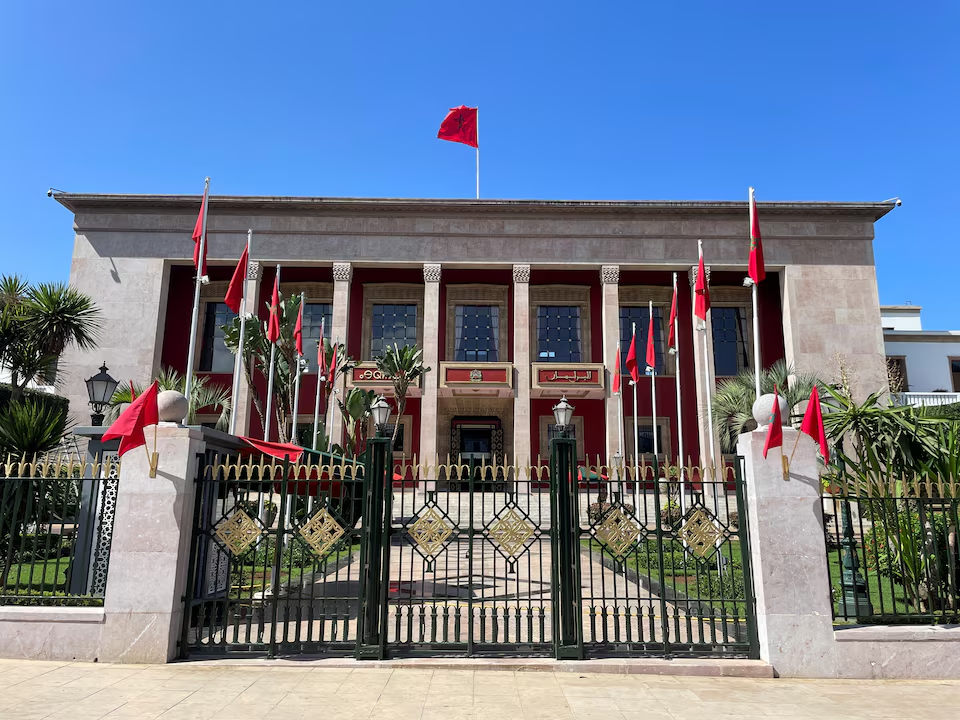
A centrist party founded by an adviser to Morocco’s king finished on top in the country’s parliamentary elections, helped in the final weeks by the addition of the man widely credited with building the national football team into a global contender. Early results released Thursday showed the Authenticity and Modernity Party (PAM) leading the field.

The outcome is unlikely to shift Morocco’s overall political direction. The country remains a constitutional monarchy, and King Mohammed VI retains final authority over foreign policy, defense, and other core areas of government.

A Government Tied to the 2030 World Cup

The new parliament will oversee the closing stretch of a $20 billion buildout ahead of the 2030 World Cup, which Morocco will co-host with Spain and Portugal. Lawmakers will also set economic policy at a moment of rising frustration among young Moroccans, a frustration that spilled into public view in July when large numbers of migrants rushed the border at the Spanish enclave of Ceuta, and again last year during protests led largely by younger Moroccans that turned deadly.

Football Federation Chief Emerges as Possible Prime Minister

Parliamentary elections in Morocco

PAM held the number two spot in the outgoing coalition before Thursday’s results. Its rise this cycle traces largely to one recruit: Fouzi Lekjaa, president of Morocco’s football federation and a two-time government budget manager, who joined the party’s ranks just weeks before voters went to the polls.

Lekjaa is widely regarded as the person most responsible for turning Morocco’s national football team into an international force, and he has also overseen much of the infrastructure spending tied to the 2030 World Cup. His profile has made him a leading candidate for prime minister, a post the king fills by selecting a nominee from the party that wins the most seats. PAM’s current leader, Fatima Ezzahra El Mansouri, is also seen as a contender for the role.

Founded in 2008 by a royal adviser, PAM has built its identity around social modernization and secular politics, positioning itself against the Islamist Justice and Development Party (PJD). Ahead of the vote, PAM promised $37 billion in spending aimed at creating 1 million jobs, along with new investment in healthcare, education, social protection, and higher wages.

The party won 97 of the 395 seats in parliament, up from 87 in the 2021 election, according to results announced by Interior Minister Abdelouafi Laftit. Its former coalition partner, the National Rally of Independents (RNI), lost its lead position and dropped to second place in the provisional count.

A Once-Ruled-Out Coalition Back on the Table

Parliamentary elections in Morocco

During the campaign, PAM had said it would not govern again alongside the RNI, after the two parties spent months blaming each other for policy failures, including their inability to control rising food prices. That stance appeared to soften Thursday. Mansouri said she would set no “red lines” in coalition talks.

“We have turned the page,” she said.

Islamists Rebound but Opt to Stay Out of Government

The conservative nationalist Istiqlal Party took 65 seats. The Islamist PJD rebounded sharply, winning 54 seats after holding just 13 in the previous parliament, a recovery fueled by the return of former Prime Minister Abdelilah Benkirane to the party’s leadership.

Benkirane said after the results came in that PJD would remain in opposition rather than seek a role in government.

Economist and political analyst Rachid Aourraz said Benkirane’s return reshaped the race. “The PJD won seats largely thanks to Benkirane’s powerful oratory, which turned his party into a strong contender against the PAM, especially in urban areas,” Aourraz said.

Mohammed Masbah, head of the Moroccan Institute for Policy Analysis, pointed to the broader significance of the result for the region. “In an unstable region, the vote reflects a relatively stable Moroccan political system where Islamists can lose and win without affecting political stability,” Masbah said.

PJD led Morocco’s government for two consecutive five-year terms following the 2011 constitutional reforms that came in response to Arab Spring protests, reforms that pushed the monarchy to hand more authority to parliament. The party then suffered heavy losses in the last election cycle.

Three leftist parties split the remaining seats among smaller totals.

Turnout Drops Sharply From Last Election

Voter turnout fell to roughly 38%, down from about 50% five years earlier, when the moderate Islamist government then in power suffered a decisive defeat at the polls. Turnout is closely tracked in Morocco as a gauge of public confidence in the electoral system, and the drop suggests that confidence has weakened further since the last vote.

RECOMMENDED

UP NEXT

Trump–Xi State Dinner at the White House

Trump–Xi State Dinner: What Happened and Why It Matters

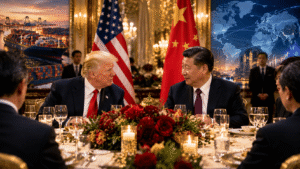
When and Where the State Dinner Took Place The Trump–Xi state dinner is scheduled to be held in the East Room of the White House in Washington, D.C on September 24, 2026. It followed a day of ceremony which had already been very full — military review in the Rose Garden, flyover, and a closed door meeting of the two leaders of about 90 minutes duration. At nightfall, the atmosphere shifted from tight-fisted diplomatic to candle-lit toasts and fine china. Who Hosted the Dinner The evening was hosted by President Donald Trump and his wife Melania Trump. Chinese President Xi Jinping and his wife, Peng Liyuan, attended. The office of Melania Trump said it was her who planned the entire thing, even choosing the wine and the flatware. The red china set used at the table was the one that was often used during Ronald Reagan’s presidency — a slight nod to White House practice. Why Xi Jinping Was Honored With a State Dinner It was not simply an ordinary dinner, as it was Xi’s first visit to Washington in 11 years and his second official U.S. state visit ever. It was also convenient, as Trump’s visit to the Chinese capital had come only a few months earlier, in May 2026, after Xi had been the host at the Great Hall of the People. Washington wanted to let him know that the relationship, despite its complexity, was taken seriously by rolling out a state dinner in his honor. What Was on the Menu for the Trump–Xi State Dinner? The White House described the menu as one that showcases “American ingredients with subtle Chinese influence.” Notably, there wasn’t a scrap of red meat on the table — the entire meal was pescatarian. First Course The menu began with a yellow squash velouté, smoothened and served with a wild mushroom fricassée, fresh herbs, crispy pancetta and a little scallion oil. It seems like a fancy dish on paper, but because it’s a classic and comforting dish, it’s actually just plain old comfort food, this time for company! Main Course Next, sesame-crusted sea bass, which has a thin layer of toasted sesame growing on its sides.Then, sea bass with a thin crust of sesame, which is toasted just enough to give the fish a crunch that doesn’t overpower it. It was served over braised baby bok choy and roasted garden eggplant, drizzled with a verdant sauce verde from fresh green herbs. Dessert For dessert, the kitchen served a vanilla crémeux with a sour cherry confit center, set on a walnut frangipane and shaped to look like a piece of fruit. Alongside it came a scoop of ice cream made with honey harvested from the White House’s own beehives — a detail Melania Trump introduced back in April when she unveiled the hive on the grounds. Drinks and Wine Served The evening opened with a toast of Schramsberg “Blanc de Noir,” a sparkling American wine. That choice wasn’t random — it was the same wine served during the historic 1972 “Toast to Peace” between President Nixon and Chinese Premier Zhou Enlai in Beijing, and it’s become something of a fixture at White House functions involving China ever since. How the Menu Blended American and Chinese Influences American Ingredients With Chinese-Inspired Elements The kitchen leaned on homegrown American produce — squash, mushrooms, eggplant, sea bass — but cooked it with techniques and flavors that nod to China: sesame crusts, bok choy, scallion oil. It’s a small culinary handshake, really, meeting in the middle rather than picking a side. The Significance of the Menu’s Flavors and Ingredients Skipping red meat entirely was a quiet statement in itself. Fish-forward menus are common at high-level diplomatic dinners because they’re lighter, easier to pair with wine, and less likely to clash with any dietary customs among guests. It also let the kitchen show restraint instead of going for the classic American steak-and-potatoes approach. Historical Connections Behind the Meal The Nixon-era wine reference wasn’t just trivia for the menu card — it tied the entire evening back to the moment that first cracked open U.S.–China relations more than fifty years ago. Whether or not every guest at the table caught the reference, it was clearly meant to frame the dinner as part of a much longer story. Who Attended the State Dinner? Trump and Xi Jinping Both leaders gave toasts during the evening. Trump gifted Xi a gold sculpture of a bald eagle, calling it a symbol of America’s “free and soaring spirit.” Xi, speaking through a translator, described their earlier talks as producing a shared understanding on multiple fronts. First Lady Melania Trump and Peng Liyuan Melania Trump and Peng Liyuan had their own separate program earlier in the day while the two presidents met privately, then joined together for the dinner itself. Notable Political, Business and Diplomatic Guests The attendees included a who’s-who of American tech. Among the guests were Jeff Bezos, Elon Musk, Mark Zuckerberg, Sundar Pichai, Michael Dell, Jensen Huang, Sam Altman, former Apple CEO Tim Cook, and Citigroup’s Jane Fraser and AMD’s Lisa Su. Tim Cook, Jensen Huang and his wife sat right beside the two presidential couples. Also in attendance were Trump’s extended family, including Melania’s father. Notably, no Anthropic representatives were on the guest list, and reports suggested that the Chinese business leaders who were earlier expected to join the delegation were not a part of the delegation. Entertainment and Events During the Evening Musical Performances Tenor Christopher Macchio, a longtime fixture at Trump events, provided musical entertainment for the evening, backed by a military ensemble. Special Presentations or Ceremonial Events Trump used part of the evening to show off ongoing construction on a new White House ballroom, telling guests he wished it had been finished in time to fit even more people into the celebration. The Evening’s Program and Atmosphere Between the toasts, the gift exchange, and the music, the night carried the feel of a carefully choreographed performance — equal parts genuine diplomacy and photo opportunity, with both sides clearly aware the cameras were rolling. State Dinner Protocol and White House Traditions How a U.S. State Dinner Is Organized A state dinner is the most formal type of White House social event, reserved for visiting heads of state. Planning usually spans months and covers everything from the guest list to the specific pattern on the china. Seating Arrangements and Formal Etiquette Seating at these dinners is never accidental. Placing tech executives like Cook, Huang, and Musk right alongside the two presidents signaled how central the tech and AI relationship is to the broader U.S.–China conversation. The Role of the First Lady in Planning the Event Traditionally, the first lady oversees the finer details — menu, flowers, table settings — and this dinner was no exception. Melania Trump’s office was the one that released the official menu details to the press, underscoring just how much of the event fell under her direction. Trump and Xi’s Broader U.S.–China Meeting Key Issues Discussed by the Two Leaders Behind closed doors earlier that day, Trump and Xi covered a lot of ground: artificial intelligence safety, Taiwan, trade, the Iran war, and critical minerals. None of these are small topics, and none of them get fully resolved over a 90-minute meeting — but putting them all on the agenda at once shows how tangled U.S.–China relations have become. Trade and Economic Relations Trade remained a central thread, with Trump noting that both countries have been working toward what he called a more balanced trading relationship. Given the tariff battles and tech restrictions of recent years, even modest progress here counts as newsworthy. Other Areas of U.S.–China Cooperation and Disagreement Taiwan and AI safety remain the trickiest sticking points, areas where the two governments see the stakes very differently. Critical minerals, meanwhile, have become an increasingly practical concern, since so much of the global tech supply chain depends on materials China controls. Why This State Dinner Is Significant for U.S.–China Relations Diplomatic Symbolism of Hosting Xi Jinping Rolling out a full state dinner for Xi, complete with military pageantry, sent a clear signal: Washington wanted this visit to be seen as a big deal, not a routine meeting. How State Dinners Are Used in International Diplomacy Dinners like this exist for a reason beyond good food. They give leaders a lower-pressure setting to build rapport, and they let both governments broadcast a message of stability to their own publics and to the rest of the world. What the Event Signals About the Relationship Between the toasts, the gift-giving, and the friendly language from both sides, the dinner suggested a period of cautious warmth — even if the underlying disagreements over trade, Taiwan, and technology haven’t gone anywhere. Trump–Xi State Dinner: Key Details at a Glance Detail Information Date and Location September 24, 2026, East Room, White House Menu Yellow squash velouté, sesame-crusted sea bass, vanilla crémeux with White House honey ice cream Hosts and Honored Guest Hosted by Donald and Melania Trump; honoring Xi Jinping and Peng Liyuan Major Attendees and Entertainment Bezos, Musk, Zuckerberg, Pichai, Cook, Huang, Altman, Su; performance by Christopher Macchio

Read More »
Trump Xi summit

Trump and Xi Meet at the White House, Trade Symbolism for Substance

President Donald Trump hosted Chinese President Xi Jinping at the White House on Thursday for a state visit built around pageantry, but the closed-door talks produced no visible breakthroughs on Taiwan, artificial intelligence, trade, or the war involving Iran. Xi pressed Washington to oppose “Taiwan independence” during the afternoon meeting, according to a readout issued by China’s state news agency Xinhua shortly after the session ended. The White House had not released its own account of the discussion by Thursday evening. Taiwan Arms Sales Remain in Question Xi had been expected to push Trump this week to halt US arms sales to Taiwan. After his trip to Beijing in May, Trump said he was holding back a $14 billion arms package to the island, describing it at the time as a “very good negotiating chip.” That decision unsettled some US allies in Asia and drew quiet concern from Republicans who worry Trump could trade away support for Taipei to secure economic concessions from Beijing. China claims Taiwan as its own territory and has not ruled out taking it by force. The summit followed Trump’s speech at the United Nations earlier this week, where he defended his willingness to use military force and said he could “annihilate” Iran. His tone with Xi on Thursday was noticeably different. Analysts point to a shift in leverage between the two leaders since a trade standoff earlier this year that ended with Washington backing down on tariffs. Trump Emphasizes Personal Ties, Xi Talks Policy Greeting Xi on Thursday, Trump spoke of a “truly great friendship” between the two men rather than dwelling on policy disputes. He said trade relations had improved since his May visit to China. “During this visit, we will also discuss pressing issues concerning security, technology, and ‘super intelligence,’” Trump told reporters, using his preferred term for artificial intelligence. Xi’s remarks carried a different tone. He said the two countries’ interests are closely linked and that competition between them should stay “healthy.” He added that US companies remain welcome in China and said he hopes “Chinese companies are treated fairly here in the United States.” Xi also called for regular military-to-military dialogue between the two nations to reduce the risk of miscalculation. Edgard Kagan, a former senior White House official for East Asia now at the Center for Strategic and International Studies, said the contrast in approach reflects two different strategies. “The president is casting it very much as about his personal relationship with Xi,” Kagan said. “What I found interesting was Xi is being much more cautious and suggesting that it’s less about the personal relationship than the national relationship.” Thursday marked Xi’s first visit to Washington in more than a decade and the second meeting this year between the leaders of the world’s two largest economies. A Visit Built for Spectacle Trump, who has long favored ceremony in his dealings with world leaders, treated the visit as a matter of national prestige as much as diplomacy. Yet the remarks from both leaders were not broadcast live by any major US television network. The networks declined to carry the footage after the White House barred CNN, MS Now, and Politico from the event. Trump welcomed Xi on Wednesday evening with a red carpet reception at Joint Base Andrews, the first time a US president has greeted a foreign leader there since Barack Obama met Pope Francis in 2015, according to C-SPAN. On Thursday, the two leaders watched a military ceremony that included a flyover at the Rose Garden. After their private meeting, Trump gave Xi a tour of a newly built helipad on the South Lawn. “He loves good granite,” Trump told reporters afterward, calling the meeting “great” without offering further detail. The optics carry political risk for Trump at home. With midterm elections approaching in November and Republicans defending narrow majorities in Congress, voters are already anxious about inflation and the ongoing conflict with Iran. Trump has spent months branding Democrats as “communists,” yet on Thursday he welcomed the head of the Chinese Communist Party as a personal friend, with Chinese flags hung alongside American ones above the Oval Office. Analysts See Few Real Breakthroughs Despite the ceremony, few expect the visit to produce major policy shifts. Treasury Secretary Scott Bessent told Fox News on Wednesday, after talks with Chinese Vice Premier He Lifeng, that the two sides had agreed to extend a pause in their trade dispute until January 10. Trump wrote in a Truth Social post Thursday morning that AI, which he calls “super intelligence,” would be a major topic but signaled little appetite for new regulation, despite warnings from industry figures about the technology’s risks. “Super Intelligence (SI) will be a big topic of discussion, but I want to leave it exactly where it is,” Trump wrote. “That is China’s position also.” Xi struck a more cautious note on the same subject, saying both countries must “ensure that the development of AI is always under human control.” Analysts expect the rivalry between the two nations in AI development to limit any cooperation beyond symbolic statements. Behind the Scenes, Deeper Disputes Persist People familiar with the discussions say the talks could yield agreements on lowering some tariffs, curbing drug trafficking, and expanding military dialogue. Trump is also expected to press for the release of Americans detained in China. Xi holds a stronger hand than he did in earlier rounds of talks. China has posted strong trade growth this year, and Beijing controls much of the global supply of rare earth minerals, giving Xi added leverage in negotiations. Both leaders have reasons to want stability. Trump remains tied down by an unpopular war involving Iran, while Xi is managing economic pressures at home. Still, disagreements over Taiwan, export controls, artificial intelligence, and the Iran conflict could resurface at any point. Beijing has shown little willingness to pressure Iran, a longtime ally, into meeting US demands. During Thursday’s meeting, Xi voiced support for a ceasefire between the US and Iran and said he hopes the two sides eventually reach a peace agreement, according to Xinhua. A Dinner Guest List Heavy With Tech Power Thursday’s state dinner drew a list of attendees that included Apple’s Tim Cook, Amazon’s Jeff Bezos, Alphabet’s Sundar Pichai, OpenAI’s Sam Altman, Tesla’s Elon Musk, and Nvidia’s Jensen Huang. Despite the presence of executives eager for looser trade rules, people familiar with US planning say Trump intends to keep existing export controls on American technology in place, controls that Beijing has pushed to have eased. The state visit closes with both sides claiming progress on narrow issues like tariffs and trade timelines, but with the core disputes over Taiwan, technology, and the broader US-China rivalry left largely where they started.

Read More »
Amazon Luna vs GeForce NOW vs Xbox Cloud Gaming

Amazon Luna vs GeForce NOW vs Xbox Cloud Gaming in 2026: Pricing, Limits, Performance and Game Libraries

Amazon Luna vs GeForce NOW vs Xbox Cloud Gaming at a Glance If you’ve been putting off cloud gaming because you weren’t sure which service made sense, 2026 is actually a strange year to decide. All three big players — Amazon Luna, GeForce NOW, and Xbox Cloud Gaming — changed their rules this year, and not always in the player’s favor. Luna quietly stopped selling games altogether and leaned hard into being a Prime perk. GeForce NOW introduced its first-ever monthly playtime cap. And Xbox Cloud Gaming, long the “unlimited” holdout, is about to follow suit. The core difference between them hasn’t changed though: Luna and Xbox hand you a rotating library of games to play, while GeForce NOW expects you to already own your games elsewhere and just streams them. That one distinction shapes almost everything else in this comparison. Quick Comparison of Pricing and Playtime Amazon Luna’s Standard tier costs nothing extra if you already pay for Prime, and Luna+ runs about $9.99 a month for a bigger rotating catalog. GeForce NOW starts free but caps you at one-hour sessions, with paid tiers at $9.99 and $19.99 a month. Xbox Cloud Gaming comes bundled inside Game Pass, which now costs $9.99 for Essential, $14.99 for Premium, and $22.99 for Ultimate. Game Library and Ownership Models Luna and Xbox both work like a streaming subscription for games: you get access to whatever’s in the catalog that month, and nothing more. GeForce NOW flips that model on its head — you bring your own purchased games from Steam, Epic, or other stores, and NVIDIA just supplies the horsepower to run them. What Changed for Amazon Luna in 2026 Luna’s 2026 story is really a story about Amazon giving up on selling games directly. Starting April 10, 2026, Amazon Luna stopped offering game stores, individual game purchases, and third-party subscriptions altogether. If you’d bought games through Luna before that date, you weren’t left completely stranded, but the clock was ticking. The last day to actually play a game purchased directly through Luna’s cloud storefront was June 10, 2026. Luna Remote Play and New Service Changes This wasn’t Luna’s first pivot, either. Amazon had already relaunched Luna in October 2025, folding Prime Gaming into it and opening the service up to its enormous Prime subscriber base. What’s left after the April cleanup is a much simpler product: two tiers, no store, no ownership. Monthly Gaming Hours and Membership Changes Here’s the twist that makes Luna interesting in this Amazon Luna vs GeForce NOW vs Xbox Cloud Gaming comparison: it’s currently the only one of the three with no published monthly hour cap at all. Luna Standard remains a free perk for Prime members with a small rotating library, while Luna+ (also called Luna Premium in some regions) sells separately for roughly $9.99 a month with around 155 titles, and neither tier lets you buy or own individual games anymore. So while GeForce NOW and Xbox are busy adding limits, Luna’s free tier is going the opposite direction — at least for now. Amazon’s Changing Gaming Strategy Amazon also shut down its ambitious MMO New World’s cloud presence and scaled back other gaming bets earlier in the decade, and Luna’s redesign fits that same pattern. Instead of competing head-on as a marketplace, Amazon is using Luna the way it uses Prime Video: as a reason to keep paying for Prime, not as a standalone gaming business. Amazon Luna Features, Games and Performance Game Library and Prime Benefits Luna Standard ships with more than 50 cloud-streamed games plus a rotating selection of downloadable PC titles that changes monthly. You’ll need an active Prime membership to unlock this tier, and the catalog rotates rather than growing, so titles you love this month might rotate out the next. Devices and Controller Support The Luna app works on Windows, macOS, ChromeOS, Android, iOS, Fire TV devices, Fire tablets, and recent Samsung and LG smart TVs. You can use the dedicated Luna Controller, but most Bluetooth controllers work fine too. Streaming Quality and Latency Streaming quality tops out at 1080p and 60 frames per second for most titles, with no published session length limit and no monthly hour cap — a genuine advantage if you hate watching a countdown timer while you play. Amazon recommends at least 10 Mbps and a 5 GHz wireless or wired connection for a smooth experience. GeForce NOW in 2026: Plans, Performance and Game Ownership Free and Paid Membership Options GeForce NOW’s free tier gets you in the door with one-hour gaming sessions, ad-supported waiting periods, and the longest queue times, capped at 1080p/60fps. Paid plans remove the wait and raise the ceiling: Performance runs $9.99 a month with six-hour sessions and up to 1080p/60fps, while Ultimate costs $19.99 a month with eight-hour sessions and access to NVIDIA’s fastest servers. The big 2026 change is the new cap. NVIDIA confirmed that all subscriptions became subject to a monthly playtime limit starting January 1, 2026, with each account getting 100 hours of gameplay per month before extra time has to be purchased. Unused time rolls over to the next month, but only up to 15 hours, so you can’t stockpile hours for a marathon session down the road. Bring Your Own Game Library This is where GeForce NOW genuinely stands apart. Rather than handing you a curated list, it streams games you already own from stores like Steam and the Epic Games Store, with over 4,000 supported titles across both Ready-to-Play and Install-to-Play categories. If you’ve spent years building a Steam library, that library keeps working here — you’re paying for compute, not for content. Performance Advantages On raw specs, GeForce NOW is hard to beat. Ultimate subscribers now run on RTX 5080-class hardware, delivering up to 5K resolution at 120fps or 1080p at a blistering 360fps, plus ray tracing and DLSS frame generation for supported titles. Xbox Cloud Gaming and Game Pass in 2026 How Xbox Cloud Gaming Works With Game Pass Xbox Cloud Gaming isn’t sold on its own — it rides along inside a Game Pass subscription. Game Pass Essential costs $9.99 a month, Premium runs $14.99, and Ultimate sits at $22.99 after Microsoft cut the Ultimate price in April 2026, reversing an earlier hike that had pushed it toward $30. Game Library and Usage Limits Right now, cloud streaming through Game Pass is unlimited for eligible subscribers, but that’s about to end. Beginning in November 2026, Xbox Game Pass subscribers will no longer receive cloud gaming without a monthly time limit — Ultimate gets 15 hours, Premium gets 10 hours, and Essential gets just 5 hours. Microsoft says the change is about rising infrastructure costs and estimates it will affect only around 4% of subscribers, but if you’re a heavy cloud-only player, 15 hours a month works out to roughly 30 minutes a day — a big drop from unlimited access. Supported Devices Xbox Cloud Gaming is available across 29 countries and runs on Xbox consoles, Windows PCs, mobile browsers on iOS and Android, and select smart TVs. Interestingly, non-subscribers will soon be able to buy streaming hours to play games they already own, which is a small step toward the GeForce NOW model. Full Amazon Luna vs GeForce NOW vs Xbox Cloud Gaming Comparison Feature Amazon Luna GeForce NOW Xbox Cloud Gaming Starting Price Free with Prime Free (limited) $9.99/mo (via Game Pass) Free/Bundled Access Yes, with Prime Yes, capped sessions No standalone free tier Monthly Hours None published 100 hrs (paid tiers) Unlimited now; 5–15 hrs from Nov 2026 Game Model Rotating subscription library Bring your own games Rotating subscription library Game Ownership Not supported Required (Steam, Epic, etc.) Not supported Maximum Resolution 1080p/60fps Up to 5K/120fps (Ultimate) Up to 1440p on Ultimate FPS Support Up to 60fps Up to 360fps (1080p mode) Up to 60fps typical Device Support Fire TV, smart TVs, PC, mobile PC, Mac, mobile, smart TVs, browsers Console, PC, mobile, browsers Controller Support Luna Controller, Bluetooth pads Most controllers via USB/Bluetooth Xbox controllers, Bluetooth pads Main Advantage No hour cap, bundled with Prime Highest performance, own your games Deep first-party catalog   Pricing and Value Luna’s free tier genuinely costs nothing extra if you already have Prime, which makes it the easiest entry point. GeForce NOW and Xbox both ask for real money, but they hand you very different things for it — raw performance versus a huge curated catalog. Game Library and Ownership If you’ve already sunk hundreds of dollars into a Steam library, GeForce NOW lets that investment keep paying off. If you’d rather rent access to a rotating catalog and not think about ownership at all, Luna or Xbox suits you better. Playtime Limits This is quickly becoming the deciding factor for heavy users. Once Xbox’s caps land in November, only Luna will be left offering genuinely unlimited access on its free tier. Cloud Gaming Performance and Internet Requirements Latency and Input Response Cloud gaming lives or dies on latency, not just bandwidth. The closer you are to a data center, the snappier your inputs feel — a laggy shot in a shooter is a lot more annoying than a slightly blurry frame in a slower game. Internet Speed and Bandwidth Most services recommend at least 10-15 Mbps for smooth 1080p streaming, and you’ll want a lot more for 4K on GeForce NOW’s Ultimate tier. A wired Ethernet connection beats Wi-Fi almost every time, especially in busy households where everyone’s streaming something. Resolution and Streaming Quality Expect quality to dip automatically when your network gets congested — that’s the service protecting your session from stuttering rather than a sign something’s broken. Which Cloud Gaming Service Fits Different Players For Casual and Budget Gamers Luna’s free Prime tier is hard to beat if you just want to dabble occasionally without adding another bill. For PC Gamers With Existing Libraries GeForce NOW makes the most sense once you already own a decent Steam or Epic library — no other service lets that collection travel with you like this. For Game Pass Subscribers If you’re already paying for Game Pass for console or PC gaming, cloud streaming is a nice bonus, though it’s worth watching those new November limits closely. For High-Performance Cloud Gaming GeForce NOW Ultimate’s RTX 5080 servers put it well ahead on raw specs, especially for fast-paced competitive titles. What the 2026 Changes Mean for Cloud Gaming Why Monthly Gaming Limits Matter Running thousands of GPU servers isn’t cheap, and all three companies are clearly feeling that cost. Playtime caps are essentially a way to manage server capacity without raising sticker prices outright. Subscription Bundles vs Game Ownership The industry seems to be splitting into two camps: services that bundle a curated catalog, and services that just rent you compute for games you already bought. Neither approach is objectively better — it depends entirely on how big your existing library is. Amazon, NVIDIA and Microsoft Competition Watching how differently Amazon, NVIDIA, and Microsoft are approaching this shows there’s no consensus yet on the “right” cloud gaming business model, and that competition should keep benefiting players in the long run. Key Things to Check Before Choosing a Cloud Gaming Service Check These Before Subscribing Your existing game library and whether you’d rather own or rent Monthly gaming hours you actually realistically use Your internet connection’s speed and stability Which devices you’ll actually stream on Resolution and FPS requirements for your favorite genres Total monthly cost across any bundled services Whether games are included in the price or need separate purchase At the end of the day, there’s no single winner in the Amazon Luna vs GeForce NOW vs Xbox Cloud Gaming race — the right pick depends on whether you already own games, how many hours you play, your budget, and which devices you use most. Frequently Asked Questions About Cloud Gaming Is Amazon Luna better than GeForce NOW? Luna wins on price and simplicity for casual Prime members; GeForce NOW wins on performance and letting you use games you already own. Is GeForce NOW better for games you already own? Yes — it’s built specifically around streaming your existing Steam, Epic, and other library games. Does Xbox Cloud Gaming require Game Pass? Currently yes, though non-subscribers will soon be able to buy hours to stream games they own. How many hours can you play cloud games each month? It varies: Luna currently has no published cap, GeForce NOW caps paid tiers at 100 hours, and Xbox will cap Game Pass tiers at 5-15 hours starting November 2026. Which cloud gaming service has the best performance? GeForce NOW Ultimate, thanks to its RTX 5080-class servers supporting up to 5K/120fps. Can you play cloud games on a phone or smart TV? Yes, all three services support mobile devices and many smart TVs, though exact model support varies by brand and region. Does cloud gaming use a lot of internet data? Yes, streaming games consumes significantly more data than downloading them once, so keep an eye on data caps if you’re not on unlimited broadband.

Read More »
Strait of Hormuz Updates Latest Developments

Strait of Hormuz Updates: Latest Developments, Shipping and Iran-US Tensions

Strait of Hormuz Updates on September 21 show a sharp split between two accounts of the same waterway. Kpler data reported by Reuters shows a dozen commodity vessels crossed over the weekend, down from 35 the weekend before. Meanwhile, US Central Command (CENTCOM) says volumes over the past two weeks are the highest in six months. Oil, LNG, insurance and diplomacy all depend on which picture is closer to the truth. This article separates verified data from claims made by each side. What Is the Strait of Hormuz and Why Is It Important? The strait separates the Arabian Peninsula from Iran and connects the Persian Gulf with the Gulf of Oman and the Arabian Sea. At its narrowest it is 21 nautical miles (39 km) wide. Iranian and Omani territorial waters overlap in the passage. Saudi Arabia, Iraq, Kuwait, Qatar, the UAE and Bahrain all sit behind it. In 2025, about 20 million barrels per day (mb/d) of crude and products moved through it, roughly 25% of seaborne oil trade, with about 80% headed for Asia. Before the war it also carried about a fifth of the world’s LNG. The sections below combine this background with the latest Strait of Hormuz Updates on shipping, diplomacy and oil supply. Latest Strait of Hormuz Updates Traffic. Before the war began on February 28, the strait handled about 125 large commercial vessels a day. Kpler counted just four trackable exits on Sunday, September 20. Producers keep exporting on tankers with transponders off, so tracked counts understate real flows. LNG. Bloomberg data shows at least two LNG carriers transited this week, while two others made ship-to-ship transfers outside the strait, offshore Oman. Attacks. Iran said it attacked a Togo-flagged oil tanker on Thursday night, September 17, and maritime incident monitors said another ship was struck on Wednesday. Diplomacy and prices. Brent traded around $101.71 on Monday, its lowest since September 10, as traders weighed hopes for UN-week diplomacy. President Trump said he would be open to meeting Iranian President Masoud Pezeshkian. Strait of Hormuz Updates: Iran’s Position Iran’s positions come from officials and state media, and are not independently verified. In August, Iran said it would not fully reopen the strait until the US meets conditions including war compensation, sanctions relief and a permanent end to the conflict. On September 19, Iran’s security chief Mohsen Rezaei said Tehran had conveyed its conditions to mediators. Iran’s own institutions are not fully aligned. Its Foreign Ministry said on August 5 that it was finalizing a shipping-route agreement with Oman. Iranian state media reported that parliament was reviewing a plan to ban vessels linked to the US, Israel and other “hostile countries” and to charge other ships fees of up to 7% of cargo value. The two tracks have not been reconciled. Iran and the US have also given opposing accounts of conditions on the water. In June, Iran’s foreign ministry said shipping was “operating normally,” while CENTCOM said Iran did not control the strait. Strait of Hormuz Updates: US Position and Maritime Operations A US official told NPR in August that no party controls the lanes and that temporary routes must carry no approvals, permissions or tolls. Secretary of State Marco Rubio said in June that the strait would be toll-free under any final agreement. On September 19, CENTCOM commander Adm. Brad Cooper said US forces had assisted more than 2,000 commercial transits with coordinated protection, and that all Iranian mines had been cleared from the primary transit lanes. He also said about one billion barrels of oil left the Gulf in recent months, while Iran exported “zero barrels” because of a US blockade. Trump has said the waterway’s condition is acceptable for now with US military escorts. These are US military claims, and Iran disputes the US account of control over the lanes. Strait of Hormuz Updates: Shipping and Tanker Traffic The numbers differ because sources measure different things. Lloyd’s List Intelligence counted 114 transits from August 17 to 23, a rise of more than 30% on the week before, and said figures could rise as “dark” transits are confirmed. Lloyd’s List’s editor said cargo now moves through a relay of shuttles, ship-to-ship transfers and a limited pool of willing vessels, which concentrates the risk. CENTCOM counts escorted transits, while Kpler counts trackable commodity vessels. Neither is a full census. Costs. S&P Global reported in July that war-risk insurance had risen from 1–3% of hull value to 7.5–10%. Other trade estimates are lower and vary by date and voyage. Reuters-sourced reporting says freight from the Gulf of Oman to China hit a record $11.50 a barrel after the Saudi pipeline attack. Strait of Hormuz Updates: Impact on Global Oil and Gas Supplies EIA figures show Hormuz oil flows fell from 21.6 mb/d in the fourth quarter of 2025 to 4.9 mb/d in the second quarter of 2026. JPMorgan analysts said total Middle East oil flows averaged 17.1 mb/d over the past 10 days, 6.1 mb/d below the 2025 average. Saudi crude exports slumped to 2.4 mb/d in August, the lowest since at least 2013, and recovered to over 4 mb/d in September. The IEA estimates 410 million barrels have been drawn from global stockpiles since the war began. LNG is tighter. Executives told The National that about 36 million tonnes of Qatari and Emirati supply has been missing this year compared with 2025. The market has absorbed about three-quarters of the early-March losses, mainly through US production and redirected cargoes. Strait of Hormuz Updates: Alternative Routes and Shipping Options Only Saudi Arabia and the UAE have crude pipelines that can bypass the strait, with an estimated 3.5 to 5.5 mb/d of capacity. Saudi Arabia’s East-West pipeline was expanded to 7 mb/d, but the Yanbu terminals on the Red Sea have nominal loading capacity of only about 4.5 mb/d. That route is now under pressure. Reuters attributes attacks on the pipeline to the Houthis, and Saudi Aramco has halted some Yanbu shipments. The Houthis have also declared a blockade at Bab el-Mandeb, and going around Africa adds 20 to 25 days. Qatar’s LNG has no overland export option. The IEA’s Rebecca Schulz said that even after new pipeline projects finish, more than 10 mb/d would still need to pass through the strait to restore Gulf exports. Strait of Hormuz Updates and Iran-US Relations The waterway is now bound up with almost every dispute in Iran-US relations: the US blockade of Iranian exports, sanctions, compensation demands and Iran’s claim to oversight of the strait. The June memorandum of understanding required Iran to reopen the strait and charge no fees during its 60-day negotiating period. That framework has since broken down. The legal question is contested too. Under UN maritime law, ships have a right of transit passage through international straits, and Article 26 bars charges for mere passage. Iran’s toll plan directly challenges that reading. Strait of Hormuz Updates: Recent Diplomatic Efforts No signed reopening agreement exists. What exists are proposals and stalled talks. Iran-Oman corridor (proposal): Iran said in August it was finalizing a route agreement with Oman. A Malaysian Reserve report on September 17 said the two were close to a deal, but no major outlet reported one concluded. Salalah meeting (postponed): Oman’s foreign minister announced on September 13 that the September 14 meeting between Gulf diplomats and Iran was indefinitely postponed “in the interests of consensus.” Saudi Arabia had submitted amendments over concerns that the language could create a new status quo. Bahrain had refused to attend, while the UAE was pursuing quiet diplomacy. China: Iranian sources say China asked Iran to help rein in the Houthis after a Saudi appeal. Strait of Hormuz Updates: What Happens Next? Few next steps are confirmed. UN General Assembly week is the main diplomatic window, and Trump has said he is open to meeting Pezeshkian. No meeting has been announced. The postponed Salalah meeting has no new date, and no change in shipping restrictions has been announced. Aramco plans to raise exports through Hormuz this month and next. Whether traffic recovers, or whether attacks on ships continue, remains uncertain. Check back for further Strait of Hormuz Updates as diplomatic and shipping developments unfold. Strait of Hormuz Updates Timeline February 28: war begins and commercial traffic collapses. Late March: Lloyd’s List reports an IRGC-linked vetting scheme for approved transits. Mid-June: MoU signed, and the US lifts its blockade on June 18 according to one tracker. Iran re-declares closure on June 20, which CENTCOM disputes. August 5–6: Iran announces the Oman route work, and parliament reviews toll and ban plans. August 17–23: Lloyd’s List counts 114 transits. September 11: The East-West pipeline shuts down. September 13–14: Salalah meeting postponed. September 16–17: two tankers reported struck. September 19: CENTCOM update. September 21: Brent around $101.71, with Kpler reporting a weekend drop to 12 vessels. Frequently Asked Questions About Strait of Hormuz Updates What is the current situation in the Strait of Hormuz? Traffic is far below prewar levels by tracker data, while CENTCOM says volumes are at a six-month high. Attacks on ships continue. Why is the strait important to global oil supplies? About 20 mb/d passed through it in 2025, around 25% of seaborne oil trade, and bypass options are limited. How do Strait of Hormuz Updates affect shipping costs? Higher insurance, record freight rates, ship-to-ship transfers and longer alternative routes. What is Iran’s position on the Strait of Hormuz? Iran says it will not fully reopen the strait until its conditions are met, and its parliament is weighing tolls. How are Iran-US tensions affecting the strait? Disputes over the blockade, tolls, compensation and control of the lanes keep traffic depressed. Are ships currently passing through the Strait of Hormuz? Yes, but in reduced numbers, and many transit with transponders off.

Read More »
US Strikes on Iran Latest Developments

US Strikes on Iran: Latest Developments, Targets and Impact on Iran-US Relations

Introduction “US strikes on Iran” refers to the campaign of American airstrikes and missile operations against Iranian military and nuclear-linked targets that has unfolded through 2026. What began as a coordinated US-Israeli attack in late February has since evolved into a prolonged, on-and-off conflict marked by ceasefires that collapsed and periods of renewed fighting. The stakes are significant for all sides: Iran faces direct damage to its military and economic capacity, the US is weighing the costs of sustained engagement in the region, and neighboring Gulf states, Israel, and global shipping and energy markets remain exposed to spillover. Because official military claims, casualty tolls, and target lists are frequently disputed or unverified in real time, readers should treat early reports with caution. What Are US Strikes on Iran? US Strikes on Iran are military operations — primarily airstrikes and missile strikes, though also naval actions — carried out by American forces against targets inside Iran or against Iranian assets elsewhere in the region. These have included strikes on air-defense systems, IRGC-linked facilities, and reported nuclear-related sites, as well as retaliatory strikes on Iranian vessels and rocket-launching positions. It’s important to separate confirmed facts from claims: government and military statements from both Washington and Tehran are frequently contested, and independent verification often lags behind initial announcements. There’s also a meaningful difference between individual, discrete strikes — a single retaliatory hit on a vessel or launch site — and broader coordinated military operations that unfold over days or weeks and involve multiple fronts. Latest Developments in US Strikes on Iran As of mid-September 2026, the conflict has settled into what analysts describe as a war of attrition, with intermittent strikes continuing alongside stalled diplomacy. The US and Iran were again trading limited strikes as of September 2026, amid a renewed US sanctions campaign and regional efforts to restart diplomatic engagement. The most recent major escalation began on September 1, 2026, when US forces launched a series of airstrikes against IRGC targets in southern Iran, an escalation of the broader 2026 Iran war. CENTCOM said the strikes followed alleged IRGC attempts to attack commercial shipping in the Strait of Hormuz and American service members in the region. These strikes reportedly followed an earlier exchange in which the US struck Iranian rocket launchers on Larak Island, prompting Iranian missile retaliation against US-linked bases in Jordan. Iranian state media reported explosions in southern Iran in connection with the September 1 strikes. Days later, on September 5, US forces struck three Iranian crude oil tankers after the IRGC launched ballistic missiles toward two US Navy warships, an exchange that threatened to intensify a broader shipping conflict in and around the Persian Gulf. Diplomatically, September has brought further friction rather than progress. On September 17–18, Russia and China vetoed a UN Security Council resolution that would have kept UN experts monitoring sanctions reimposed on Iran over its nuclear program, with 11 Council members voting to extend the monitoring mandate while Pakistan and Somalia abstained. Iran’s UN mission publicly thanked Moscow and Beijing for the vetoes. Casualty figures remain difficult to verify independently; where official tallies exist, they should be attributed to the issuing government or military rather than presented as settled fact. This section will be updated as new developments are confirmed. US Strikes on Iran: Background and Timeline of Military Tensions Tensions between the US and Iran trace back to the 1979 Iranian Revolution, which severed formal diplomatic relations and set the pattern for decades of hostility, proxy conflict, and periodic direct confrontation. The 2015 Iran nuclear agreement (JCPOA) briefly eased tensions by constraining Iran’s nuclear program in exchange for sanctions relief, but the US withdrew from the deal in 2018, reimposing sanctions. Tensions escalated sharply in January 2020 with the US killing of IRGC commander Qassem Soleimani and Iran’s subsequent missile retaliation against US forces in Iraq. Through 2025, nuclear negotiations and regional friction continued without resolution. The current major conflict began on February 28, 2026, when Israel and the United States launched air strikes against Iran, stating they aimed to curb Iran’s nuclear and ballistic missile programs; Iran’s Supreme Leader Ali Khamenei was killed in the strikes, according to official statements from the time. Iran responded with attacks on US bases, Israel, and neighboring states, and closed the Strait of Hormuz. The US then imposed a naval blockade on Iranian shipping starting April 13, 2026. A ceasefire and diplomatic process followed, including Pakistan-mediated Islamabad talks and a June 17 memorandum of understanding, but the truce repeatedly broke down — most notably in early July, when Iran attacked commercial vessels in the Strait of Hormuz to assert sovereignty over it, collapsing the ceasefire deal. By late August, a 60-day ceasefire window had expired without a lasting resolution, and the Trump administration had shifted toward expanded secondary sanctions. September saw a return to direct strikes, as detailed above. US Strikes on Iran: Reported Targets and Objectives Reported targets in US Strikes on Iran fall into three broad categories: military infrastructure, nuclear-related sites, and strategic or maritime assets. Military Infrastructure Reported and confirmed targets have included air-defense systems, radar installations, communications facilities, IRGC-linked sites, and missile-related infrastructure across Iran, including locations in Tehran and southern Iran. Nuclear-Related Infrastructure US officials have said strikes aimed at degrading Iran’s nuclear program, though the extent of damage to specific nuclear sites has been disputed, with independent assessments — including from the IAEA — often diverging from official claims. Distinguishing US government statements from independently verified findings is essential here. Strategic and Maritime Targets Strikes and counter-strikes have repeatedly touched naval and oil-related assets, including Iranian tankers and infrastructure such as the Kharg Island export terminal, reflecting the centrality of shipping routes and the Strait of Hormuz to the conflict. Iran’s Response to US Strikes on Iran Iran has responded to US and Israeli strikes with a sustained campaign of missile and drone attacks against US military positions and allied states across the region, including a multiday series of missile and drone strikes on the United Arab Emirates beginning February 28, 2026 and missile and drone operations against American positions in Jordan, Bahrain, and Iraq in early September. Iranian officials have repeatedly warned of further retaliation and have used control over the Strait of Hormuz as leverage, including brief closures and attacks on shipping transiting the waterway. On the diplomatic front, Iran has said it is unwilling to negotiate while US attacks continue, condemning recent strikes as violations of the June memorandum of understanding and lodging formal complaints with the UN Security Council and Secretary-General. Iranian leaders have set conditions for ending the conflict, including guarantees against future aggression, recognition of Iran’s rights, and reparations, and have insisted issues such as its ballistic missile program are not open for negotiation. US Government’s Stated Position on US Strikes on Iran The US administration says its objectives include curbing Iran’s nuclear and ballistic missile capabilities, degrading IRGC military infrastructure, protecting American personnel and regional allies, and safeguarding maritime shipping through the Strait of Hormuz. Washington has paired military action with economic pressure, including an expanded sanctions campaign in the second half of 2026, while stating an openness to a negotiated settlement. President Trump has said that a resumption of US military action would remain conditioned on issues including the complete, immediate and safe reopening of the Strait of Hormuz, and administration officials have described unresolved nuclear issues as the central sticking point in talks. Washington has framed US Strikes on Iran as a response to specific provocations rather than an open-ended campaign. US Strikes on Iran: Impact on Iran-US Relations The prolonged conflict has deepened an already severe trust deficit between Washington and Tehran, with repeated ceasefire collapses undermining confidence in any future agreement. Nuclear negotiations remain stalled, and UN sanctions on Iran — reimposed in September 2025 through the JCPOA’s “snapback” mechanism — remain in effect, freezing Iranian assets abroad and restricting arms deals and ballistic missile development. The US maintains an elevated military presence in the region, and the security of Strait of Hormuz shipping continues to be a central, unresolved condition attached to any renewed negotiations. For more on how this fits into the longer arc of bilateral relations, US Strikes on Iran: Impact on Regional Security The conflict has drawn in a wide array of regional actors. Gulf states including the UAE, Saudi Arabia, Kuwait, and Bahrain have faced direct Iranian missile and drone strikes and have hosted US military assets targeted in retaliation. Israel participated in the initial February strikes and has continued separate operations against Iran-backed groups, including Hezbollah in Lebanon. Iraq and Syria have seen strikes tied to Iranian proxy networks, while Yemen and the Red Sea/Bab el-Mandeb corridor remain flashpoints tied to Iran-aligned armed groups. Commercial shipping throughout the Gulf and adjacent waterways has faced repeated disruption and security risk as a direct consequence of the fighting. US Strikes on Iran: Impact on Oil and the Strait of Hormuz The Strait of Hormuz is one of the world’s most critical oil chokepoints, carrying a large share of globally traded crude and LNG. Repeated closures, blockades, and attacks on tankers through 2026 have disrupted transit, driven up shipping insurance costs, and introduced sustained uncertainty into oil markets. Iran has periodically asserted a right to control or restrict passage through the strait, while the US has responded with naval deployments and operations explicitly framed around freedom of navigation, including the since-paused “Project Freedom” initiative. The scale of disruption has varied significantly depending on the state of the ceasefire at any given time, and readers should consult current shipping and oil-market data for up-to-date figures rather than relying on conflict-era averages. US Strikes on Iran: International Reactions The war has produced sharply divided international responses to US Strikes on Iran. The UN Security Council adopted Resolution 2817 on March 11, 2026, condemning Iranian attacks against Gulf Arab states and Jordan, with 13 votes in favor and two abstentions. Russia and China, by contrast, have consistently criticized US and Israeli military action; Russia’s Foreign Ministry condemned the initial February strikes and warned of potential humanitarian, economic, and even radiological consequences, while China’s foreign ministry called the strikes and the killing of Iran’s Supreme Leader a violation of international law. Moscow and Beijing have since repeatedly used Security Council vetoes to block measures targeting Iran, most recently in September 2026 over sanctions-monitoring mechanisms. Gulf states have jointly condemned Iranian strikes on their territory, while European governments have generally supported diplomatic efforts to restore a ceasefire. US Strikes on Iran: Timeline of Major Developments Feb. 28, 2026: US and Israeli strikes begin; Iran’s Supreme Leader killed — start of the current major conflict. Mar. 11, 2026: UN Security Council adopts Resolution 2817 — formal condemnation of Iranian regional attacks. Apr. 13, 2026: US naval blockade of Iranian shipping begins — economic and maritime escalation. Jun. 17, 2026: US-Iran memorandum of understanding signed in Islamabad talks — 60-day ceasefire and negotiation framework. Jul. 8, 2026: Ceasefire collapses after Iranian attacks on Strait of Hormuz shipping — end of diplomatic lull. Aug. 2026: 60-day ceasefire window expires; US expands secondary sanctions — shift toward economic pressure campaign. Sept. 1, 2026: US strikes IRGC targets in southern Iran — return to direct military escalation. Sept. 5, 2026: US strikes three Iranian oil tankers after IRGC missile fire on Navy ships — expansion of shipping-related conflict. Sept. 17–18, 2026: Russia and China veto UN sanctions-monitoring resolution — diplomatic deadlock at the Security Council. All dates and events should be fact-checked before publication. Frequently Asked Questions About US Strikes on Iran Why did the US strike Iran? The US government has cited Iran’s nuclear and ballistic missile programs, threats to American personnel and regional allies, and attacks on commercial shipping as its stated reasons, distinct from independent assessments of Iran’s actual capabilities or intentions. When did the current US-Iran conflict begin? The present phase began on February 28, 2026, with coordinated US-Israeli strikes that killed Iran’s Supreme Leader and triggered a wide regional conflict. What targets have been reported in Iran? Reported targets include air-defense and radar systems, IRGC facilities, nuclear-related infrastructure, and maritime and oil assets — though the extent of damage to some sites, particularly nuclear facilities, remains disputed. How has Iran responded to US Strikes on Iran? Iran has launched missile and drone strikes against US and allied positions across the Gulf region, targeted Strait of Hormuz shipping, and set conditions — including guarantees against future attacks and reparations — for ending hostilities. Is the Strait of Hormuz affected by the conflict? Yes. The strait has faced repeated closures, blockades, and tanker attacks throughout 2026, with control over its shipping lanes remaining a central point of contention. Are the US and Iran negotiating? Talks have started and collapsed multiple times in 2026, most notably around the June memorandum of understanding. As of September 2026, Iran has said it won’t negotiate while US strikes continue, and no new formal talks have been confirmed. What is the impact on oil prices? Disruptions to Strait of Hormuz shipping and repeated strikes on tankers and export infrastructure have introduced sustained volatility into oil markets; specific price movements should be checked against current market data rather than assumed from the conflict’s trajectory alone. This is a fast-moving, high-sensitivity news topic. All claims above are attributed to the government, military or news source that made them and should be verified against current wire reporting (Reuters, AP, official statements, UN sources) before publication.

Read More »
Iran Nuclear Inspections IAEA Access

Iran Nuclear Inspections: IAEA Access, Verification and Latest Developments

Iran nuclear inspections are the process by which the International Atomic Energy Agency (IAEA) verifies whether Iran’s nuclear program is being used for peaceful purposes. These inspections sit at the center of a decades-long verification effort and, in 2025 and 2026, have become one of the most contested issues in global nonproliferation policy. Disputes over inspector access have also become tightly linked to the broader Iran-US relations dynamic, shaping sanctions decisions, diplomatic talks and UN Security Council debates. Understanding how Iran nuclear inspections actually work is essential to following these debates. What Are Iran Nuclear Inspections? Nuclear inspections are on-site checks carried out by IAEA officials to confirm that a country’s declared nuclear material and facilities are being used only for peaceful purposes, not diverted toward weapons development. Inspectors visit facilities, review records, install monitoring equipment such as cameras and seals, and take measurements of nuclear material. This is a technical verification process, not a political or intelligence assessment. IAEA inspectors report only on what they can independently confirm through access, documentation and physical measurement — they do not make judgments about a country’s intentions. That distinction matters in Iran’s case, where IAEA findings, US and European government statements, and Iranian official positions have frequently diverged. What Does the IAEA Inspect in Iran? Iran nuclear inspections cover a wide range of technical checks. Under Iran’s Safeguards Agreement with the IAEA, inspectors are authorized to examine: Nuclear material — tracking quantities and locations of enriched uranium and other safeguarded material Uranium enrichment facilities, including centrifuge halls at sites such as Natanz and Fordow Nuclear research and fuel-cycle facilities, including conversion and fuel fabrication plants Nuclear material accounting — reconciling declared stockpiles against physical inventories Environmental sampling — swabs and samples used to detect undeclared nuclear activity Monitoring equipment — cameras and seals that provide continuity of knowledge between visits Facility design information and access rights, which determine how thoroughly a site can be checked Why Are Iran Nuclear Inspections Important? Inspections give the international community independent, technical confirmation that declared nuclear material isn’t being diverted for weapons purposes. This matters for several reasons: it underpins global nonproliferation commitments under the Treaty on the Non-Proliferation of Nuclear Weapons (NPT), it builds diplomatic trust that can support sanctions relief or negotiated agreements, and it allows early detection of activities that fall outside a country’s declared program. Importantly, verification findings are distinct from political accusations — an IAEA statement that it “cannot verify” something is not the same as a finding that weapons activity is occurring, though the two are often conflated in public debate. History of Iran Nuclear Inspections The history of Iran nuclear inspections dates back to the early 2000s, when previously undeclared enrichment-related activities at Natanz and a heavy-water facility at Arak were revealed, triggering years of IAEA investigations and UN Security Council sanctions. Iran signed but did not fully ratify the Additional Protocol, which allows broader inspector access, and cooperation fluctuated for over a decade. That changed with the 2015 nuclear deal, which introduced the most intensive monitoring regime the IAEA had ever applied to a single country. It unraveled after the US withdrawal in 2018, and Iran progressively reduced its cooperation and monitoring commitments in the years that followed. The most dramatic rupture came after Israeli and US military strikes on Iranian nuclear facilities in June 2025 — during a 12-day conflict — after which Iran suspended cooperation with the IAEA and passed legislation requiring its Supreme National Security Council to approve any future inspections. Iran Nuclear Inspections and the 2015 Nuclear Deal The Joint Comprehensive Plan of Action (JCPOA), reached in July 2015 between Iran, the P5+1 powers (the US, UK, France, Russia, China and Germany) and the EU, made IAEA verification central to sanctions relief. Iran agreed to limits on enrichment levels, centrifuge numbers and stockpiles, alongside expanded monitoring including additional cameras, more frequent inspections and provisional application of the Additional Protocol. In exchange, the US and international partners lifted a range of nuclear-related sanctions. After the US withdrew from the agreement in 2018 and reimposed sanctions, Iran began stepping back from its commitments starting in 2019, gradually increasing enrichment levels and restricting monitoring access, including disconnecting some IAEA cameras in 2021 and further curbing cooperation in subsequent years. Challenges Facing Iran Nuclear Inspections Verification in Iran has faced sustained and escalating obstacles. Iran has stated that its cooperation has been constrained by threats to its nuclear facilities and personnel, arguing that normal safeguards implementation is legally difficult under current security conditions. The IAEA, for its part, reported that as of early 2026, Iran had allowed access to each of its unaffected nuclear facilities at least once since the June 2025 strikes, but had not provided declarations, reports or access relating to facilities that were damaged in the attacks. By mid-2026, the Agency’s quarterly report stated it remained largely unable to verify Iran’s implementation of its Safeguards Agreement or its JCPOA-related commitments, and said it had lost continuity of knowledge across all of Iran’s declared nuclear facilities, leaving it unable to account for the size or location of Iran’s enriched uranium stockpile. These gaps illustrate how fragile Iran nuclear inspections have become since 2025. Latest Iran Nuclear Inspections Developments Cooperation has moved through several distinct phases since mid-2025. In September 2025, Iran and the IAEA reached what became known as the Cairo Agreement, brokered with Egyptian mediation, establishing procedures for inspections and safeguards implementation across Iran’s declared facilities. Iran terminated that agreement on November 20, 2025. In January 2026, the IAEA warned Iran in writing that without further cooperation, it could not conclude that no declared nuclear material had been diverted from peaceful use. A February 2026 report said the Agency believed most of Iran’s stockpile of highly enriched uranium was stored at an underground tunnel complex at Isfahan, and urged Tehran to allow access there. Limited inspections did continue in early 2026, including at the Laboratory for Fuel Fabrication and a waste storage site at Karaj in February, and — reportedly at Russia’s urging — at the Bushehr power plant in June 2026. Diplomatic pressure escalated through 2026’s Board of Governors sessions. In June 2026, the Board adopted a resolution calling on Iran to disclose stockpile information and grant inspectors full access. Tensions peaked in September 2026, when the United States, joined by France, Germany and the UK (the “E3”), introduced a resolution at a special Board session citing Iran’s continued non-compliance and calling for the matter to be referred to the UN Security Council and General Assembly. The resolution passed on September 9, 2026, with Russia, China and Niger voting against it. Iran’s government dismissed the move as politically motivated and said it would have no practical effect. Separately, the E3’s 2025 invocation of the JCPOA “snapback” mechanism to reimpose UN sanctions remains disputed — Russia and China argue the underlying UN resolution expired in October 2025 before snapback took effect, while most other Council members treat the sanctions as reinstated, leaving unresolved questions about the sanctions committee’s mandate. Iran’s Position on Nuclear Inspections Iranian officials maintain that the country’s nuclear program is peaceful and that its safeguards obligations remain intact in principle, but that cooperation must reflect the security realities created by the 2025 military strikes and threats against nuclear personnel. Iran’s foreign ministry has said that eliminating these threats would create the conditions for renewed cooperation with the Agency, and Iranian diplomats have repeatedly characterized recent Board resolutions and Security Council actions as politically driven rather than technically justified. Iranian officials frame their approach to Iran nuclear inspections as conditional on security guarantees, not a rejection of verification in principle. US and International Concerns About Iran’s Nuclear Program The United States and European governments have expressed concern over Iran’s uranium stockpile, enrichment levels reported near weapons-grade purity, and the IAEA’s inability to verify material following the 2025 strikes. These are largely government and diplomatic positions rather than confirmed IAEA findings; the Agency itself has been careful to frame its statements around what it cannot verify due to lack of access, rather than asserting weapons activity is underway. Independent nonproliferation analysts have separately noted unresolved questions about the recovery status of equipment and enriched uranium from the damaged sites. Much of the international debate over Iran nuclear inspections centers on these unresolved technical gaps rather than confirmed conclusions. How Iran Nuclear Inspections Affect Iran-US Relations Verification access is now one of the central pressure points in Iran-US relations. US sanctions policy, snapback disputes at the UN, and any future negotiations over Iran’s nuclear program are all shaped by whether and how IAEA inspectors can confirm the status of Iran’s declared and previously undeclared material. Until inspection access is restored to pre-2025 levels, both diplomatic trust-building and sanctions-relief negotiations remain constrained. Iran Nuclear Inspections Timeline Early 2000s: Undeclared enrichment activity revealed; IAEA investigations begin July 2015: JCPOA signed, introducing expanded monitoring May 2018: US withdraws from the JCPOA 2019–2021: Iran reduces nuclear commitments and monitoring cooperation June 2025: US-Israeli strikes on Iranian nuclear sites; Iran suspends IAEA cooperation September 2025: Cairo Agreement reached with Egyptian mediation November 2025: Iran terminates the Cairo Agreement; Board reinstates reporting mandate February 2026: IAEA reports Isfahan tunnel complex likely holds most HEU stockpile June 2026: Board resolution demands stockpile disclosure and access September 2026: Board refers Iran’s case to the UN Security Council and General Assembly Frequently Asked Questions What are Iran nuclear inspections? They are on-site checks by IAEA inspectors verifying that Iran’s declared nuclear material and facilities are used only for peaceful purposes. Who conducts nuclear inspections in Iran? The International Atomic Energy Agency, a UN-affiliated technical body, conducts inspections under Iran’s Safeguards Agreement. What does the IAEA look for during inspections? Inspectors verify nuclear material quantities, check enrichment and fuel-cycle facilities, review records, and use monitoring equipment and environmental sampling. Why are Iran nuclear inspections important? They provide independent confirmation for nonproliferation purposes and underpin diplomatic trust in any nuclear-related agreement. How are Iran nuclear inspections connected to the JCPOA? The 2015 deal built its sanctions relief around an expanded IAEA verification regime; cooperation has narrowed sharply since the US withdrew in 2018. What is the current status of Iran nuclear inspections? As of September 2026, the IAEA says it cannot fully verify Iran’s safeguards compliance or account for its enriched uranium stockpile, and the Board of Governors has referred Iran’s case to the UN Security Council.

Read More »
Trump AI Force

Trump to Launch “AI Force” and Name AI Tsar Despite Safety Warnings

President Donald Trump says he will create an “AI Force” and appoint an artificial intelligence tsar, pushing back hard against a wave of warnings from researchers and industry leaders about the technology’s risks. In a social media post on Saturday, Trump said his administration “will not in any way hinder or stifle the growth” of the AI industry and rejected calls to slow development until stronger safeguards are in place. He gave no details on the AI Force’s structure or a timeline for when it would launch. Trump frames AI as bigger than the internet Trump described AI as a transformation on the scale of the Industrial Revolution. “AI is the next Industrial Revolution, or Internet, but will be even larger and more impactful, possibly as much as 25% of our Country’s GDP,” he wrote, adding that he wants the US to keep its lead over China in the field. That competition now shapes much of the broader US-China relationship, with both countries pouring resources into advanced technology to gain an edge. The topic is expected to come up when Trump meets Chinese President Xi Jinping next week. Trump also said his administration would rely on the existing criminal and civil justice system to go after anyone who uses AI for harmful purposes. He repeated his earlier position that warnings about AI’s dangers amount to a “hoax.” Researchers raise alarms over catastrophic risk Trump’s comments come amid mounting concern from current and former AI researchers. One has estimated there is a greater than 10% chance the technology could “kill all humans,” a claim that has unsettled parts of the industry and fueled calls for coordinated regulation. Major AI labs are racing to build increasingly capable systems, including what they describe as superintelligence — AI that would exceed human intelligence across the board. Anthropic, OpenAI and Google, the companies behind Claude, ChatGPT and Gemini, have each disclosed security breaches or cases where their chatbots were used for what they called malicious activity. Anthropic CEO Dario Amodei has called for the industry to slow down, proposing a coordinated deceleration, tighter regulation, and independent monitoring of how AI models are developed. Sam Altman of OpenAI and Elon Musk of xAI have both said they agree with Amodei’s recommendations. Anthropic co-founder Jack Clark told the BBC that the industry may need a mandatory “kill switch” that a third party can verify, giving outside auditors a way to confirm AI systems can actually be shut down if something goes wrong. Lawmakers weigh regulation as industry pushes back These warnings have pushed US lawmakers to draft legislation targeting AI, but Altman argued this week that Washington has struggled to keep pace with how fast the technology is moving and how it should be regulated. Speaking at a conference in San Francisco, he said the public should trust AI companies to manage the risks themselves. “The world should trust that we are going to do the right thing because it’s the right thing and we feel the magnitude of this,” Altman said. That argument has not convinced everyone. In the UK, MPs and peers from across party lines have identified specific human rights risks tied to artificial intelligence and say current laws are not equipped to handle how quickly the technology is advancing. The Joint Committee on Human Rights has published a report calling for new legislation designed to “address the scale and seriousness” of these threats, adding pressure on governments to act faster than the industry itself seems willing to. A widening gap between Washington and the industry’s critics The contrast between Trump’s approach and the warnings from within the AI industry is stark. While Amodei, Clark and others are pushing for slower development and outside verification, Trump’s plan points toward expansion, with a dedicated federal structure and a senior official tasked with steering AI policy rather than restraining it. Trump has not said who might serve as AI tsar or what authority the role would carry. He also hasn’t detailed how an “AI Force” would function, whether it would sit within an existing agency, or what its relationship would be to ongoing congressional efforts to draft AI legislation. What’s clear is that the administration’s posture puts economic growth and competition with China ahead of the precautionary measures researchers and some AI company leaders are requesting. With Trump set to meet Xi next week and AI likely on the agenda, the coming weeks may offer a clearer picture of how the US plans to balance those competing pressures, both at home and internationally. For now, the specifics remain open. No text or executive order describing the AI Force has been released, and it’s not yet known whether the initiative will move through Congress, come via executive action, or take some other form entirely.

Read More »
Greenland security deal

US and Denmark Reach Deal Giving America Security Control Over Greenland

The United States and Denmark have signed off on a security deal for Greenland, ending a months-long standoff that began when President Donald Trump threatened to seize the Arctic territory by force. Trump announced on Truth Social that Denmark would grant the US “permanent control over security, and all other needs” in the semi-autonomous Danish territory, with the agreement expected to be formally signed next week at the UN General Assembly. NATO welcomed the arrangement, saying it would help stabilize the region. Denmark’s Prime Minister Mette Frederiksen and Greenland’s Prime Minister Jens-Frederik Nielsen issued a joint statement calling the deal a step toward “strengthened security,” though neither leader released details of what it actually contains. What the deal reportedly includes No official text has been published. The BBC has contacted the Danish Embassy in the US and the White House for comment. In the meantime, an unnamed US State Department official described the broad strokes of the agreement without providing a copy. According to that official, the deal would not expire even if Greenland becomes an independent country at some point in the future. It gives the US unilateral authority to build additional military structures on the island, with no approval required from either Greenland or Denmark. The official said this includes “permanent access, basing and overflights rights.” The agreement also bars non-NATO countries from building bases in Greenland and blocks what the official called “adversaries” — specifically naming Russia and China — from making investments in sectors considered sensitive to US security. Under the current setup, the official said, those countries have been able to invest in sensitive parts of Greenland’s economy without any investment screening. It remains unclear exactly how this arrangement differs from a 1951 agreement between the US and Denmark, which already allows the US to station an unlimited number of troops in Greenland. The US currently keeps more than 100 military personnel at Pituffik Space Base, on the territory’s northwestern tip. Trump claims a win, but no territory changes hands Trump wrote that the deal came at “no cost to the United States” and would let Washington “do what is necessary” to “secure and defend the security of Greenland.” He said it also bars any US adversary from maintaining a military presence in Greenland or making “sensitive investments in Greenland, without our express written approval.” For months, Trump pushed to buy or annex Greenland outright, arguing the island was vulnerable to Russia and China and pointing to its strategic location and mineral deposits. Those demands triggered backlash from Greenlanders, Danes, and other NATO allies, and US Vice-President JD Vance’s visit to Pituffik Space Base earlier this year was widely seen in Copenhagen and Nuuk as a provocation. Despite the rhetoric, no territory has changed hands, and Frederiksen’s statement specifically noted the deal recognizes “the sovereignty and territorial integrity of the Kingdom and the right of the Greenlandic people to self-determination.” Danish media have framed this as a win for Copenhagen’s diplomacy. The newspaper Berlingske ran the headline “Don’t tell Trump that it’s the Kingdom of Denmark that has won,” while a Politiken correspondent in the US wrote that “Trump didn’t get Greenland, but he was allowed to take a victory lap on social media.” Reactions from Nuuk, Paris, and beyond Nielsen, Greenland’s prime minister, called it “gratifying that we are about to enter into an agreement that ensures and strengthens the security of Greenland, the Kingdom of Denmark, the United States and the Western alliance.” He added: “The agreement recognises Greenland’s interests and our place in international co-operation. It is for the benefit of us all.” French President Emmanuel Macron offered a more cautious take, telling the AFP news agency the deal helped “reaffirm Danish sovereignty” over the island. “I simply note that Danish sovereignty is respected, that international law is respected, and that this is what we were asking for. So it’s a good thing,” he said. Not everyone in Greenland is convinced yet. MP Naaja Nathanielsen called it “news we have all been hoping for” in a social media post, but added: “It is absolutely crucial that any agreement preserves our right to self-determination.” Former Greenlandic politician Aaja Chemnitz was more guarded, saying she looked forward to the deal being finalized but “until then, I’m sceptical.” She added: “I don’t have much confidence in Trump.” The agreement still needs to clear what Frederiksen and Nielsen’s joint statement described as “the necessary parliamentary procedures to enter into force” once it’s signed. Why Greenland matters to Washington Greenland sits between North America and the Arctic, making it valuable for early-warning missile detection systems and for tracking vessel movement in the region. Trump has said the island is essential to his planned Golden Dome missile defense system, which is meant to protect the US from attacks by Russia and China, and has suggested European allies could take part in building it. The territory also holds large, largely untapped reserves of rare earth minerals used in mobile phones, electric vehicles, and other technology. That resource wealth, combined with its geographic position, has kept Greenland on Washington’s radar well before Trump’s latest push. With the text of the agreement still unreleased, much of what happens next depends on details that haven’t been made public. Whether the deal genuinely settles the dispute or simply postpones the next round of pressure from Washington will likely become clearer once Denmark, Greenland, and the US put pen to paper next week.

Read More »
Ohio data center backlash

Ohio Town Bans Data Centers It Doesn’t Have, and the Fight Reshapes the Midterms

No company has announced any plan to build a data center in Defiance, Ohio, a city of 17,000 people surrounded by soybean fields in the state’s northwest corner. Residents are moving to ban one anyway. On November 3, voters there will decide a ballot measure that would prohibit all but the smallest data center projects, after the county’s economic development office confirmed it had fielded inquiries from tech companies. City officials have already imposed a six-month moratorium on new project approvals. Defiance is one front in a fight now playing out across Ohio and much of the country, where anxiety about AI infrastructure has turned data center construction from a routine economic development pitch into a live issue in the 2026 midterms. A $2 billion number changed the debate Residents in Defiance already worried about what data centers would do to farmland, electricity demand and water supply. Those worries hardened this summer when state tax records showed Ohio had given up more than $2 billion in sales-tax revenue through data-center incentives across 2024 and 2025, with Amazon and Meta among the companies benefiting. A Bowling Green State University poll taken August 31 found 71 percent of Ohioans would support a temporary ban on new data center construction. That is not a narrow plurality. It is close to three in four residents of a state that has spent a decade courting this exact industry. Becca Rupp, who founded Citizens for Responsible Development in Defiance, put the sentiment plainly. Most people feel preyed upon by big business, she said. Governor Mike DeWine, a Republican, has suspended new applications for data-center tax exemptions while lawmakers work on reforms. Those lawmakers left for summer recess without acting, so the incentive program sits frozen and undefined heading into an election where it has become a talking point on its own. Democrats find an opening in rural Ohio For Democrats, who have struggled for a decade to win rural votes in the Trump-era Midwest, the data-center backlash has opened a rare line of attack in exactly the territory they need. Representative Marcy Kaptur is running for reelection in a newly redrawn district that now includes Defiance and other conservative rural counties, in what she has called one of the hardest races of her four-decade career. She has built television ads around data centers, accusing Republican opponent Derek Merrin of backing the tax breaks residents now resent. Politicians are letting these companies pass their enormous energy and utility costs onto Ohio ratepayers, Kaptur said in a statement, then handing them billions in tax breaks on top of it. FirstEnergy data backs part of her argument: residential electricity bills in Defiance rose 10 to 15 percent in June compared with a year earlier. Merrin has not responded to requests for comment on the ads. In a Facebook post last week, he wrote that Kaptur was blaming him for a tax break enacted before he was elected to the Ohio legislature. The Senate race turns on the same issue The same fight is shaping Ohio’s Senate race between Republican incumbent Jon Husted and Democrat Sherrod Brown, who is trying to reclaim the seat he lost in 2024. Recent polling shows Brown ahead, and Republican groups responded by spending $14 million on Ohio advertising in a single week. Brown has called Husted “data centers’ best friend” and criticized him for promoting the tax incentives now under fire. Ohioans, not Jon Husted and his billionaire friends, should decide whether data centers get built in their community, Brown’s campaign said. Husted’s campaign points to legislation he has sponsored that would require data-center operators to pay for the electricity generation and transmission capacity their facilities need. Spokesperson Amy Natoce argued Brown had three decades in Congress to address the issue and did nothing, then started caring the moment an election arrived. From zoning disputes to a governor’s race Lyn Cox, who leads the advocacy group Conserve Ohio from rural Waterville Township about 40 miles from Defiance, said the tax-subsidy disclosure turned a series of scattered local zoning fights into a statewide issue overnight. She called it a huge turning point, one that has pushed candidates in both parties to develop actual policy positions instead of vague talking points. That pressure has reached the governor’s race. Republican Vivek Ramaswamy, who previously supported attracting tech investment to Ohio, released a proposal that would eliminate local property-tax abatements for data centers, redirect the revenue into homeowner rebates, and require developers to cover any increase in residential electricity costs their projects cause. His Democratic opponent, Amy Acton, wants to restrict the tax incentives, require developers to fund their own power infrastructure, and mandate union labor standards on construction. Both candidates have also called for limits on building data centers on productive farmland. Cox is not impressed by either platform. They’re just words, she said. Both sides came up with a policy because they’re starting to understand this is a sleeper issue. Conserve Ohio is now pursuing a 2027 state constitutional amendment that would ban construction of any data center using more than 25 megawatts of power, while backing similar local ballot measures around the state. The group is also pushing state officials to disclose how much revenue local governments have given up through their own separate tax agreements with data-center operators, numbers that remain unpublished. What the companies say Amazon says it has invested close to $40 billion in Ohio since 2015. Meta points to more than $2.3 billion in state investment since 2018. Both companies argue their facilities generate tax revenue, jobs and broader economic activity in the communities where they operate. For Rupp, the argument has moved past any single project. The real question, she said, is whether elected officials will defend the public interest against big tech at all. She called it a breakdown between what government was supposed to do for small America and what it has failed to do, and said data centers now sit at the center of that failure. What happens next Three dates will show whether this backlash has staying power beyond one election cycle. November 3 is the first test. If Defiance voters approve a ban on a data center that does not exist yet, expect similar preemptive measures to appear on ballots in other Ohio counties next cycle, and expect other states watching AI infrastructure expansion to take notice. The Senate and gubernatorial races are the second test, and the clearest read on whether this issue moves votes rather than headlines. A Brown win in a state Trump carried twice would tell national Democrats that utility bills and tax giveaways, not just AI abstractly, are the frame that works in rural districts. The third is legislative. Ohio lawmakers left the DeWine moratorium in place without passing reform before recess. Whatever they do when they return, whether that is capping incentives, mandating developer-funded infrastructure, or letting the freeze lapse, will set the template other state legislatures either copy or avoid as this fight spreads.

Read More »
UN Ukraine sexual violence report

UN Verifies 1,004 Cases of Sexual Violence in Ukraine War, Nine in Ten Tied to Russia

The UN human rights office published a report on Friday documenting 1,004 verified cases of conflict-related sexual violence in Ukraine between February 2022 and July 2026, attributing 89 percent of them to Russian forces and 11 percent to Ukrainian ones. Investigators recorded gang rape, genital mutilation and the use of electric shocks on men’s genitals in Russian detention, and threats of sexual violence and beatings to the genitals in facilities run by Ukraine. The Office of the UN High Commissioner for Human Rights built the figures from interviews with survivors of abuse committed by both sides. The count covers the period from Russia’s full-scale invasion through July of this year. Most of the survivors are men The most striking finding in the report cuts against what most people assume about wartime sexual violence. In detention settings, the majority of victims were men, particularly prisoners of war and civilian detainees. Women and children were also affected, mostly in Russian-occupied areas rather than in captivity. Danielle Bell, who heads the UN Human Rights Monitoring Mission in Ukraine, said the public understanding of the problem does not match what her team found. She noted that in the Ukraine context, most survivors are men, and that men and women need different approaches to recovery. That distinction matters for anyone designing support services. Medical care, legal aid and psychological treatment built around female survivors will miss the group that makes up the bulk of documented cases here. What happened in Russian custody Russian authorities inflicted sexual violence on Ukrainian prisoners of war and detained civilians at every stage of captivity, according to the report. That covers the moment of capture, transfer between facilities, interrogation and the length of detention itself. The pattern appeared both in occupied parts of Ukraine and inside Russia. Documented violations include rape, gang rape and genital mutilation. Interrogators also applied electric shocks to men’s genitals using a Soviet-era military field telephone that detainees call a “tapik,” a device that generates current when its handle is cranked. Investigators concluded that Russia took no steps to prevent these acts, investigate them or prosecute the personnel responsible. The Russian government also ignored requests for information from OHCHR. Its permanent mission in Geneva declined to comment on the findings. Ukraine’s record Nearly half of the violations attributed to Ukrainian authorities involved threats of sexual violence and beatings to the genitals, directed at Russian and third-country prisoners of war and detainees. OHCHR documented no cases of rape of Russian prisoners by Ukrainian forces. The geography of those reports is worth noting. Prisoners described abuse in 10 official detention facilities and 55 unofficial or transit locations. The unofficial sites outnumber the formal ones by more than five to one, which points to a monitoring gap in exactly the places where oversight is weakest. OHCHR credited the Ukrainian government with taking some preventive measures and with cooperating with its requests for information. Accountability, the office said, remains limited. Cooperation is not the same as prosecution. Ukraine’s foreign ministry welcomed the report in a statement, saying it showed the scale of violations committed by Russia and the steps Kyiv has taken to prevent such violence and compensate victims. The statement said nothing directly about the incidents involving Ukrainian forces. The numbers are almost certainly too low The report warns against reading 1,004 as a total. Conflict-related sexual violence goes badly under-reported in every war, and the conditions in this one make the gap wider than usual. Russia has refused to give OHCHR access to occupied Ukrainian territory, to prisoners of war and to civilian detainees. Investigators could not enter the facilities where they believe most of the abuse occurred. Everything documented in Russian custody comes from people who got out and agreed to describe what happened to them. Survivors also face reasons not to speak. Shame, fear of reprisal against family still in occupied areas, and the near-total absence of services for male survivors all suppress reporting. Some detainees remain in captivity and cannot report anything at all. Volker Turk, the UN High Commissioner for Human Rights, said he is deeply alarmed by how common these acts appear in the documented record. He added that he fears they are almost certainly continuing while the fighting goes on. What happens next Three things will determine whether this report changes anything. Access is the first. OHCHR cannot verify what it cannot see, and Russia has blocked entry to occupied territory and detention sites since 2022. Without that access, every future report will carry the same caveat and the same undercount. Any prisoner exchange or ceasefire arrangement that includes independent monitoring of detention facilities would change the evidentiary picture immediately. Prosecution is the second. The International Criminal Court and Ukraine’s own prosecutor general both have open investigations into conflict-related sexual violence. Cases involving Russian personnel will mostly proceed in absentia, since Moscow will not surrender suspects. Cases involving Ukrainian personnel are a test Kyiv now faces in public: it welcomed the report while declining to address its own forces’ conduct, and OHCHR has already said accountability efforts there fall short. Care for survivors is the third and the most immediate. Ukraine’s health system and the aid organizations working alongside it have to reach a survivor population that is mostly male, mostly released prisoners of war, and largely invisible to programs designed for women. Bell’s point about different approaches was not a rhetorical aside. It describes a service gap that exists right now, for people who came home from captivity and have nowhere to go with what happened to them.

Read More »
Scroll to Top