

For several tense hours on Wednesday morning, Lithuania’s capital, Vilnius, appeared to be facing a direct security threat. Government leaders were moved into protected facilities, flights were disrupted, traffic stalled across parts of the city, and residents sought shelter in underground spaces as unidentified drones were reported overhead.
The incident marked one of the most alarming security alerts in a NATO capital since Russia launched its full-scale invasion of Ukraine in 2022. Situated roughly 1,000 miles from the front lines, Lithuania suddenly found itself confronting a threat that highlighted how the war’s effects are spreading far beyond Ukrainian territory.
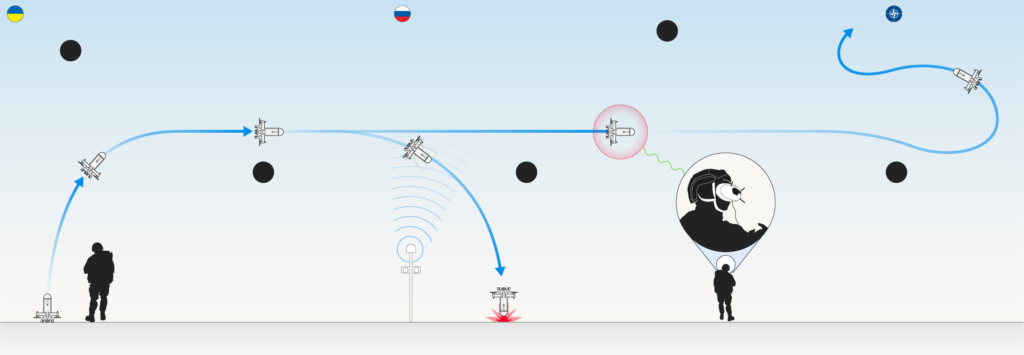
Yet investigators quickly uncovered a surprising reality: the drones were not launched directly by Russia into NATO territory. Instead, they were reportedly Ukrainian drones that had been electronically manipulated and redirected by Russian systems.
The development signals an emerging phase of modern warfare — one where electronic interference can transform enemy weapons into geopolitical tools.
A New Battlefield: Electronic Warfare Beyond Ukraine
Security analysts say Russia’s growing ability to interfere with navigation systems is reshaping the conflict.
Rather than destroying Ukrainian drones outright, Moscow is increasingly using electronic warfare tactics to seize control of their navigation paths. By disrupting GPS signals, drones can be pushed off course and unintentionally sent into neighboring NATO countries.
Experts warn this creates serious political and military risks.
Keir Giles, an analyst specializing in Russia and Eurasia affairs, argues that Moscow has little incentive to halt such operations if there are few consequences.
According to defense observers, disruptions affecting Baltic airspace and navigation systems have been escalating for months, but recent incidents suggest the strategy has evolved from interference into deliberate redirection.
Drone Incidents Spread Across NATO’s Eastern Flank
Since early 2026, multiple incidents have raised alarm across the Baltic region and northern Europe.
Reports indicate redirected drones have:
- Crashed inside Estonian territory
- Triggered explosions near fuel infrastructure in Latvia
- Forced NATO responses, including the reported interception of a drone over Estonian airspace by an F-16 fighter jet
- Intensified political tensions within Baltic governments
In Latvia, the fallout became severe enough to spark political repercussions after controversy surrounding a previous drone incident contributed to instability within the ruling coalition.
These events have transformed what was once considered a localized conflict into a broader security issue affecting NATO’s eastern members.
How Russia Hijacks Drones Without Shooting Them Down

At the center of this strategy are two electronic warfare techniques: jamming and spoofing.
GPS Jamming: Blinding the Drone

The first step involves overwhelming a drone’s GPS receiver with powerful electronic noise.
This process blocks legitimate satellite signals, leaving the drone unable to determine its true position.
Without accurate coordinates, navigation systems become vulnerable.
GPS Spoofing: Feeding the Drone False Information
After disrupting signals, attackers introduce counterfeit GPS data.
These fake signals convince the drone it is somewhere entirely different from its actual location.
Navigation systems then automatically adjust flight paths based on false coordinates.
Researchers monitoring Baltic navigation systems say some drones appear to believe they remain deep inside Russian territory, causing them to veer westward toward NATO airspace.
The sophistication of these attacks has increased significantly.
Beyond location manipulation, analysts say incorrect timing data can also be injected into systems, causing software failures and potentially crashing drones outright.
Kaliningrad Emerges as Key Electronic Warfare Hub
Analysts point to Russia’s heavily militarized enclave of Kaliningrad — located between Poland and Lithuania — as a major center for GPS disruption activities.
The region reportedly hosts powerful transmission systems capable of interfering with navigation across broad areas of the Baltic Sea and neighboring states.
The impact has reportedly extended beyond military concerns.
Emergency services in parts of northern Europe have increasingly had to adapt operations because of unreliable GPS coverage.
Navigation disruptions have also affected aviation routes and maritime activity across the region.
Some researchers further suggest Russia has explored satellite-based interference technologies capable of extending spoofing operations from space, potentially widening the threat area.
Ukraine Responds With New Drone Technologies
Ukraine is rapidly adapting to Russia’s electronic warfare tactics.
One major development is the use of fiber-optic drones.
Unlike traditional systems that rely on GPS or radio communication, these drones remain connected through physical cables that unspool during flight.
Because they do not depend on wireless signals, they are significantly harder to jam or spoof.
Current versions reportedly strike targets more than 10 miles away.
Ukraine is also expanding AI-guided navigation systems.
These technologies use onboard cameras, terrain mapping, and visual recognition instead of satellite navigation.
As a result, drones can continue missions even when GPS becomes unavailable.
Some systems are reportedly capable of operating hundreds of miles from their controllers.
Russia Adapts as Electronic Arms Race Intensifies

The contest is rapidly becoming an electronic arms race.
Russia has begun deploying its own fiber-optic systems while expanding jamming capabilities.
Defense experts say fewer signal types remain untouched by interference.
The battlefield is evolving into a contest between autonomous systems, electronic countermeasures, and AI navigation.
According to navigation specialists, almost every major signal environment is now contested.
“Everything is being jammed and spoofed,” one expert noted, underscoring the scale of the challenge.
Could Drone Diversions Be Considered Aggression Against NATO?
The growing number of drone incursions raises difficult legal and strategic questions.
Although no direct attack has occurred, experts argue Russia’s actions may fit within a broader pattern of “hybrid” or “shadow” warfare aimed at testing NATO cohesion.
By engineering incidents that trigger evacuations, political crises, or military responses — without crossing into open conflict — Moscow may be probing alliance readiness.
Security analysts say the objective may not be territorial gains but psychological and political pressure.
The strategy allows Russia to challenge NATO while staying below the threshold of formal confrontation.
Europe Faces a New Security Reality

The events in Vilnius demonstrated how quickly electronic warfare can create panic far from active battle zones.
What began as a conflict centered in Ukraine is increasingly spilling into European security systems, infrastructure, and political institutions.
Experts warn the threat is likely to grow rather than fade.
As Russia and Ukraine continue adapting technologies at high speed, NATO countries may need to rethink defenses not only against missiles and aircraft, but against invisible electronic attacks capable of reshaping the battlefield without firing a shot.
The drone war is no longer confined to Ukraine. It is now testing the resilience of Europe itself.