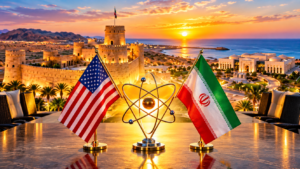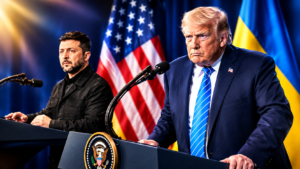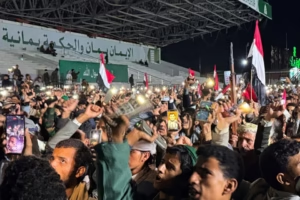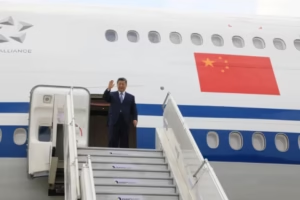


The United States and Iran appear to have reached a major diplomatic breakthrough after months of tensions, military confrontations, and intense negotiations, with President Donald Trump announcing Sunday that a peace agreement between the two countries is now complete.
The announcement, made on Trump’s Truth Social platform, immediately sent shockwaves through diplomatic circles and energy markets, raising hopes that one of the most dangerous standoffs in the Middle East could finally be moving toward a resolution.
“The deal with the Islamic Republic of Iran is now complete. Congratulations to all,” Trump wrote.
The U.S. president also revealed that he had authorized the immediate reopening of the Strait of Hormuz and ordered the removal of U.S. naval restrictions that had been imposed during the conflict.
“I hereby fully authorise the toll-free opening of the Strait of Hormuz, and, simultaneously herewith, authorise the immediate removal of the United States naval blockade,” Trump said.
“Ships of the world, start your engines. Let the oil flow.”
Within minutes, Iranian officials began issuing their own statements, confirming that a framework agreement had been finalized while emphasizing that formal implementation would still require additional steps.
Tehran Confirms Agreement but Stresses Its Own Gains
Iran’s response was notably more cautious than Washington’s celebration.
Deputy Foreign Minister Kazem Gharibabadi confirmed that negotiators had completed the text of what is being called the Islamabad Memorandum of Understanding and said an official signing ceremony is scheduled to take place in Switzerland later this week.
According to Iranian officials, the document will soon be released publicly.
“The public will be able to see both Iran’s achievements and its commitments,” Gharibabadi said. “Our commitments are not comparable to the gains and achievements we have secured.”
The language reflects Tehran’s effort to present the agreement as a diplomatic victory rather than a concession to American pressure.
Iranian leaders have long been sensitive to domestic criticism regarding negotiations with Washington, and officials appeared eager to emphasize that the country entered the agreement from a position of strength.
Strait of Hormuz Reopening Could Ease Global Economic Concerns
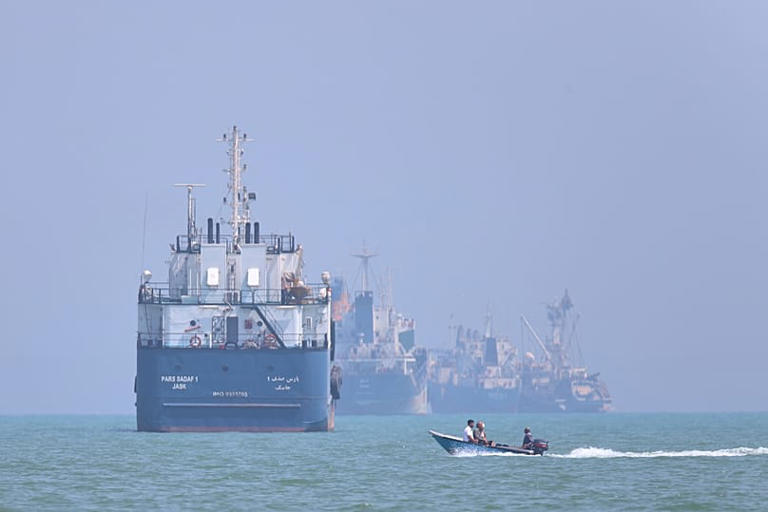
Perhaps the most significant immediate consequence of the deal is the reopening of the Strait of Hormuz.
The narrow waterway serves as one of the world’s most important energy corridors, carrying a substantial share of global oil and natural gas exports.
Any threat to navigation through the strait has historically caused concern in financial markets and among governments dependent on Gulf energy supplies.
The prospect of unrestricted shipping is likely to be welcomed by energy companies, traders, and consumers alike.
While Iranian officials did not directly reference the strait in their initial statements, Iranian media reported that Tehran and Oman would cooperate on establishing a new legal framework governing navigation and maritime security in the Persian Gulf.
The arrangement could help reduce future tensions and provide greater predictability for international shipping.
For global markets that have spent months worrying about disruptions, the reopening of the strait represents one of the clearest signs that the agreement could have immediate economic benefits.
Pakistan’s Quiet Diplomacy Pays Off
Behind the scenes, much of the credit for bringing the two sides together is being directed toward Pakistan.
Prime Minister Shehbaz Sharif announced the agreement shortly before Trump’s statement, revealing the extent of Islamabad’s role in mediating talks between Washington and Tehran.
“Following intensive talks, we are pleased to announce that the peace deal between the United States of America and the Islamic Republic of Iran has been reached,” Sharif wrote.
He also said both sides had agreed to immediately and permanently halt military operations across multiple fronts, including in Lebanon, where regional tensions have repeatedly threatened to expand the conflict.
Sharif praised the contributions of several countries involved in the mediation effort, including Qatar, Saudi Arabia, and Türkiye.
Diplomats say the negotiations represented a rare example of regional powers working together to prevent a wider conflict that many feared could destabilize the Middle East.
A 60-Day Window for Bigger Negotiations
Despite the celebratory tone surrounding the announcement, the agreement itself is not the final destination.
Instead, it opens the door to a 60-day negotiation period during which both sides will attempt to resolve some of the most difficult issues that have divided them for years.
Iran has made clear that further progress will depend on Washington following through on its commitments.
Officials in Tehran say the next phase of talks will begin only after verification that the United States has implemented agreed measures, including lifting maritime restrictions and other provisions contained in the memorandum.
That means the coming weeks will be crucial.
Success could lead to a broader settlement covering sanctions, regional security, economic cooperation, and Iran’s nuclear program. Failure could quickly reignite tensions.
Tehran Still Sends a Defiant Message
Even as Iranian officials acknowledged the breakthrough, they continued to project an image of resistance and strength.
Iran’s military command issued a separate statement describing the agreement as proof that the country’s adversaries had been forced to accept reality.
The message was aimed largely at domestic audiences and supporters across the region, many of whom remain skeptical of engagement with the United States.
The dual approach—celebrating diplomacy while maintaining a defiant tone—highlights the delicate balancing act Iranian leaders face as they attempt to defend the agreement politically at home.
Nuclear Program Remains the Biggest Challenge
Although the reopening of the Strait of Hormuz and the end of military operations are grabbing headlines, the future of Iran’s nuclear program remains the most sensitive issue on the negotiating table.
The upcoming talks are expected to focus heavily on enrichment activities, monitoring mechanisms, and guarantees that Iran will not develop nuclear weapons.
Trump has repeatedly emphasized that any long-term agreement must ensure Tehran cannot obtain a nuclear arsenal.
On Saturday, he described the proposed arrangement as creating a permanent barrier against nuclear weapons development.
For both sides, the nuclear question remains the ultimate test of whether this diplomatic breakthrough can evolve into a lasting peace.
A Rare Moment of Optimism
For much of the past year, relations between Washington and Tehran appeared headed toward deeper confrontation.
Military strikes, regional tensions, and escalating rhetoric had fueled fears of a broader conflict that could draw in multiple countries and disrupt global energy markets.
Sunday’s announcements have changed that narrative—at least for now.
Whether the agreement ultimately succeeds will depend on implementation, trust, and political will on both sides.
But after months of uncertainty, the deal offers something that has been in short supply throughout the crisis: a genuine opportunity for diplomacy to replace conflict.
The coming 60 days will reveal whether that opportunity becomes a lasting peace—or simply another chapter in the long and complicated history of U.S.-Iran relations.