
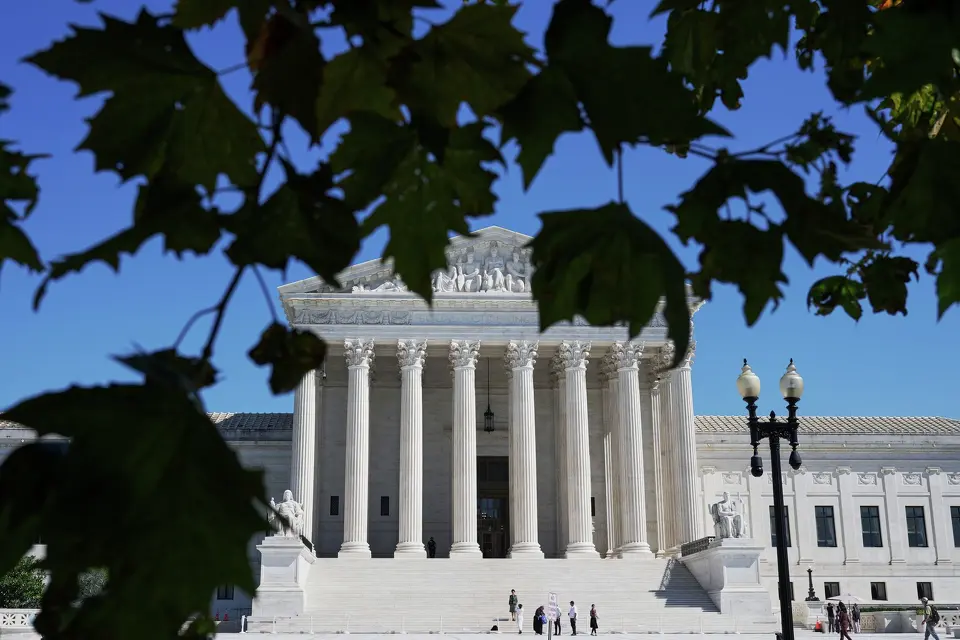
The U.S. Supreme Court on Monday, Oct. 5, turned away former Alabama Chief Justice Roy Moore’s attempt to restore an $8.2 million jury award in his defamation case over a 2017 campaign ad. The justices denied his petition on an order list released as they returned to the bench to open their new term. They gave no reason, and none of them signaled any interest in reviewing the case.
The denial leaves in place the federal appeals court ruling that overturned the verdict. It is the latest in a string of losses for Moore, who failed in his 2017 campaign for the U.S. Senate and has spent years fighting over how that race ended up in court.
What the ad said
A jury sided with Moore and awarded him $8.2 million. The case then moved to the U.S. Court of Appeals for the 11th Circuit, which reversed the result.
Why the appeals court ruled against him
The 11th Circuit agreed with Senate Majority PAC that Moore failed to present clear and convincing evidence that the group published the ad’s implication with “actual malice.” Supreme Court precedent sets that standard. It requires a plaintiff to prove the alleged defamation was made with knowledge that it was false or with reckless disregard for whether it was false.
The standard is hard to meet. A plaintiff who is a public figure cannot win by showing only that a statement was false or damaging. The plaintiff must show the speaker knew the statement was untrue or recklessly ignored the chance that it was. The appeals court found Moore had not made that showing.
An earlier loss in June
Moore had already lost at the Supreme Court once this year. He filed an emergency motion asking the court to block the appeals court’s ruling from taking effect while his appeal went forward. Justice Clarence Thomas, who handles urgent requests from the circuit that includes Alabama, denied that request in late June.
An emergency denial does not decide the underlying case, so Moore filed a petition asking the full court to hear it. That petition is the one the justices rejected Monday.
The signal before Monday
Few people who follow the court expected a different result, because the justices had already treated the petition in a way that pointed toward denial. Senate Majority PAC, which won in the appeals court, waived its right to respond to Moore’s petition.
When a respondent waives, the justices sometimes ask for a response anyway. They do that when at least one of them sees enough in a petition to want to hear the other side. They did not do it here. That choice suggested no justice saw a reason to look closely at Moore’s case.
How the court decides which cases to hear
The court receives thousands of petitions each term and grants review in a small fraction of them. It takes four of the nine justices to agree to hear a case. Most denials arrive on order lists like Monday’s with no explanation attached, which is standard practice.
Monday’s list was mostly denials across a long run of cases. Moore’s petition sat among them. Other petitioners also received bad news on the first day of the term.
A defamation precedent that keeps surviving
The Moore denial also fits a pattern at the court. The justices have now turned down another petition that asked them to reconsider their defamation precedents, which date to New York Times Co. v. Sullivan, decided in 1964. That decision imposed the high burden that public figures face when they try to win defamation cases.
Critics of the Sullivan standard have pushed the court to revisit it. Each denied petition leaves the rule in place. Moore’s case did not ask the court to overturn Sullivan outright, but his loss turned on the standard the case created. The court’s refusal to take it up leaves the actual malice requirement as it was.
What the denial means for Moore
The petition was Moore’s last route to restoring the $8.2 million award. With the Supreme Court declining to step in, the 11th Circuit’s decision stands, and the jury’s award does not return to him.
The order list gave no indication of how many justices, if any, wanted to hear the case. A denial with no noted dissent means no justice put in writing a wish to take it up. That tracks the earlier signals. Thomas rejected the emergency request in June. The respondents waived their reply in the summer. The full court has now closed the case on its first day back.
Moore’s allegation that the ad falsely portrayed him as soliciting sex from a minor never received a final ruling from the Supreme Court on its merits. The appeals court decided the case on the evidence of actual malice. Its holding is that Moore did not prove the group behind the ad acted with knowledge of falsity or reckless disregard for the truth. The justices left that finding alone.