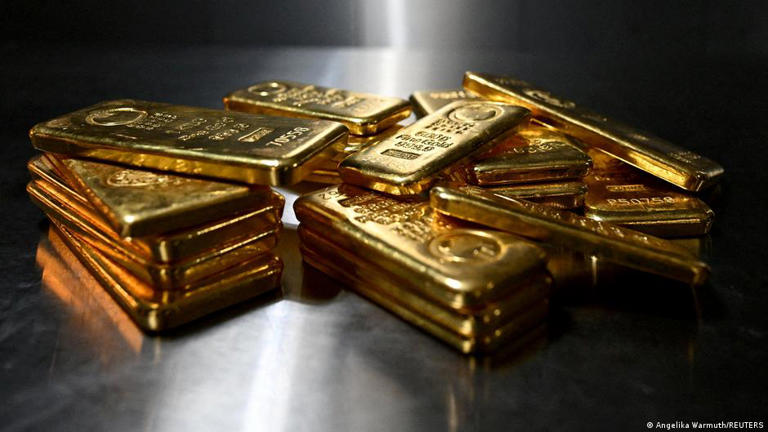
Russia has drawn down a substantial share of its gold reserves in 2026, part of an effort by the Kremlin to raise cash and plug a growing hole in its budget as the war in Ukraine drags into its fifth year.
The Russian Central Bank reported that gold holdings stood at 73.4 million troy ounces, or 2,282 metric tons, as of the start of July. That figure marks a drop of roughly 43.5 metric tons since January, pulling reserves down to their lowest point since before the full-scale invasion began in February 2022.
The timing of the sell-off overlapped with a run-up in gold prices. The metal traded near $4,800 per ounce during the first four months of the year before slipping back to around $4,000. At that price range, Moscow’s sales have likely brought in more than $5 billion.
Elina Ribakova, an economist at the Peterson Institute for International Economics, said the move points to a shrinking pool of options for the Kremlin. “The fact that they’re selling gold means that they’re running out of other more liquid assets,” she told DW. “So there is pressure on the deficit and also pressure on the sources to finance this deficit.”
Defense costs strain the budget
The bulk of the pressure traces back to military spending. Russia’s finance ministry warned the cabinet earlier this year that war-related overspending would hit at least $28 billion in 2026, with additional overruns expected in 2027 and 2028, according to reporting from the Financial Times. Defense outlays have more than quadrupled since 2021, reaching about 16 trillion rubles, or $204 billion, in 2025.
Chris Weafer, a Moscow-based analyst with Macro-Advisory, said the scale of the gold sales is notable but shouldn’t be read as a sign of desperation. “It’s an extraordinary situation, but it’s a relatively normal trend,” he told DW. “It doesn’t represent any element of Russia going broke, running out of money, not having anything else and literally selling the household silver.”
According to Weafer, most of the gold has moved through Russia’s finance ministry via the National Welfare Fund, rather than directly from the central bank. Gold became one of the few assets available to the fund after Western sanctions cut off access to US Treasuries and European government bonds following the 2022 invasion. “Since early 2022, gold was one of the assets that the National Welfare Fund could buy, because US treasuries and bunds weren’t available to them,” he said.
He described the gold as a core liquid holding for the fund, one that exists precisely to be tapped in moments like this. “To that extent, one can argue it is serving the intended purpose,” Weafer said.
Weafer estimated the National Welfare Fund’s total value at around $150 billion, with roughly $50 billion classified as liquid. Keeping that liquid cushion intact matters to the Kremlin beyond the immediate budget math, he said, because a shrinking buffer would invite speculation about a wider financial crisis and weaken Moscow’s negotiating position abroad. “It likes to portray the country as being very stable and very strong, and that $50 billion of cash is an important part of that,” Weafer said.
One factor works in Russia’s favor: it ranks among the world’s top gold producers, meaning it can rebuild reserves by buying directly from domestic mining companies rather than on international markets. Russia currently holds the fifth-largest gold reserves in the world, in the same range as China, France and Italy, though well behind leaders Germany and the United States.
Ribakova pointed to the same advantage. “Russia has an advantage,” she said. “It does produce gold itself. So when it was worried about sanctions, it allocated part of the money into the gold purchases, which they were buying from the domestic producers.”
Oil revenue remains the deciding factor
Russia’s federal budget deficit could exceed official targets by more than 1 trillion rubles, or roughly $12.85 billion, in 2026, based on recent government figures. The shortfall is currently projected at 1.6% of GDP, close to $40 billion, with room to widen further.
Higher oil prices, driven in part by the war in Iran, have given Moscow some breathing room this year by boosting revenue from oil and gas exports. Ribakova said that revenue stream, more than any other factor, determines how long Russia can keep funding the war.
“Everything hinges on that,” she said. “When the oil price is high, Russia gets revenues. It’s easier to borrow, its domestic financial system is healthier. If the oil price drops, say, to sixty or forty, then you immediately have a crisis.”
Both economists agreed that despite the current strain, Russia has enough flexibility to keep financing the war for the foreseeable future by trimming spending outside the defense sector.
“Putin can continue going for years in the current environment,” Ribakova said. “Maybe not making any progress on the front line, which we haven’t seen any progress for the last couple of years, but still being able to throw resources at the war with Ukraine.”
Weafer offered a similar assessment of the near term. “Even if the deficit continues as is, Russia can still find the money and really won’t be in any sort of a financial crisis or a weak geopolitical position over the next 12 to 24 months,” he said.
His outlook dims further out. Weafer pointed to the accumulating cost of running the economy on a war footing, and said the strain is now surfacing as friction inside the Russian government itself.
“It is creating this huge distortion in the economy and creating this longer-term negative picture that’s now creating divisions in government,” he said.
That divide, Weafer said, runs between officials focused on economic growth and the Kremlin’s wartime priorities. Those pushing for a return to normal economic conditions argue the current spending path cannot hold indefinitely, “if you want the economy to go back to a more normal trajectory after peace. That’s the bottom line,” he said.