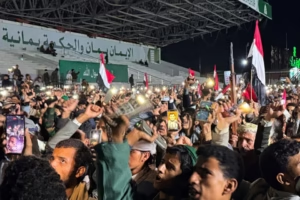


Thousands of demonstrators took to the streets of Geneva on Sunday ahead of the Group of Seven (G7) summit in neighboring France, voicing concerns over economic inequality, corporate influence, global conflicts, and social justice issues.
While the majority of the march remained peaceful, isolated incidents of vandalism occurred during the demonstration, including the burning of a Tesla vehicle and damage to a bank branch. The events unfolded as world leaders prepared to gather across the border in the French resort town of Evian-les-Bains for three days of high-level discussions on some of the world’s most pressing challenges.
Swiss police estimated attendance at up to 7,000 people and reported confiscating several knives and pyrotechnic devices before and during the demonstration. Authorities maintained a significant security presence throughout the city but described the overall event as largely orderly.
The protests underscored the continuing tensions that often accompany major international summits, where activists use the global spotlight to challenge political leaders and economic institutions.
G7 Summit Returns Amid Global Uncertainty
The June 15–17 summit will bring together leaders from the world’s major industrialized democracies: France, the United States, the United Kingdom, Canada, Germany, Italy, and Japan, alongside representatives of the European Union.
This year’s gathering comes at a particularly sensitive moment in global affairs.
Conflicts in Ukraine and the Middle East are expected to dominate discussions, while leaders are also likely to focus on international security, economic stability, climate challenges, and energy policy.
Diplomatic efforts surrounding a potential framework peace agreement between the United States and Iran are also expected to feature prominently on the agenda.
Analysts say the summit will test relations among Western allies as they seek common ground on a range of geopolitical issues while managing differences over trade, security, and foreign policy.
Protesters Target What They See as Concentrated Power
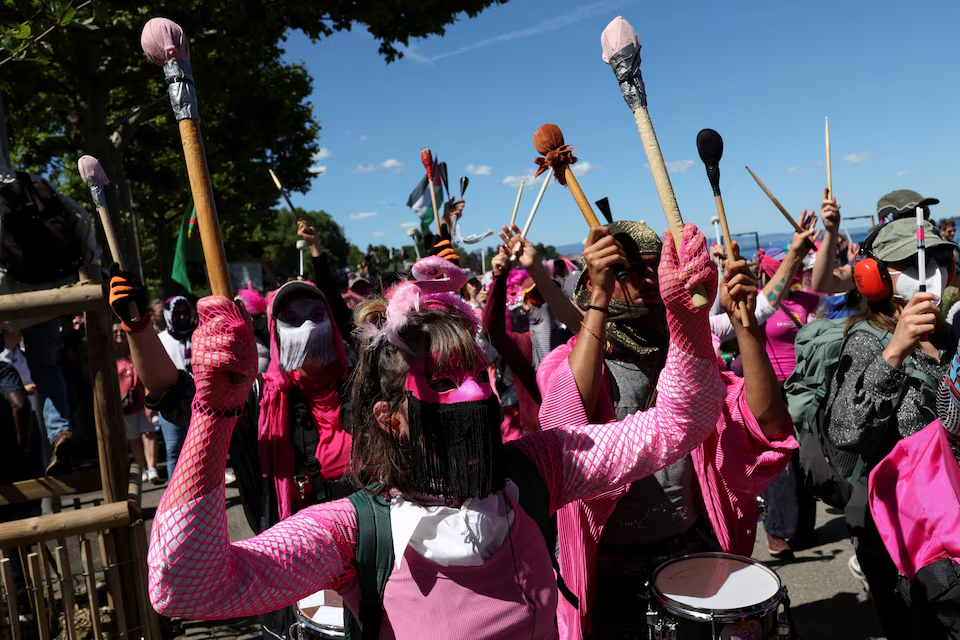
For many participants in Geneva, the demonstration was about more than a single summit.
Protesters described the G7 as a symbol of concentrated political and economic power that they believe increasingly benefits wealthy elites while leaving ordinary citizens behind.
Many attendees carried banners calling for greater economic equality, stronger social protections, climate action, and reforms to global financial systems.
The protests also reflected growing frustration over widening wealth disparities around the world.
Those concerns have been amplified in recent days following reports that technology entrepreneur Elon Musk became the world’s first trillionaire, a milestone that reignited debate over wealth concentration and corporate influence.
For some demonstrators, the timing served as a stark illustration of what they view as an increasingly unequal global economy.
“To me, it’s a meeting of the rich that shows once again how the rich can become even richer while the poor are left behind,” said protester Pippa Saugy during the march.
Her comments echoed a broader sentiment among participants who argued that economic growth has not been shared equally across societies.
Security Measures Transform Geneva’s City Center
Authorities had prepared extensively for the demonstration amid concerns that violence could erupt ahead of the summit.
Businesses in parts of Geneva boarded up windows in advance, while hundreds of police officers were deployed throughout key areas of the city.
Security barriers, patrol units, and riot police were visible across central Geneva as officials sought to prevent disorder and protect public property.
The heightened security measures reflected lessons learned from previous G7 gatherings, many of which have attracted large-scale protests and occasional clashes between activists and law enforcement.
Although Sunday’s demonstration remained mostly peaceful, the isolated acts of vandalism reinforced concerns about maintaining order during high-profile international events.
Police have not yet released detailed information regarding arrests or investigations connected to the damaged property.
Demonstrators Criticize Heavy Police Presence
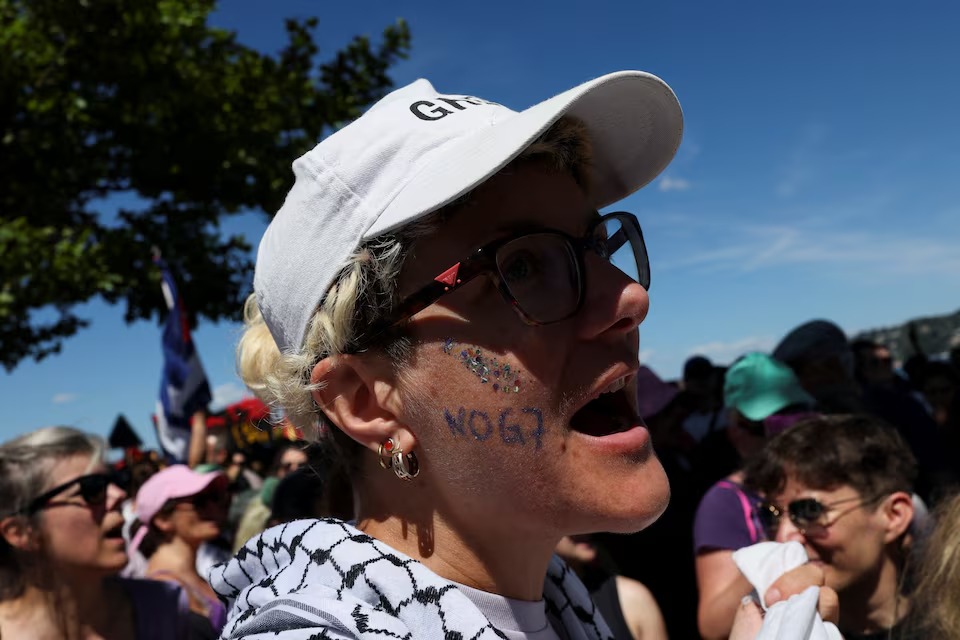
Not all of the criticism during the protest was directed at world leaders.
Several participants voiced concerns about the extensive police deployment, arguing that authorities were attempting to discourage public dissent through a visible show of force.
Mattia Piccard, one of the demonstrators, said the security measures created an atmosphere of intimidation.
“This is an attempt to frighten demonstrators, to frighten people and discourage them from coming out to protest,” Piccard said.
Civil liberties groups have long debated the balance between maintaining public safety and protecting the right to peaceful assembly during major international events.
Supporters of strong security measures argue they are necessary to prevent violence, while critics contend they can discourage legitimate political expression.
Gender Equality Emerges as a Key Theme
Alongside concerns about wealth inequality and global governance, gender equality was another prominent issue raised during the march.
Several activists argued that decisions made by powerful governments and economic institutions continue to overlook women’s rights and broader issues of social inclusion.
Demonstrator Clélia Colin said she attended the protest specifically to highlight what she sees as persistent gender inequalities within political and economic systems.
“The values represented by the G7 are completely misogynistic, and they contribute to inequality because there is absolutely no equality,” Colin said.
Her comments reflected a broader call among activists for greater representation and stronger commitments to gender equality in policymaking at both national and international levels.
A Familiar Scene at Global Summits
Protests have become a familiar feature of G7 meetings over the past several decades.
Activists from around the world frequently use these gatherings to draw attention to issues ranging from globalization and climate change to labor rights, poverty, and international conflict.
Supporters of the demonstrations argue that they provide an important counterweight to powerful political and economic institutions.
Critics, however, contend that the protests often oversimplify complex global challenges and sometimes overshadow substantive policy discussions taking place inside summit venues.
Regardless of perspective, Sunday’s events in Geneva once again highlighted the deep divisions that continue to shape debates about globalization, wealth distribution, and political power.
Leaders Face Pressure Both Inside and Outside the Summit
As G7 leaders gather in Evian-les-Bains, they will confront not only international crises but also growing public scrutiny over how their decisions affect ordinary people.
For many protesters, the demonstration served as a reminder that issues such as economic inequality, social justice, and political accountability remain deeply connected to global policymaking.
While world leaders meet behind closed doors to discuss war, diplomacy, and economic strategy, thousands of voices outside the summit are demanding that those conversations also address the widening gaps between wealth and poverty, power and representation.
The scenes in Geneva illustrate that even as governments work to manage international challenges, public pressure for change continues to grow.