Iran’s Revolutionary Guards said Wednesday they targeted US military sites in Bahrain and Kuwait, hours after the United States launched a wave of strikes on Iranian territory in response to attacks on tankers in the Strait of Hormuz.
The exchange marks the latest blow to a cease-fire agreement already under severe strain. The Islamic Revolutionary Guard Corps said it carried out a joint missile and drone operation against key US sites, including Bandar Salman, home to Bahrain’s Fifth Naval District, and Ali Al Salem Air Base in Kuwait. The IRGC also said it shot down a US MQ-9 drone that attempted to interfere with the operation.
Air raid sirens sounded across Bahrain and Kuwait, officials said. Kuwait’s army reported that its air defenses were confronting “hostile” missile and drone attacks.
US Central Command said its strikes hit more than 60 small boats belonging to the Revolutionary Guard, part of an effort to impose a heavy cost on Iran for attacks on shipping that Washington says violated the cease-fire. “The unwarranted aggression by Iranian forces is a clear and dangerous violation of the cease-fire and undermines freedom of navigation,” CENTCOM said in a statement.
Iran’s top joint military command, the Khatam al-Anbiya Central Headquarters, condemned the US strikes as a “blatant act of aggression,” threatened a “crushing response,” and said Tehran would not allow US interference in the management of the strait.
Parliament speaker Mohammad Baqer Qalibaf, a top Iranian negotiator, accused the US of breaching the cease-fire agreement. He pointed to the latest strikes alongside renewed oil sanctions, what he called violations of Iranian “adjustments” in the Strait of Hormuz, and Israeli attacks against Lebanon. “The era of bullying and extortion is over,” Qalibaf wrote on X. “We don’t fold.”
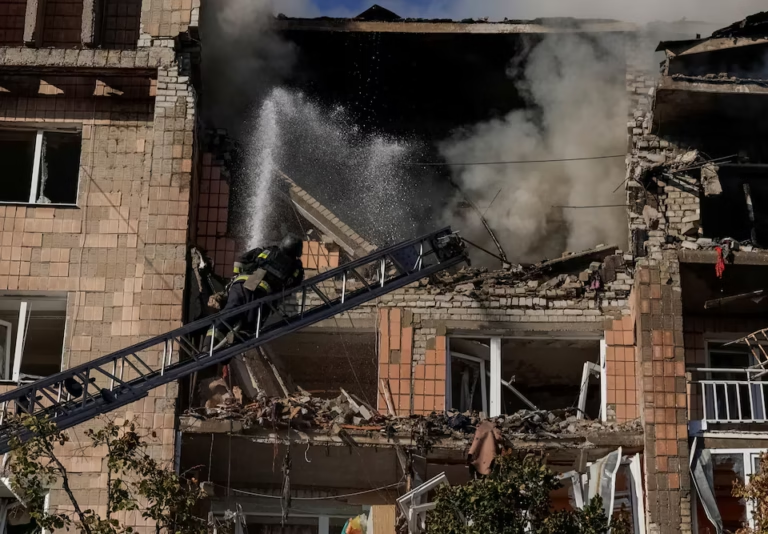
Iranian media reported explosions at several sites, including Kharg Island, the country’s main oil export hub, along with Qeshm Island and the southern port cities of Sirik and Bandar Abbas. Iran’s Press TV said multiple blasts were heard on Kharg Island, though CENTCOM made no mention of the island in its own statements. Kharg Island handles roughly 90% of Iran’s crude oil exports.
A US official told Reuters the strikes targeted Iranian air defense systems, coastal surveillance equipment, surface-to-air missiles, anti-ship cruise missiles and drone launch sites. No civilian deaths were reported in Iran, though an Iranian state TV reporter said several people were injured by shrapnel after a projectile struck a commercial pier in Sirik. Reports indicated the strikes also hit fishing piers in Sirik and Bandar Abbas.
The clashes represent the latest threat to the cease-fire the US and Iran reached last month, which had paused a conflict that began with joint US and Israeli strikes across Iran.
Oil prices rise
In a move that could further destabilize the agreement, Washington on Tuesday withdrew a key concession that had allowed Iran to sell oil on international markets. Oil prices rose more than 3% following the announcement.
A US official said earlier that negotiators remained committed to working in good faith toward a lasting agreement with Iran. Still, control of the strait has given Tehran substantial leverage, allowing it to sustain a standoff against the world’s most powerful military. Analysts say Iran uses attacks on shipping to reinforce that leverage as talks continue toward a long-term settlement.
Under the interim agreement between Washington and Tehran, the US Treasury had issued a general license on June 22 permitting the sale of Iranian crude oil, petrochemicals and petroleum products through August 21. When the Treasury revoked that license Tuesday, it gave Iran until July 17 to wind down any remaining transactions.
“Any measure necessary”
Iran’s foreign ministry condemned the sanctions move as a breach of the framework agreement meant to end the broader war, and said Washington would bear responsibility for the consequences. Early Wednesday, the ministry said Iran would take whatever measures it deemed necessary to protect its interests and national security.
While Tehran denied responsibility for the recent strikes on ships in the strait, Qatar blamed Iran directly, including for an attack on the Qatari liquefied natural gas tanker Al Rekayyat, which reported being struck by a drone that started a fire in its engine room. The crew escaped safely and was evacuated.
Iran’s foreign ministry called Qatar’s accusations “perplexing” and said Tehran was fulfilling its commitments diligently. At the same time, the ministry said commercial vessels using routes not coordinated with Iran faced risks. A second US official, speaking on condition of anonymity, said initial indications suggested Iran had fired on three commercial vessels.
Iran’s clerical leadership has moved to establish a permanent system for collecting transit fees in the strait, a step that would mark a substantial shift in regional power away from Washington, which has long served as the area’s primary security guarantor.
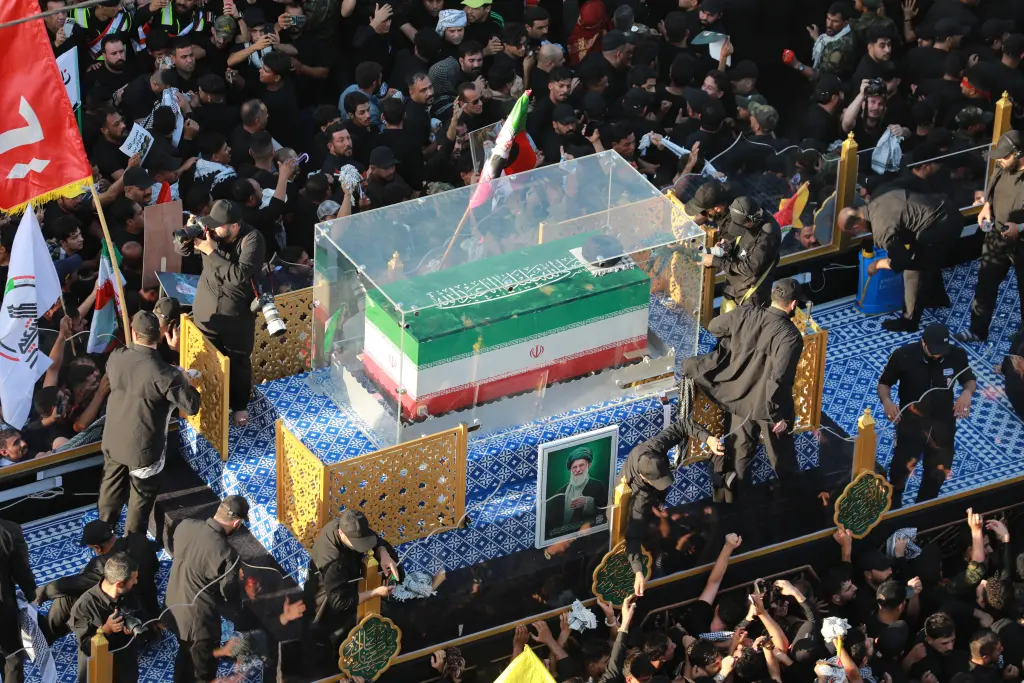
The US strikes followed large crowds gathering in the holy city of Qom to mourn Iran’s Supreme Leader, Ayatollah Ali Khamenei, who was killed alongside his daughter, granddaughter, son-in-law and daughter-in-law on the first day of the war.
The cease-fire had been designed to provide a 60-day window for negotiations toward a permanent agreement, but indirect talks held in Qatar ended last week without progress. President Donald Trump has repeatedly threatened to resume bombing unless Iran agrees to “make a deal.”
Iran’s Foreign Minister Abbas Araqchi said that under the terms of the interim cease-fire memorandum, negotiations on a final agreement would “not commence if threats continue.”
A widening standoff
The events of the past two days have exposed how little separates the current cease-fire from renewed open conflict. Each side has now struck the other’s territory and forces directly, and each has framed its own actions as a response to violations committed by the other. The US points to attacks on commercial shipping and the killing of tanker crew members as justification for its strikes on Iranian military infrastructure. Iran points to those same US strikes, along with the reimposition of oil sanctions, as evidence that Washington never intended to honor the memorandum signed last month.
That memorandum had been built around a narrow set of concessions: a pause in strikes, a temporary opening for Iranian oil sales, and a commitment from both sides to pursue direct talks on the strait’s long-term management. Each of those elements now appears in question. The oil sales concession has been revoked outright. The pause in strikes has been broken by both parties within the span of two days. And talks on the strait, which were supposed to involve Iran and Oman working alongside other Gulf states, have not resumed since the funeral proceedings for Khamenei began.
Gulf states caught in the middle have found themselves absorbing the consequences of a conflict they did not start. Bahrain and Kuwait, both hosts to significant US military infrastructure, now face direct exposure to Iranian retaliation aimed at American forces on their soil. Qatar and Saudi Arabia, meanwhile, have watched their own commercial vessels come under attack in a waterway neither country controls.
The strategic calculation driving Iran’s approach appears rooted in the leverage the strait itself provides. Roughly a fifth of the world’s oil supply passes through Hormuz, and Iran’s ability to disrupt that flow, even temporarily, gives Tehran a bargaining position that conventional military weakness would otherwise deny it. Attacks on individual tankers, rather than a full blockade, allow Iran to demonstrate that capability while stopping short of the kind of disruption that might draw a broader international coalition into the conflict.
For Washington, the challenge lies in calibrating a response that punishes Iran for strikes on shipping without triggering the kind of escalation that collapses the cease-fire entirely. CENTCOM’s emphasis on hitting boats, launch sites and air defense systems, rather than population centers or leadership targets, suggests an effort to keep the strikes within that boundary. Whether Iran interprets the scale of the response the same way remains uncertain, particularly given the IRGC’s stated intent to hit US military sites directly in Bahrain and Kuwait.
With indirect talks in Qatar having ended without progress and Trump’s threats of renewed bombing still on the table, both sides now face a narrow set of choices. Neither has signaled willingness to step back from the positions staked out over the past two days, leaving the fate of the cease-fire, and the broader question of who controls one of the world’s most critical waterways, unresolved.