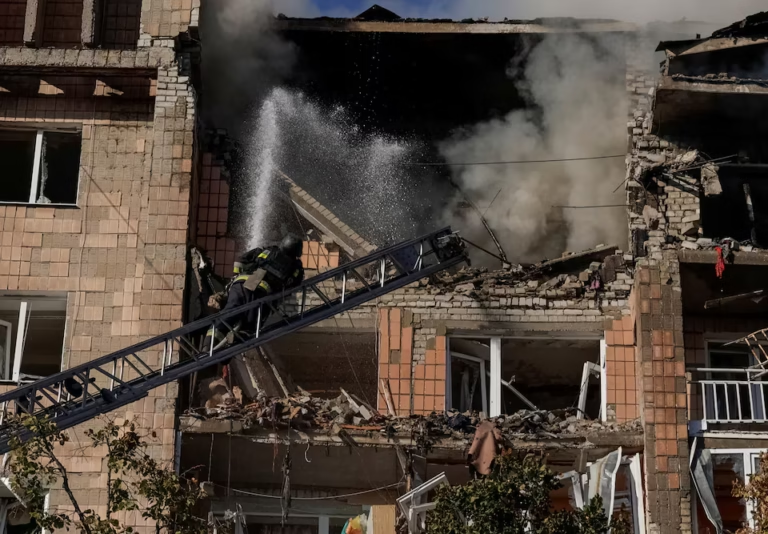

Russia fired ballistic missiles at Kyiv again overnight, officials said Wednesday, marking the third attack on the Ukrainian capital in less than a week. The strikes come as Ukraine faces a critical shortage of US-made air defense interceptors, the only weapon in its arsenal capable of stopping ballistic projectiles.
The attack coincides with the NATO summit underway in Ankara, where US President Donald Trump is scheduled to meet with Ukrainian President Volodymyr Zelenskiy.
Ukraine’s air defenses intercepted 139 of the 169 drones launched overnight, according to air force data. But the country’s defenses failed to down any of the five ballistic missiles Russia fired in the same period, continuing a pattern that has left Ukrainian cities increasingly exposed.
Moscow has intensified its air campaign against Ukraine in recent months, as its ground offensives have largely stalled. At the same time, Ukrainian strikes on Russian military logistics and oil infrastructure have triggered widespread fuel shortages inside Russia. In July alone, Russian strikes on Kyiv and the surrounding region have killed 60 people.
The gap in Ukraine’s defenses has grown stark. Since the start of the month, Ukrainian air defenses have shot down just four of 54 ballistic missiles fired by Russia, according to air force data, a rate that leaves the vast majority of incoming missiles unopposed.
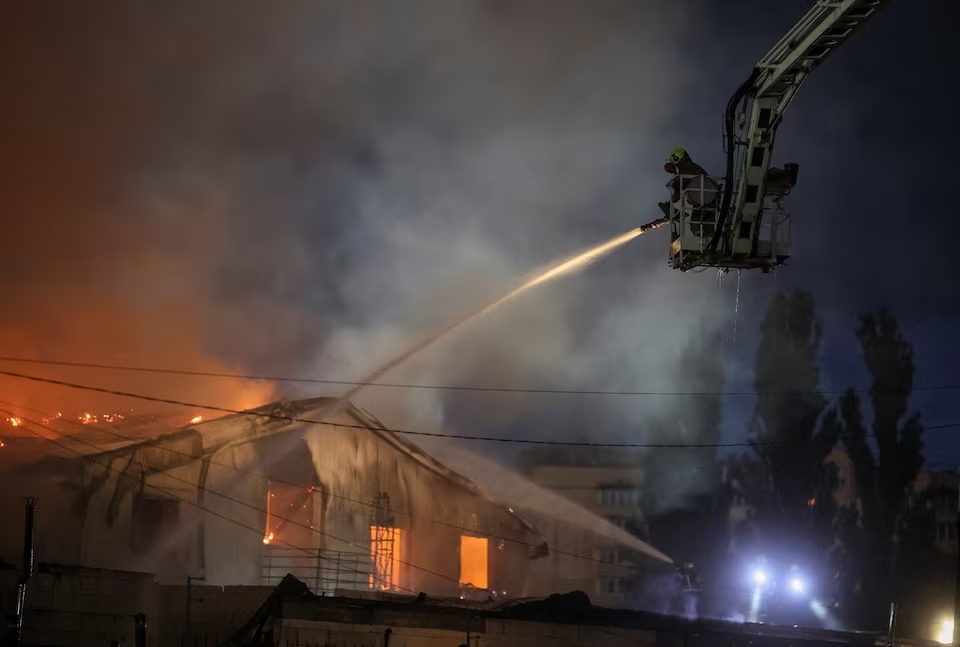
Reuters witnesses reported explosions tearing through Kyiv just before the air raid siren sounded. A woman was killed and two people were wounded in the overnight attack, authorities said.
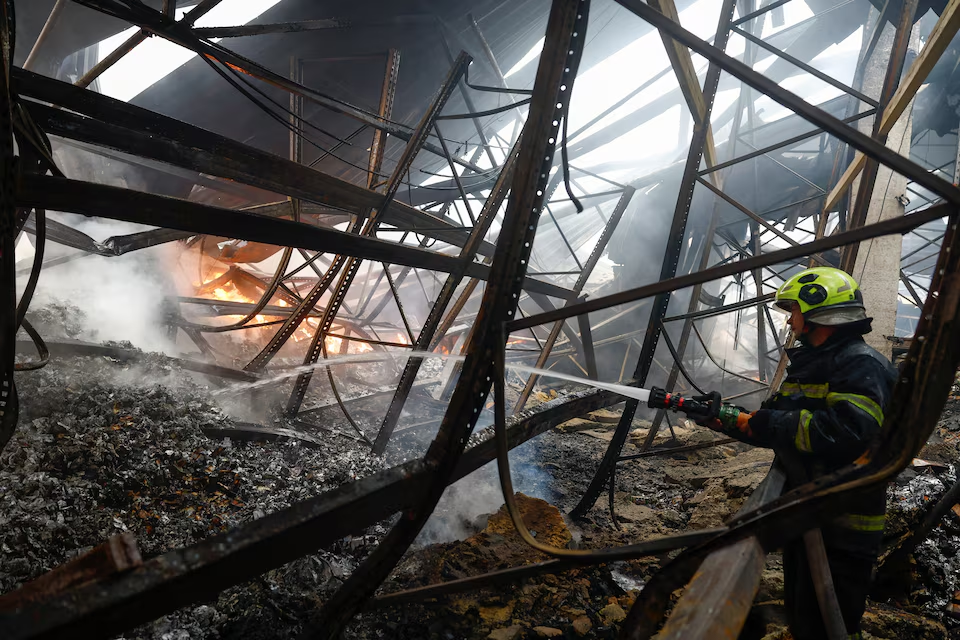
Kyiv Mayor Vitali Klitschko said the strikes ignited fires in a storage area and a non-residential building located in two districts on opposite sides of the Dnipro River. Reuters footage showed two warehouses engulfed in flames after the strikes, with firefighters working from crane ladder platforms into the morning to bring the fires under control.
Kharkiv, Ukraine’s second-largest city, also came under missile attack overnight, local officials said. The strikes damaged private homes and a church in the city. A separate missile strike on Wednesday hit a residential building in Kharkiv and killed two people, Mayor Ihor Terekhov said.
Zelenskiy has repeatedly pressed the United States to supply more interceptors capable of countering ballistic missiles, weapons whose high velocity and steep flight path make them difficult to intercept using conventional air defense systems. He is expected to raise the issue directly with Trump during their meeting at the Ankara summit Wednesday.
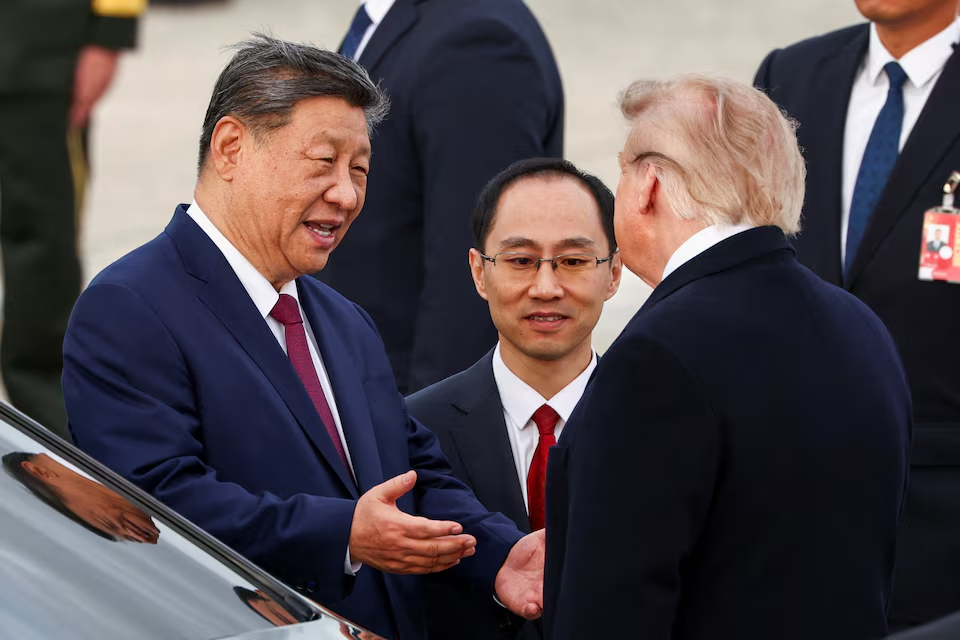
Trump, who spoke with both Zelenskiy and Russian President Vladimir Putin ahead of the summit, said Tuesday in Ankara that he believed the war could be “settled, hopefully soon.”
Putin has said he intends to continue the war despite mounting difficulties for Russian forces. Moscow has demanded that Kyiv cede the remainder of its eastern Donetsk region, territory Russian forces have failed to fully capture despite more than four years of fighting.
In Russia, Ukraine’s overnight drone attacks killed one person and damaged numerous industrial sites, according to local authorities.
The widening gap between Ukraine’s interceptor supply and Russia’s missile production has become a central point of tension as the war grinds into its fifth year. Ukrainian officials have warned for months that without a steady flow of Patriot interceptors and other systems capable of engaging ballistic targets, cities like Kyiv and Kharkiv will remain vulnerable to the kind of strikes that hit both this week. The numbers from July bear that out. A four-in-54 interception rate against ballistic missiles stands in sharp contrast to Ukraine’s success against drones, which its forces continue to intercept at a rate above 80%.
That disparity reflects the fundamental difference between the two threats. Drones travel slowly enough that a range of systems, from mobile air defense units to small arms fire, can engage them. Ballistic missiles move at speeds that only a narrow set of specialized interceptors can match, and Ukraine’s supply of those systems depends almost entirely on continued shipments from the United States and its allies.
The timing of this week’s strikes, arriving as Trump and Zelenskiy prepare to meet in Ankara, places additional pressure on the summit talks. Zelenskiy has used previous meetings with Trump to press for expanded weapons deliveries, and the renewed bombardment of Kyiv gives him fresh evidence to argue that Ukraine’s current stockpile cannot keep pace with Russian strikes. Trump’s own comments in Ankara, expressing hope that the war could be resolved soon, leave open the question of whether his administration will commit to the kind of sustained interceptor deliveries Zelenskiy has requested.
Putin’s position, meanwhile, has shown no sign of softening. His insistence on Ukraine surrendering the rest of Donetsk represents a territorial demand that Kyiv has rejected throughout the conflict, and Russian forces have continued pressing that claim despite the toll of more than four years of fighting. The continued missile strikes on Kyiv and Kharkiv, even as diplomatic talks proceed in Ankara, suggest Moscow sees no contradiction between pursuing negotiations and maintaining pressure on Ukrainian cities in the meantime.
For residents of Kyiv, the practical toll of this week’s attacks has been immediate. Klitschko’s account of fires breaking out simultaneously in districts on both sides of the Dnipro River points to strikes spread across a wide area of the capital, rather than concentrated on a single target. The scenes captured by Reuters, with firefighters still working from crane platforms into the morning hours, illustrate the scale of the response required after just one night of bombardment.
Whether Wednesday’s meeting between Trump and Zelenskiy produces any shift in the flow of interceptors to Ukraine remains to be seen. For now, the pattern established over the past week, repeated ballistic missile strikes on Kyiv met with almost no successful interceptions, shows no sign of changing.