


Russia launched one of its largest aerial assaults in recent months overnight, firing dozens of missiles and hundreds of drones at major Ukrainian cities, killing at least 11 people, injuring dozens more, and damaging one of Eastern Europe’s most important religious landmarks.
The attacks struck Kyiv, Kharkiv, Dnipro, and other regions, forcing civilians to spend hours in shelters as air raid sirens echoed across the country. Ukrainian officials said the strikes targeted both urban areas and critical infrastructure, while a fire at the historic Kyiv-Pechersk Lavra monastery complex shocked religious communities across Ukraine and beyond.
The latest wave of violence comes at a pivotal moment in global diplomacy. World leaders gathering for the G7 summit in France are already confronting major international crises, including the recently announced U.S.-Iran peace agreement. Ukrainian President Volodymyr Zelenskyy used the attack to renew calls for stronger international pressure on Moscow and additional military support for Ukraine.
As the war enters its fifth year, the strikes underscore how far prospects for a negotiated settlement remain from reality despite ongoing diplomatic efforts.
Kyiv Endures Hours of Fear and Destruction
Residents of the Ukrainian capital experienced another sleepless night as missiles and drones approached the city from multiple directions.
Witnesses described scenes of panic as explosions illuminated the sky and emergency alerts sounded throughout the night. Air defense systems worked continuously to intercept incoming threats, but falling debris and direct impacts still caused significant damage across the city.
Authorities reported that at least five people were killed in Kyiv and dozens more injured.
Emergency crews responded to multiple fires and damaged buildings throughout the capital. Roads were closed, power disruptions were reported in some districts, and rescue workers searched through debris for survivors as dawn broke over the city.
For many residents, the attack was a grim reminder that despite improvements in Ukraine’s air defenses, no major city remains fully protected from large-scale missile barrages.
Historic Kyiv-Pechersk Lavra Damaged in Attack
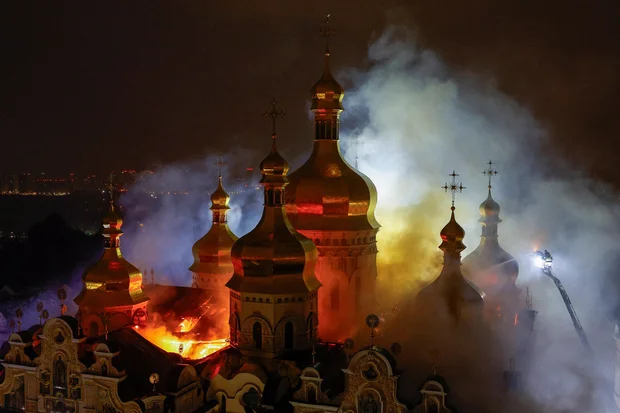
Among the most symbolic targets affected by the overnight strikes was the Kyiv-Pechersk Lavra, one of the oldest and most revered Orthodox Christian sites in the world.
A fire broke out within the monastery complex after debris struck the area, setting part of the Dormition Cathedral ablaze. Images from the scene showed smoke rising above the iconic golden-domed structure as firefighters worked to contain the flames.
The monastery, founded in the 11th century, is recognized as a UNESCO World Heritage Site and occupies a central place in the religious history of both Ukraine and Russia.
For centuries, it has served as a spiritual center for Orthodox Christianity, attracting pilgrims from across Eastern Europe.
President Zelenskyy condemned the damage, describing it as a severe attack on Christian cultural heritage.
“This is one of Russia’s most serious crimes against Christian culture,” he said in a statement following the attack.
The strike immediately drew international condemnation and renewed concerns about the destruction of cultural and religious landmarks during the conflict.
Russia and Ukraine Offer Competing Accounts
Russia acknowledged carrying out a large-scale military operation but denied deliberately targeting the monastery.
The Russian Defense Ministry said its forces had conducted what it described as a “massive strike” against military facilities in Kyiv, Kharkiv, and the Dnipro region.
Moscow claimed, without presenting evidence, that the monastery was struck by debris from a Ukrainian air defense missile rather than by a Russian projectile.
Ukraine rejected that explanation and accused Russia of attempting to shift responsibility for damage caused by its military campaign.
The dispute reflects a familiar pattern throughout the war, with both sides often presenting sharply different accounts of attacks and their consequences.
Independent verification of specific claims remains difficult in active conflict zones.
International Leaders Condemn the Attack
The damage to the Kyiv-Pechersk Lavra prompted strong reactions from European leaders.
French Foreign Minister Jean-Noel Barrot compared the strike to an attack on one of France’s most treasured religious landmarks.
“It is the equivalent of bombing Notre Dame,” he said, referring to the famous cathedral in Paris.
French President Emmanuel Macron also condemned the assault, arguing that attacks on cultural and religious sites only strengthen international support for Ukraine.
European Union leaders attending the G7 summit echoed those sentiments and signaled that additional discussions on sanctions and military assistance would likely take place.
European Commission President Ursula von der Leyen said leaders would focus on increasing pressure on Russia and supporting efforts to bring the conflict closer to a negotiated settlement.
Massive Scale of the Aerial Assault
According to Ukraine’s Air Force, Russia launched 70 missiles and 611 drones during the overnight operation, making it one of the largest combined aerial attacks of the year.
Ukrainian forces reported intercepting 50 missiles and 582 drones before they reached their intended targets.
Military analysts noted that the attack reflects Moscow’s continued reliance on large-scale missile and drone campaigns designed to overwhelm air defense systems.
By launching hundreds of aerial threats simultaneously, Russia aims to increase the likelihood that some projectiles penetrate defensive networks and reach strategic targets.
Despite Ukraine’s success rate in interceptions, the sheer volume of incoming weapons continues to place enormous pressure on air defense units across the country.
Zelenskyy responded by urging Western allies to accelerate deliveries of advanced missile defense systems and anti-ballistic capabilities.
Religious Significance Deepens Public Anger
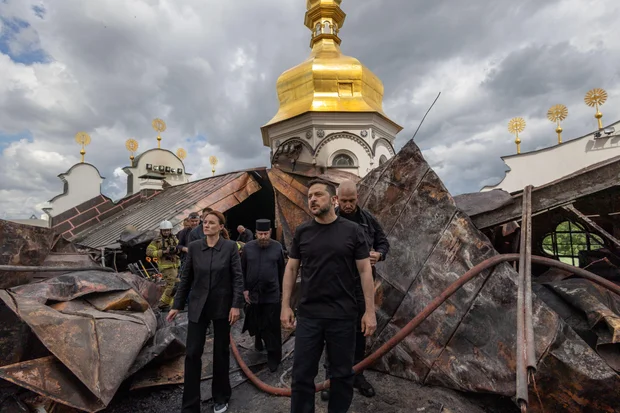
The attack on the monastery has resonated deeply within Ukraine because of the site’s religious and historical importance.
The Kyiv-Pechersk Lavra is regarded as one of the birthplaces of Orthodox Christianity in Eastern Europe.
Its underground cave system contains relics of numerous saints and has been a destination for worshippers for nearly a thousand years.
The Dormition Cathedral itself carries a powerful history. The structure was largely destroyed during World War II and rebuilt in the years following Ukraine’s independence.
Many Ukrainians view the latest damage not only as an attack on a building but also as an assault on national identity and cultural heritage.
Museum worker Natalia Korol, speaking near the site, expressed outrage over the attack.
“It is a shrine,” she said. “You cannot strike shrines.”
Ukraine Continues Cross-Border Drone Campaign
The violence was not limited to Ukrainian territory.
Russian officials reported that a Ukrainian drone strike killed three people and injured three others in the city of Tula, located south of Moscow.
Ukraine has increasingly expanded its long-range drone operations inside Russia in recent months.
Kyiv argues that these attacks are aimed primarily at military installations, fuel depots, and energy infrastructure that help finance and sustain Russia’s war effort.
The growing reach of Ukrainian drone capabilities has added a new dimension to the conflict, bringing the consequences of the war deeper into Russian territory.
Diplomatic Efforts Overshadowed by Renewed Fighting
The attacks occurred just hours after international attention shifted toward the announcement of a U.S.-Iran peace agreement and after separate conversations between President Donald Trump, Zelenskyy, and Russian President Vladimir Putin concerning the ongoing war.
The timing highlighted the challenge facing diplomats attempting to end Europe’s largest conflict since World War II.
Since Russia launched its full-scale invasion in February 2022, the war has claimed thousands of civilian lives and caused immense destruction across Ukraine.
Hundreds of thousands of soldiers on both sides are believed to have been killed or wounded, while millions of Ukrainians have been displaced.
Despite periodic discussions about ceasefires and negotiations, neither side has shown a willingness to abandon its core objectives.
War Shows No Sign of Immediate End
As rescue workers cleared debris from Kyiv’s damaged monastery and residents surveyed the destruction left behind, the latest attack reinforced a difficult reality: the conflict remains far from resolution.
The overnight barrage demonstrated Russia’s continued ability to launch large-scale strikes despite years of sanctions and battlefield setbacks. At the same time, Ukraine’s growing drone campaign illustrates Kyiv’s determination to carry the fight beyond its borders.
With international leaders gathering to discuss the future of global security, Ukraine hopes the attack will galvanize additional support.
For now, however, the war continues to exact a heavy toll on civilians, historic landmarks, and the broader stability of Europe, with no immediate breakthrough in sight.