
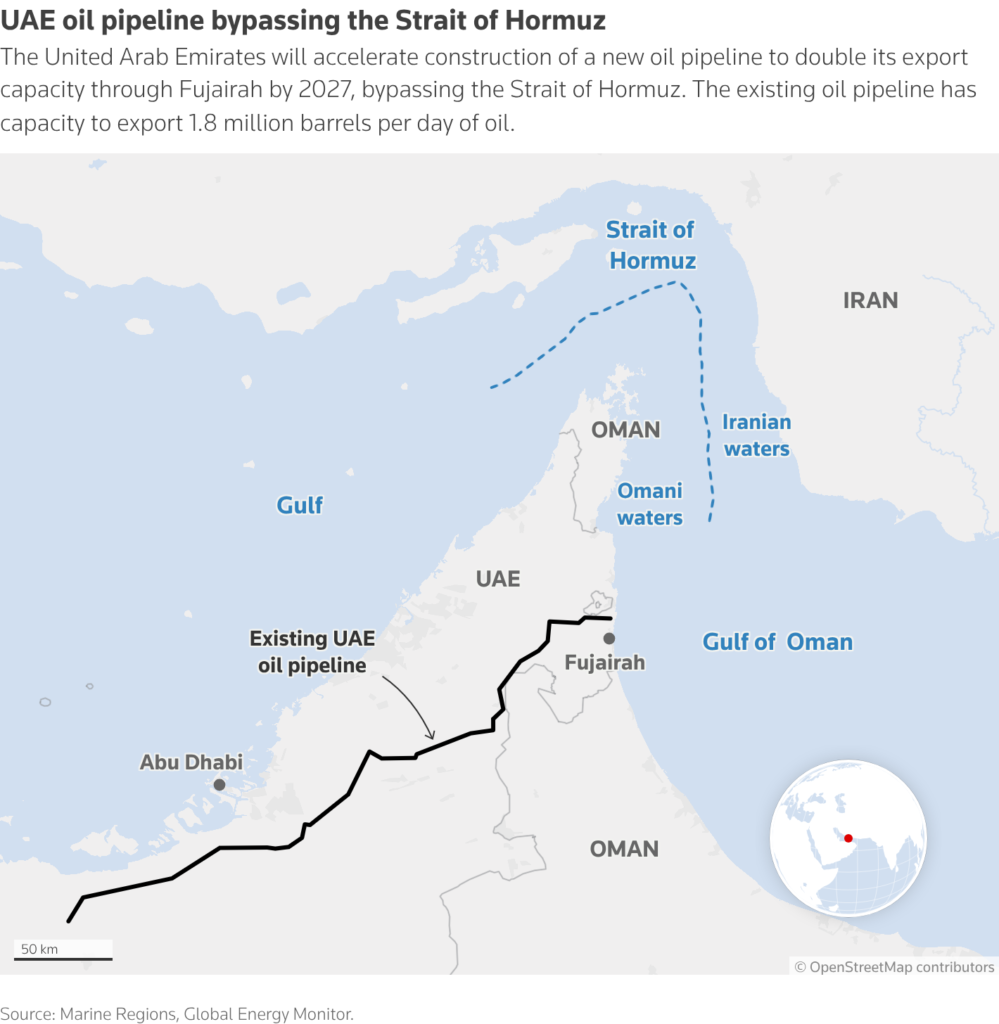
The United Arab Emirates is accelerating construction of a major oil pipeline designed to significantly increase the country’s export capacity outside the Strait of Hormuz, as regional tensions and security threats continue to disrupt global energy markets.
According to the Abu Dhabi Media Office, UAE President Sheikh Mohamed bin Zayed’s executive committee, led by Crown Prince Sheikh Khaled bin Mohamed bin Zayed, has directed the Abu Dhabi National Oil Company (ADNOC) to speed up work on the new West-East Pipeline project. The pipeline is expected to begin operations next year and could double the country’s oil export capacity through the port of Fujairah by 2027.
The move highlights growing concern among Gulf nations about the vulnerability of energy shipments passing through the Strait of Hormuz, one of the world’s most critical maritime trade routes.
Rising Regional Tensions Drive Urgency
The UAE’s decision comes amid escalating instability linked to the ongoing Iran conflict, which has transformed the strategic importance of alternative export routes in the Gulf region.
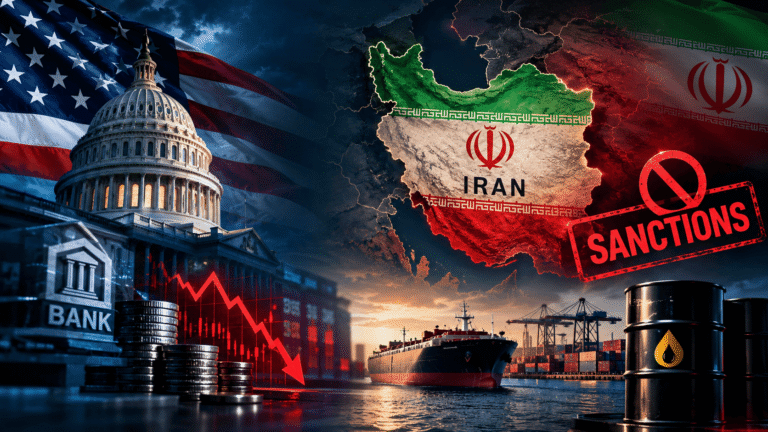
Since the outbreak of the war earlier this year, Iran has expanded its claims over maritime zones near the Strait of Hormuz. Tehran’s Islamic Revolutionary Guard Corps (IRGC) Navy released maps in May outlining a significantly larger “operational control area” stretching across parts of the Gulf of Oman and near the UAE coastline.
The developments have alarmed regional governments and global energy traders alike. The UAE has accused Iran-backed forces of targeting energy infrastructure, including attacks on an ADNOC tanker and Fujairah’s oil facilities earlier this year.
Abu Dhabi condemned the incidents as acts of economic coercion and warned that continued attacks threaten global energy security and international trade.
Fujairah Emerging as a Strategic Energy Hub
Fujairah, located on the Gulf of Oman outside the Strait of Hormuz, has become increasingly important to the UAE’s long-term energy strategy. Unlike ports inside the Gulf, Fujairah allows tankers to bypass the narrow and politically sensitive waterway that handles nearly one-fifth of the world’s oil shipments.
The UAE already operates the Abu Dhabi Crude Oil Pipeline (ADCOP), commonly known as the Habshan-Fujairah pipeline, which can transport up to 1.8 million barrels of crude oil per day directly to Fujairah.
The new West-East Pipeline is expected to dramatically expand that capacity, giving the UAE greater flexibility to maintain exports even during regional disruptions.
Energy analysts say the project could strengthen the UAE’s position as one of the few Gulf producers capable of exporting substantial oil volumes without relying entirely on Hormuz.
Strait of Hormuz Crisis Reshapes Energy Markets
The conflict in the Gulf has severely disrupted shipping activity through the Strait of Hormuz since late February, when military tensions escalated following attacks involving Iran, the United States and Israel.
The near-closure of the waterway has sent global energy prices soaring, while fears of prolonged disruption have increased concerns about inflation, fuel shortages and slower economic growth worldwide.
Several countries have introduced fuel rationing measures, and oil producers across the Middle East have been forced to adjust export strategies.
The UAE and Saudi Arabia remain the only Gulf producers with large-scale pipelines capable of bypassing Hormuz entirely. Other regional exporters — including Kuwait, Iraq, Qatar and Bahrain — still depend heavily on the strait for crude shipments.
Saudi Arabia has also relied heavily on its East-West pipeline, which transports crude from the Gulf to the Red Sea port of Yanbu. Saudi Aramco recently increased the line’s capacity to help maintain exports during the crisis.
UAE Gains Greater Freedom After Leaving OPEC
The pipeline expansion also comes shortly after the UAE formally exited the Organization of the Petroleum Exporting Countries (OPEC), ending years of production quota restrictions.
Freed from output limits, the UAE has signaled plans to rapidly increase production capacity in response to global supply concerns and growing demand from Asian markets.
ADNOC has already been pursuing an ambitious expansion strategy aimed at boosting production capacity to 5 million barrels per day by next year. Before the conflict disrupted operations, the UAE was producing close to 3.4 million barrels daily.
However, shipping restrictions and security threats in the Gulf forced ADNOC to temporarily reduce some production earlier this year.
Executives at ADNOC Drilling have indicated the company is prepared to support further production increases if necessary.
Security Concerns Continue Around Key Ports
Despite Fujairah’s strategic value, the port itself has increasingly become a target amid regional hostilities.
The UAE has blamed Iran-linked attacks for several recent disruptions at Fujairah and nearby Khor Fakkan, both of which are vital for oil exports and broader trade. The facilities are also crucial for the country’s food imports and logistics operations.
Reports have emerged of oil tankers navigating the Strait of Hormuz with tracking systems disabled in an attempt to avoid potential attacks while transporting crude trapped inside the Gulf.
The growing risks have intensified calls for alternative infrastructure and stronger maritime security arrangements across the region.
A Long-Term Shift in Gulf Energy Strategy
The UAE’s accelerated investment in export infrastructure reflects a broader shift in Gulf energy policy as producers seek greater resilience against geopolitical instability.
By expanding routes outside Hormuz, Abu Dhabi aims to secure its role as a reliable global supplier even during periods of regional conflict.
For international energy markets already strained by supply disruptions and rising prices, the success of the UAE’s pipeline strategy could play a critical role in stabilizing future oil flows from the Gulf.