

U.S. retail sales posted another solid increase in April, marking the third consecutive month of growth as American consumers continued spending despite mounting inflationary pressures linked to the ongoing conflict involving Iran. However, economists warn that much of the increase reflects higher prices rather than stronger purchasing power, raising concerns about the sustainability of consumer spending in the months ahead.
New economic data released Thursday painted a mixed picture of the American economy. While households continued to spend on goods, dining and online shopping, inflation surged sharply, eroding wage gains and increasing pressure on family budgets. Analysts say the current resilience in consumer spending is being temporarily supported by larger tax refunds and strong financial markets, but those buffers may soon begin to fade.
Retail Sales Rise for Third Straight Month
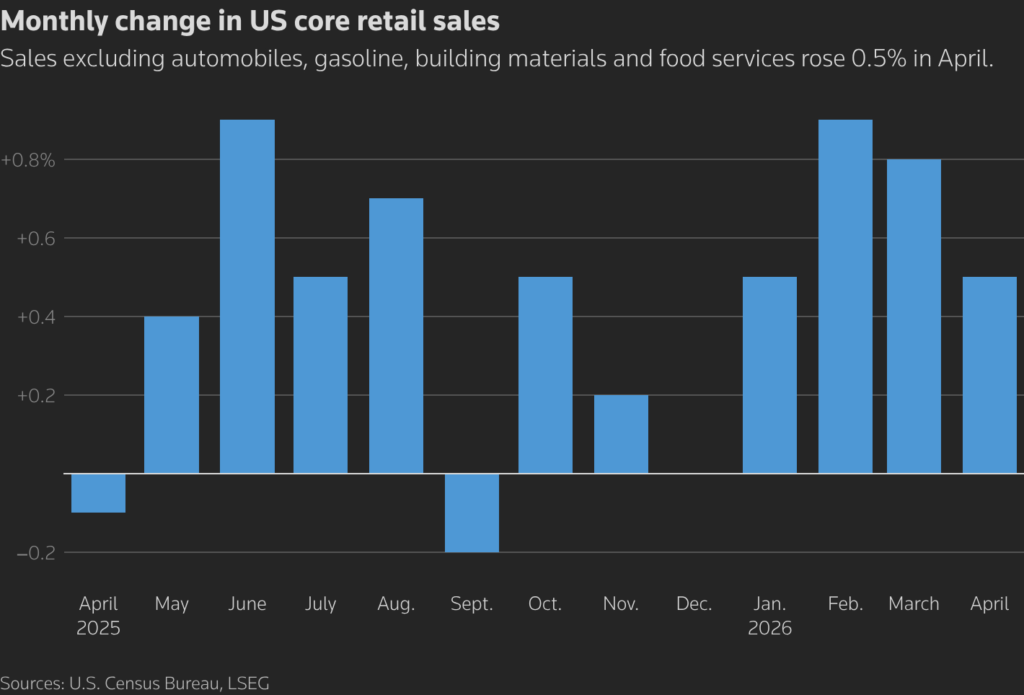
According to the Commerce Department’s Census Bureau, retail sales rose 0.5% in April following a revised 1.6% increase in March. The latest gain matched economists’ expectations and reflected continued momentum in consumer activity despite growing economic uncertainty.
On an annual basis, retail sales increased 4.9% compared to April last year. Yet after adjusting for inflation, economists estimate that real retail spending may have actually slipped slightly during the month, highlighting how rising prices are inflating headline figures.
Retail sales data are not adjusted for inflation and primarily measure spending on goods rather than services. As a result, analysts say the latest numbers must be viewed in the context of rapidly rising costs for fuel, imported goods and essential commodities.
Iran Conflict Fuels Inflation Surge
A key driver behind the rising prices has been the ongoing conflict involving Iran, which has disrupted shipping routes through the Strait of Hormuz — one of the world’s most important energy corridors.
The instability in the region has pushed up prices for crude oil, fuel, fertilizer, aluminum and other commodities critical to global supply chains. Energy costs, in particular, have risen sharply in recent months, feeding broader inflation across the U.S. economy.
Government data released earlier this week showed consumer prices accelerated strongly for a second consecutive month in April, with annual inflation reaching its highest level in three years.
Imported inflation has also intensified. Separate data from the Labor Department showed import prices rose 1.9% in April, the fastest monthly increase since March 2022. Compared with a year earlier, import prices surged 4.2%, reflecting broad-based increases in fuel, food and industrial goods.
Fuel imports recorded especially dramatic gains, jumping 16.3% during the month after a 10% increase in March. Economists say the sharp rise in imported energy costs is feeding directly into transportation, manufacturing and consumer prices across the economy.
Consumers Still Spending Despite Rising Costs
Even with inflation climbing, American consumers continued spending across several sectors in April.
Electronics and appliance stores recorded a 1.4% rise in sales, while nonstore retailers — including online shopping platforms — posted a 1.1% increase. Gasoline station receipts also climbed 2.8% as higher fuel prices pushed up overall spending at the pump.
Discretionary spending remained surprisingly resilient as well. Sporting goods, hobby, musical instrument and book stores experienced a notable rise in sales, suggesting many consumers are still willing to spend on leisure and entertainment activities despite economic concerns.
Restaurants and bars also saw moderate growth, with food services and drinking places reporting a 0.6% increase in receipts. Economists closely monitor dining activity because it is often viewed as a key indicator of household financial confidence.
Still, analysts caution that rising spending does not necessarily signal strong financial health. Much of the growth reflects higher prices rather than increased consumption volumes.
Tax Refunds and Stock Gains Offer Temporary Relief
One factor helping households manage rising prices has been larger federal tax refunds this year. According to Internal Revenue Service data, the average tax refund through late April was more than $300 higher than during the same period last year.
Combined with gains in financial markets earlier this year, those refunds have provided a temporary financial cushion for many families struggling with inflation.
However, economists say the support may not last much longer.
Analysts at several financial institutions report that lower-income households are spending their refunds more quickly than in previous years, often using the money for everyday expenses rather than paying down debt or increasing savings.
“Consumers are drawing down refunds at a faster pace, especially among lower-income groups,” one economist noted. “That reduces the protective buffer against future inflation pressures.”
Inflation Now Outpacing Wage Growth
For the first time in three years, inflation in April exceeded wage growth, signaling growing strain on household purchasing power.
Although the labor market remains relatively stable and layoffs are still historically low, rising living costs are beginning to offset income gains for many workers.
The Labor Department reported that first-time applications for unemployment benefits rose slightly last week, though overall claims remain at manageable levels.
At the same time, several retail categories linked to discretionary or higher-ticket purchases weakened noticeably. Sales at clothing stores fell 1.5%, while furniture and home furnishing retailers recorded a 2% decline. Auto dealership sales also slipped modestly during the month.
Economists say these declines may signal that consumers are becoming more cautious as inflation pressures intensify.
Core Spending Shows Signs of Slowing
A closely watched measure known as “core retail sales,” which excludes automobiles, gasoline, building materials and food services, rose 0.5% in April after a stronger increase in March.
Because core retail sales closely align with the consumer spending component of gross domestic product (GDP), the figures are often viewed as a key indicator of broader economic momentum.
However, after adjusting for inflation, economists estimate core retail spending rose only slightly in real terms, suggesting actual consumer demand may be slowing.
Consumer spending accounts for more than two-thirds of the U.S. economy, making its trajectory critical for future economic growth. Growth in household spending has already cooled in recent quarters, slowing from strong expansion rates recorded in 2025.
Federal Reserve Expected to Hold Rates Higher for Longer
The latest inflation data have strengthened expectations that the Federal Reserve will keep interest rates elevated for an extended period.
Financial markets now widely anticipate the central bank will maintain benchmark rates within the current range through at least 2027 as policymakers attempt to contain inflation without triggering a severe economic slowdown.
Higher borrowing costs are already weighing on housing, credit markets and business investment. Economists warn that prolonged high rates combined with stubborn inflation could eventually slow consumer demand more sharply.
Uncertain Outlook Ahead
While the U.S. consumer has so far demonstrated resilience, economists increasingly believe spending momentum may weaken later this year as inflation continues to erode purchasing power and temporary financial supports disappear.
The combination of elevated fuel prices, geopolitical instability, higher import costs and tighter monetary policy is creating growing uncertainty for both households and businesses.
For now, retail activity remains steady, but analysts say the coming months will determine whether American consumers can continue powering the economy amid one of the most challenging inflationary environments in recent years.