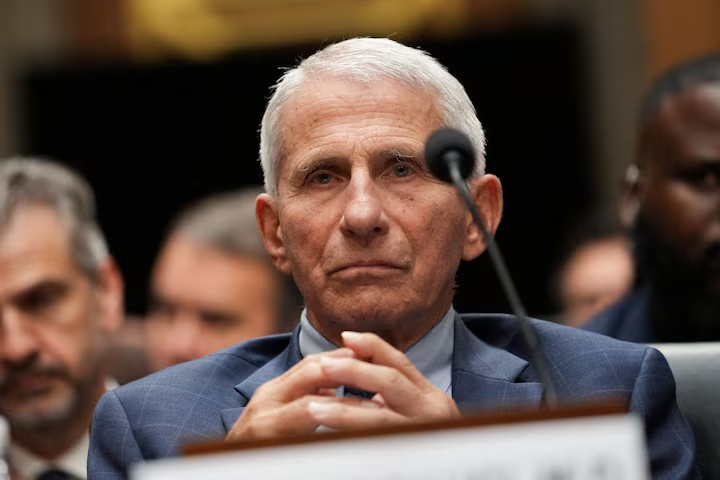
A Senate committee voted along party lines Thursday to hold Dr. Anthony Fauci in contempt of Congress, escalating a Republican-led push to force the former top infectious disease official to answer questions about his handling of the COVID-19 pandemic.
The Homeland Security and Governmental Affairs Committee approved the contempt referral 8-7, with every Republican voting in favor and every Democrat against. The move follows a hearing last week in which Fauci, 85 and retired since 2022, declined to answer more than 100 questions by invoking his Fifth Amendment right against self-incrimination.
Committee Chair Rand Paul, a Kentucky Republican and one of Fauci’s most persistent critics in Congress, pushed for the referral as part of a multi-year investigation into the origins of the coronavirus. Paul and other Republicans have long argued that Fauci concealed information about how the virus emerged and misled the public about the government’s pandemic response.
The vote lands amid a wider effort by the Trump administration and congressional Republicans to revisit decisions made during the pandemic and assign blame to the officials who directed it. Health Secretary Robert F. Kennedy Jr., who has restructured federal health agencies around skepticism of pandemic-era science, has cast his changes as a response to what he describes as coercive public health mandates. Kennedy and Paul have both written books criticizing Fauci directly.
Democrats push back
Democrats on the committee introduced five separate motions to delay the vote, and each failed along party lines. One motion, brought by ranking member Gary Peters of Michigan, would have required Paul to commit to sending any referral through a full Senate vote rather than routing it directly to the Justice Department.
Peters described the underlying investigation as rushed and one-sided, arguing that punishing a witness for asserting a constitutional right would damage the committee’s credibility. Democrats also said they had been denied sufficient access to documents related to the probe, an accusation Paul disputed.
Fauci led the National Institute of Allergy and Infectious Diseases for 38 years and became the public face of the U.S. pandemic response, a role that made him a lightning rod for criticism as COVID-19 killed more than 1.1 million Americans nationwide. President Trump and many conservatives attacked his guidance on lockdowns, masking and social distancing, along with his backing of vaccines, even though public health agencies worldwide endorsed those same measures based on the scientific evidence available at the time.
David Schertler, an attorney representing Fauci, dismissed the contempt vote as political theater. “A crude political stunt intended to punish Dr. Fauci for exercising his constitutional rights,” Schertler said, calling on the full Senate to reject what he termed a “meritless and politically motivated contempt resolution.”
Schertler pointed to Paul’s public statements over the years as evidence of personal animus. “For years, Senator Paul has proclaimed to anyone who would listen that Dr. Fauci should be prosecuted and put in prison,” he said. “Dr. Fauci has committed no crime, and Senator Paul knows it.”
Pardon complicates legal picture
Former President Joe Biden issued Fauci a preemptive pardon in January 2025, intended to shield him from what Biden’s administration called unjustified and politically motivated prosecution tied to his COVID-19 role. That pardon does not extend to any conduct after it was granted.
Paul has argued the pardon undercuts Fauci’s Fifth Amendment claim entirely, reasoning that a person already immune from prosecution for past conduct has nothing left to incriminate himself on. Paul has also contended that Fauci waived any remaining protection simply by choosing to testify at last week’s hearing.
Fauci told the committee that Paul had summoned him only to manufacture testimony that would support the senator’s repeated public statements calling for his imprisonment.
New details emerged Wednesday night when the Wall Street Journal reported that the committee had obtained a backup copy of Fauci’s iPhone covering his time as NIAID director, including the period in 2020 when he helped lead the first Trump administration’s pandemic response. Senator Ron Johnson of Wisconsin, who chairs the committee’s Permanent Subcommittee on Investigations, told the Journal his office had obtained the backup, which the Department of Health and Human Services had transferred to the committee.
What happens next
A contempt referral ordinarily requires approval from both the originating committee and the full Senate, where passage would likely need 60 votes. That threshold would require Democratic support, which appears unlikely given the party’s near-unanimous defense of Fauci throughout the process.
Paul has signaled he may try to bypass that step. He told Fox News he could send the contempt referral directly to the Justice Department along with a legal brief, without waiting for a floor vote. His office did not respond to a request for comment on the plan.
If the referral does reach the Justice Department, it would fall to the U.S. Attorney’s Office in Washington, currently led by Trump ally Jeanine Pirro, to decide whether to pursue a grand jury indictment.
Congress is not the only venue where Fauci faces legal exposure. West Virginia recently joined Louisiana, Florida and Alabama in opening state-level investigations into his conduct during the pandemic. Because Biden’s pardon applies only to federal charges, it offers no protection against prosecution at the state level.
The committee’s action marks one of the most direct moves yet by Republicans to hold a former pandemic official personally accountable through the contempt process, and it sets up a test of how far GOP lawmakers are willing to push the case without Democratic cooperation in the Senate.