Clicxpost

Africa

EU Commits €11.5 Billion Investment in South Africa for Green Energy, Infrastructure, and Health Development

EU Commits €11.5 Billion Investment in South Africa

The European Union (EU) unveiled a record €11.5 billion ($13.3 billion) package of investment to support South Africa in transitioning to a greener and more resilient economy. The investment, made public on Thursday, will be used for renewable energy projects, the modernization of infrastructure, and the manufacture of pharmaceuticals, the largest EU financial commitment to an African nation in years.

A great deal of the investment is aimed at helping Africa’s most industrialized economy shift away from coal dependence to green and sustainable energy. Projects aimed at renewable power generation, upgrade of the grid network, energy storage facilities, and developing a green hydrogen economy are part of the strategy, which would make South Africa a regional clean energy export hub.

Powering South Africa’s Green Transition

South Africa, on which it is currently relying on coal to produce over 80% of its electricity, has been facing a chronic energy crisis characterized by rolling blackouts, stagnant economic growth, and rising unemployment. The EU investment is under its Global Gateway Initiative, a strategic initiative that seeks to boost sustainable development and counter China’s ever-growing footprint on the continent through its Belt and Road projects.

According to the EU press release, part of the funding will go towards the Coega Green Ammonia Project—a flagship project that aims to meet the growing global demand for green ammonia, a critical ingredient in fertilizers, mining processes, and the production of clean chemicals. The Eastern Cape-based Coega project is expected to create thousands of jobs and enable further private investment, and thus become a foundation of South Africa’s green industrial revolution.
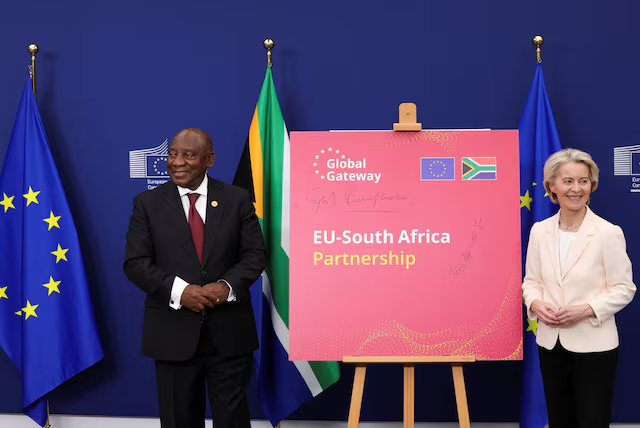
European Commission President Ursula von der Leyen emphasized the partnership’s strategic value, stating that “Europe stands with South Africa as it moves toward a sustainable, inclusive future. Our investments will help unlock green energy potential, strengthen healthcare manufacturing, and drive innovation that benefits the entire continent.”

Strengthening Africa’s Pharmaceutical Autonomy

In addition to energy, the EU funding will also boost the capacity of South Africa to manufacture pharmaceuticals, such as vaccines and biotechnology. This is targeted at building indigenous and regional capacity to manufacture vaccines and strategic medicines for the African market to reduce importation and enhance healthcare resilience on the continent.

South Africa played a key role in the COVID-19 pandemic with the Aspen Pharmacare plant that produced vaccines that were supplied within Africa. The new investment seeks to build on that success by establishing new value chains and regional research partnerships.

Economic and Political Context

The EU investment pledge coincides with the fact that the economy of South Africa is subjected to various challenges, namely, increasing unemployment (well over 32%), decreasing foreign investment, and the effects of recent U.S. trade policy actions.

U.S. President Donald Trump introduced 30% tariffs against South African exports in August, citing trade imbalances and industrial subsidy issues. The move was a severe blow to the country’s export-focused industries, including metals, auto parts, and agricultural produce. The expiration of the impact of a considerable U.S.-Africa trade agreement on September 30 has yet again compounded the intricacy of the country’s export scenario.

South African authorities are currently in talks with Washington to cut or eliminate the tariffs, claiming they risk destabilizing economic stability and regional trade links.

Pretoria has also been trying to woo foreign investors to revive growth via public-private collaborations, energy and mining sector reforms, and incentives for clean technology development.

Continuity or Expansion of Previous Pledges

It is not certain whether the newly announced €11.5 billion investment is in addition to or on top of the €4.7 billion which President von der Leyen committed to in March 2025 when she travelled to South Africa. That earlier commitment was largely for the purposes of guaranteeing the Just Energy Transition Partnership (JETP)—a multilateral coalition of the EU, the U.S., the U.K., and other stakeholders to support South Africa in its decoupling from coal and its net-zero emissions economy by 2050.

Experts interpret this new EU funding as proof of European renewed confidence in South Africa’s long-term energy transformation program and strategic counterweight to both American tariff pressure and China’s increased presence in African infrastructure projects.

Looking Ahead: A New Chapter in EU-Africa Cooperation

The new financing deal is a possible watershed for EU-Africa relations, and it is the latest acknowledgment by Europe of Africa’s role in the global energy transition. The enormous renewable resources—particularly solar, wind, and green hydrogen potential—of South Africa make it set to be a significant supplier to the future clean energy economy.

If managed successfully, the investment would help plug South Africa’s chronic energy gap, unlock industrial diversification, and stimulate job creation in high-tech and green sectors.

However, experts warn that administrative delays, corruption risks, and infrastructure bottlenecks could slow its progress. It will require good governance, cooperation between the state and private sector, and adequate project delivery timelines to function.

Conclusion

The €11.5 billion commitment by the EU is not only a money proposition — it’s a vote of confidence in South Africa’s ability to spearhead Africa’s transition to green. Barring short-term roadblocks presented by U.S. tariffs and internal challenges, this partnership could unlock the door to a more resilient, creative, and greener South African economy and be attuned to global climate and development goals.
RECOMMENDED
Africa

Heavy rains lead to Senegal floods, government reports several deaths

By George Mensah 3 min read

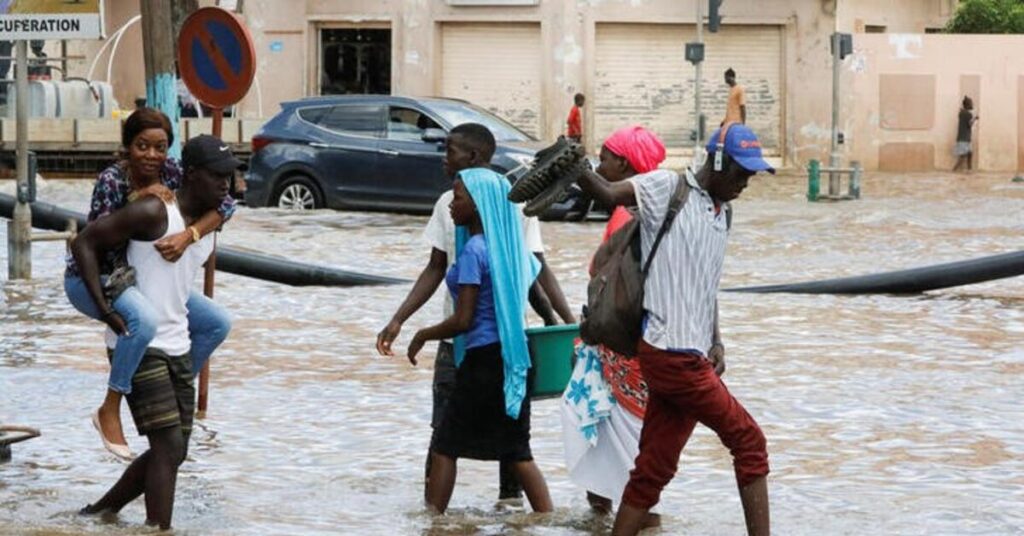
Heavy rain flooded roads and destroyed buildings across Senegal over the weekend, and the government said several people were killed and that more rain is coming. Flash floods in the capital, Dakar, and other areas disrupted traffic, and Prime Minister Ahmadou Al Aminou Lo warned that the school year, due to start this week, could be postponed if the water does not recede.

The floods come less than four weeks before Dakar hosts the 2026 Summer Youth Olympics, which start on October 31.

Deaths reported in Dakar and Matam

Senegal’s Interior Ministry reported deaths and injuries in Dakar and in Matam, a town in the northeast. It said a building collapsed in Kaolack, a town in the south. The reports did not give a death toll.

Local media reported that a mother and her child died in the Parcelles Assainies area of Dakar after their home flooded.

More rain forecast for Monday to Wednesday

Lo said there is a high probability of more rain on Monday, Tuesday and Wednesday. The forecast covers the same days on which many families would be preparing children for the start of term.

He said the school year could be postponed if floodwaters have not receded. The government has not yet announced a new date.

How much rain fell

Senegal’s meteorological agency, ANACIM, published rainfall totals for 24 hours. Rufisque, a town just outside Dakar, and Ranerou, in the Matam region, each recorded 142 mm. Dakar’s Yoff district recorded 138 mm.

The two places with the highest totals are about as far apart as two parts of the country can be, which suggests the rain covered a wide area and was not limited to the capital.

For comparison, after floods in Dakar in 2020, then-Water Minister Serigne Mbaye Thiam said 124 mm of rain had fallen, about what the city normally gets over the whole rainy season from July to September. The measuring stations and years differ, so the figures are not an exact match. Even so, both totals reported this weekend are above that 2020 number, and they were recorded within one day.

The Youth Olympics clock

Senegal is preparing to host the first Youth Olympic Games ever held in Africa. The event runs from October 31 to November 13, 2026.

The government expected flooding to be a risk for the event. On July 3, Lo chaired an interministerial meeting on flood preparedness and management, and the government approved measures to protect the venues and infrastructure. A dedicated task force was set up to handle flooding and waste at competition and accommodation sites, according to Ecofin Agency

That work followed Law No. 2026-381 of May 19, 2026, which strengthens the role of local authorities in flood prevention and management. The law is not specific to the Games. The task force works with the organising committee and the International Olympic Committee’s coordination commission.

This weekend’s rain is the first major test of those plans. The reports so far do not say whether any Olympic venues were affected, so that question remains open.

A problem that comes back each year

Floods in Dakar are not new. In 2020, the government faced criticism over a slow response to flooding that killed at least six people. A local resident told FRANCE 24 at the time that every flood brings food rations, but that what residents need is drainage and sanitation.

Dakar has a record of flooding after heavy local downpours, according to a European Space Agency hazard map, which classes the risk using flood events over the past 10 years. This weekend adds another event to that record.

What happens next

Three things will show how serious the situation is. The first is the rainfall on Monday, Tuesday and Wednesday, and whether floodwater drains from the streets of Dakar and Matam. The second is the government’s decision on the start of the school year. The third is whether the Interior Ministry publishes a full death toll and the number of damaged buildings.

With the Youth Olympics less than four weeks away, how quickly Dakar’s roads reopen will also be watched by organisers, athletes and visitors planning to travel.

Africa

Ethiopia Retakes Mekelle Airport as Tigray Fears War’s Return

By George Mensah 4 min read

Ethiopia’s federal military has recaptured the main airport in Mekelle, the capital of the northern Tigray region, three sources told Reuters on Saturday, October 3. If confirmed, the move is a major setback for an opposition alliance in its stronghold. Reuters could not verify the claim, and the region’s ruling party, the Tigray People’s Liberation Front (TPLF), could not be reached for comment.

The airport is Alula Aba Nega Airport, about 10 km (6 miles) from the centre of Mekelle. It was one of three airports in Tigray that opposition forces seized when fighting began on September 23. That fighting is the most serious escalation of violence in northern Ethiopia since the 2020-2022 civil war.

What the three sources said

One source with knowledge of events in the city and a humanitarian source told Reuters that troops from the Ethiopian National Defence Forces had regained control of the airport. A third source, a Mekelle resident who asked not to be named for security reasons, confirmed that government forces took it. This resident said gunfire could be heard outside the city centre.

The resident also described scenes inside the city. Some Tigrayan Defence Force fighters were leaving their posts and heading home, the resident said, and government facilities were being looted.

A source close to the TPLF told Reuters that government troops and allied militias had encircled the city.

AFP, citing a local journalist and residents, reported that TPLF fighters and leaders were seen leaving Mekelle. The journalist told AFP that federal forces had not yet been seen inside the city. Al Jazeera reported that media access in Ethiopia is heavily restricted and that communications blackouts have limited reporting. Those limits are the context for why the accounts so far rest on anonymous sources.

How the fighting reached Mekelle

Last month, rebels announced a seven-party coalition led by the TPLF, the same group that fought federal forces in the 2020-2022 war, according to Al Jazeera. The coalition began an offensive that seized three airports in Tigray. It also engaged in fighting on the borders with the Amhara and Afar regions.

The government is now mounting a counteroffensive, Al Jazeera reported, citing the Critical Threats Project at the American Enterprise Institute. That project says federal forces are pushing into Tigrayan territory along three routes toward Mekelle. Al Jazeera’s bureau chief in Ethiopia, Mohammed Taha Tawakel, reported on Friday that forces loyal to the federal government had taken several towns and were closing in on the city.

Al Jazeera reported that fighting is also raging in the Amhara and Afar regions, so the conflict is not confined to Tigray. AFP photographed TPLF members walking along a main road in Mekelle on September 23, the first day of the fighting.

A wider regional dispute

The fighting has raised fears of a wider conflict that could draw in neighbouring countries in the Horn of Africa and the Gulf, Reuters reported. The federal government in Addis Ababa cut diplomatic ties with Eritrea this week. It accused Eritrea of backing the rebel alliance, along with Sudan and Egypt. All three countries deny the accusation. Reuters published an analysis this week on why renewed fighting in Tigray risks a regional war.

The accusation matters because of what the 2022 Pretoria peace agreement required. That deal, which ended the earlier war, obliged the TPLF to disarm. It also called for the withdrawal of Eritrean and other non-federal forces from Tigray and for humanitarian access to the region, according to Newsy Today. The accusation against Eritrea therefore touches the terms of the agreement that ended the last war.

What history suggests

Analysts told Reuters that taking Mekelle would be unlikely to end the conflict on its own. The 2020 war shows why. Federal forces captured Mekelle within the first month of that war, and the TPLF took it back seven months later.

Taking the airport is also a different step from holding the city. AFP’s local journalist reported that federal forces had not yet entered Mekelle, and the resident who spoke to Reuters heard gunfire at its edges. The resident also said looting of government facilities was already under way, which points to a security gap in the city.

What to watch next

Three things will show how far the airport’s recapture changes the fighting. The first is whether federal troops enter Mekelle itself or stay at its edge. The second is whether the TPLF confirms or denies the loss, since it had not commented when Reuters reported. The third is how Eritrea, Sudan and Egypt respond to the accusations after Ethiopia’s break with Eritrea.

Reuters said it could not verify the reports, and it and AFP are the main sources for updates. Until the government or the TPLF speaks publicly, the picture in Mekelle rests on anonymous sources.

ADVERTISEMENT
Scroll to Top