
The government shutdown is on the verge of reaching its third week with no end in sight, careening towards the second-longest on record in U.S. history. Some members of Congress are warning it will soon surpass the 35-day record during Donald Trump’s first presidential term, another political confrontation with mammoth nationwide consequences.
As the shutdown continues, its impacts are being felt across almost every aspect of American life — from federal employees going without paychecks to small businesses losing funds, and from air travel disruptions to millions of Americans facing uncertainty over healthcare.
A Political Stalemate with High Consequences
The October 1 shutdown was sparked by an intense fight between Democratic lawmakers and President Trump over the federal budget.
The Trump administration has framed the shutdown as an opportunity to reshape priorities for the government, advancing conservative policy priorities and cutting programs it deems wasteful or politically motivated. Democrats have countered, insisting that any follow-up spending deal must include protections for access to healthcare for millions of Americans who would lose their coverage or face skyrocketing premiums if no deal is reached.
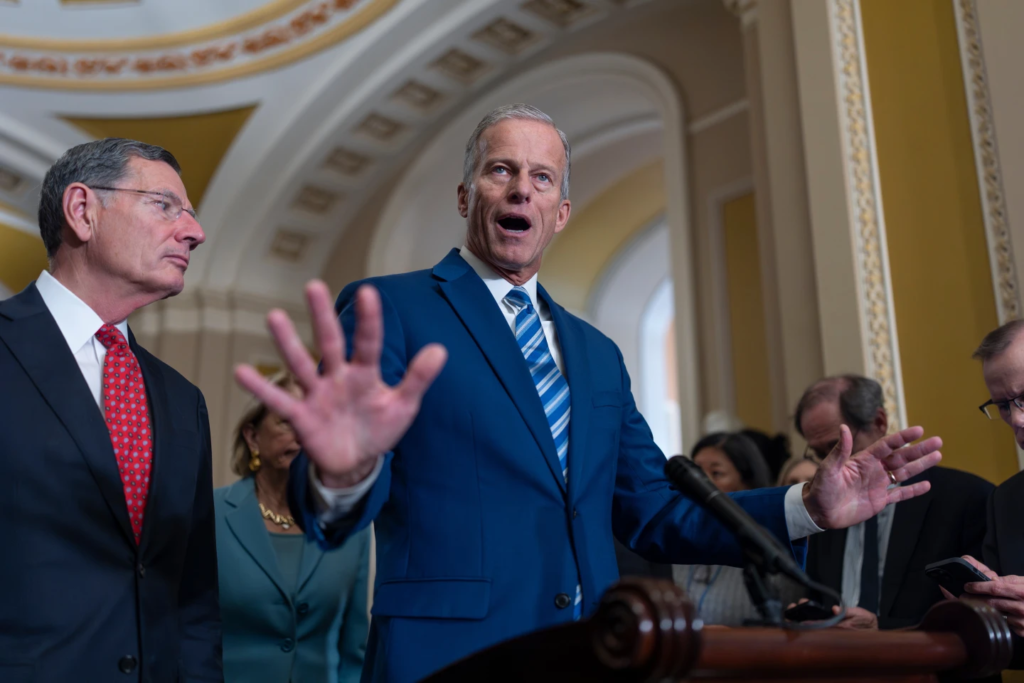
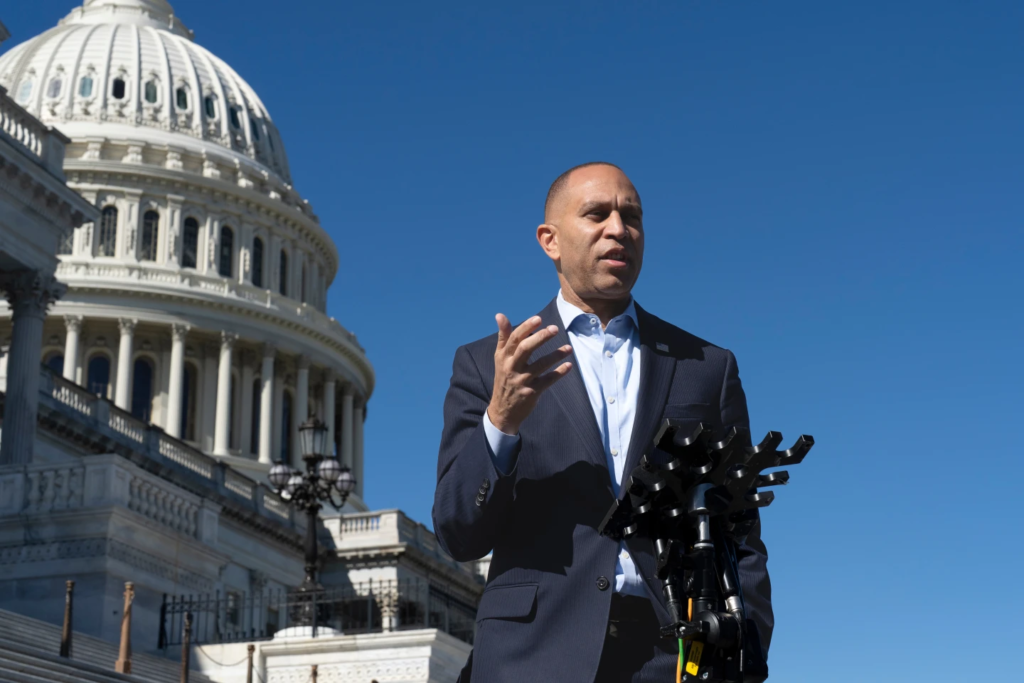
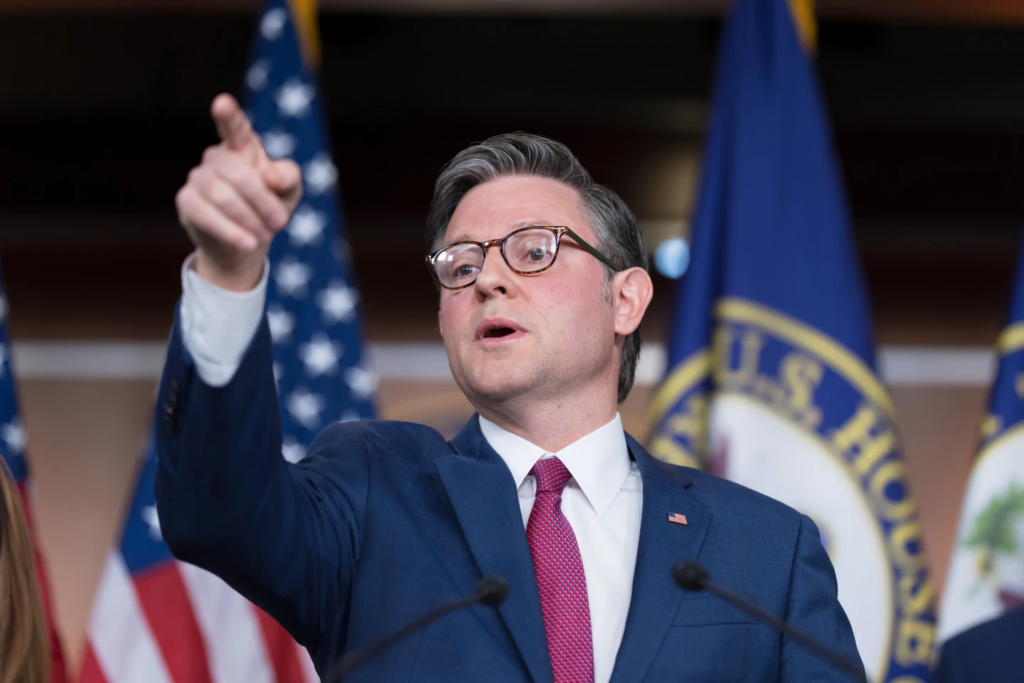
Neither side is showing signs of compromise. “We’re not conducting negotiations in a hostage situation,” said Senate Majority Leader John Thune (R-S.D.), while House Democratic Leader Hakeem Jeffries (D-N.Y.) declared, “We are not going to bend and we’re not going to break. We’re standing up for the American people.”
Federal Workforce: A Nation on Pause
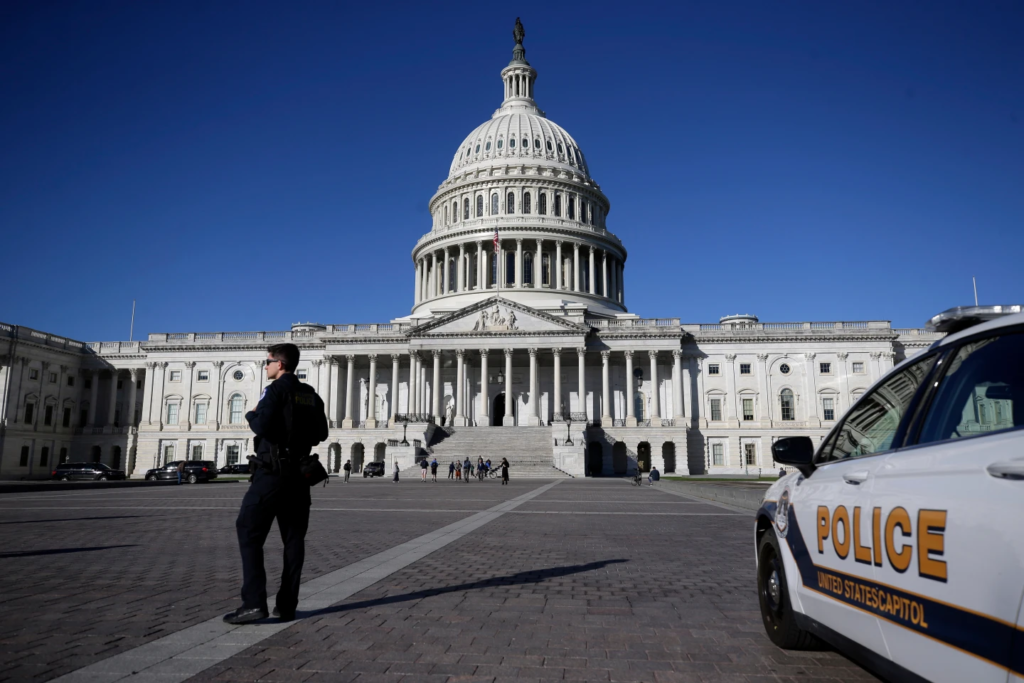
The federal government, reports the Congressional Budget Office (CBO), has about 2.3 million civilian employees. Of those, about 750,000 workers are furloughed every day, meaning they are prevented from coming to work until the government is reopened.
Others, being “essential,” have to keep working without getting paid right away — including providing critical services like national security, air traffic control, and public safety.
Both military and civilian employees are guaranteed retroactive pay, but that’s little comfort for those who have mounting missed mortgage payments, utility bills, and rent. “People can’t pay their bills with IOUs,” said one furloughed employee at the Environmental Protection Agency in Virginia.
The Pentagon, though, did manage to reallocate funds to cover one skipped paycheck for the nation’s 1.3 million active-duty personnel, although officials say a second deferment is not likely.
The cost of compensating idle workers is prohibitive. The CBO estimates that the shutdowns cost taxpayers around $400 million a day in back pay.
Trump Administration’s Aggressive Strategy
Unlike past administrations, Trump officials have been using the shutdown to enact draconian staff cuts at big agencies. The White House Office of Management and Budget revealed proposals to eliminate more than 4,000 federal jobs, primarily in the Treasury, Health and Human Services, Education, and Housing and Urban Development Departments.
White House budget chief Russ Vought said during an appearance on The Charlie Kirk Show that the administration’s goal is to permanently “shutter the bureaucracy.”
“We’re not just cutting funding — we’re cutting the bureaucracy itself,” Vought said. “We now have an opportunity to do that.”
A federal judge, however, has provisionally suspended the dismissals, finding that they appear politically motivated and were enforced without procedure. White House Press Secretary Karoline Leavitt stated that the administration is “100% confident” the courts will eventually uphold the dismissals.
Human Impact: Food Banks Step In
The majority of government employees survive paycheck to paycheck, and as the shutdown continues, food insecurity becomes progressively more difficult to address.
The Washington, D.C., Capital Area Food Bank also reported emergency food distributions to aid affected federal contractors and employees. Similar programs are under way in cities from Atlanta to Seattle as community groups anticipate an increase in demand.
“This is not about politics anymore — it’s about families who can’t feed their children,” said Maryland food bank volunteer Monica Reyes.
Economic Ripple Effects
The longer the shutdown continues, economists warn, the more catastrophic the damage to the national economy.
Oxford Economics estimated the possible cost at 0.1 to 0.2 percentage points of U.S. growth for each week of the shutdown. If it continues through an entire fiscal quarter — a first — growth would decline by up to 2.4 percentage points.
Pivotal industries already are feeling the pinch
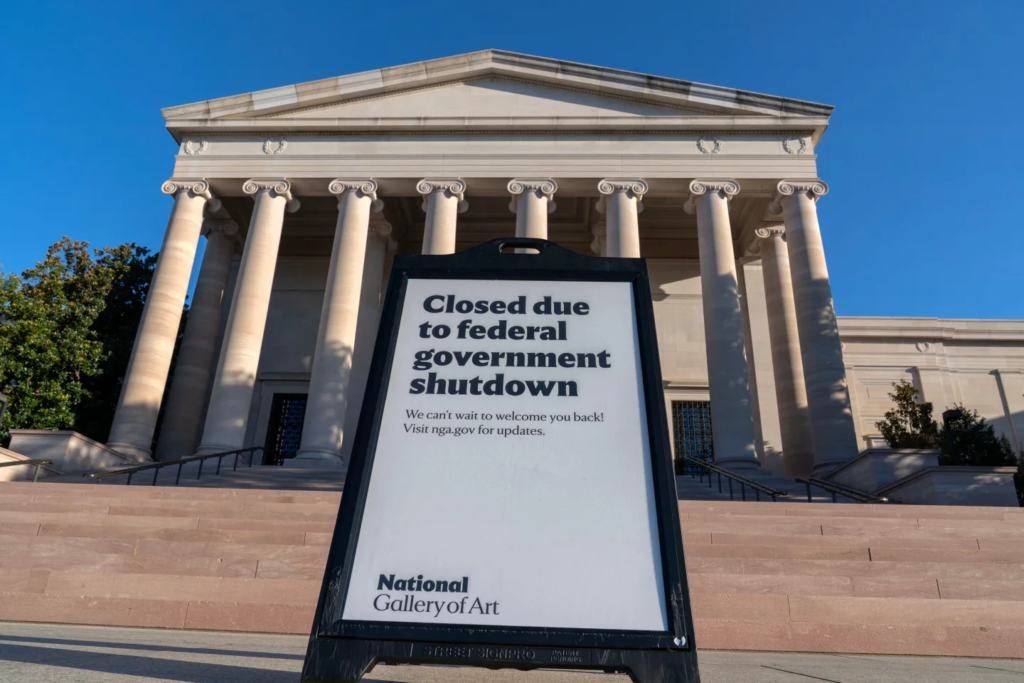
Tourism: The U.S. Travel Association puts losses at $1 billion a week, with travelers canceling visits to closed national parks, museums, and monuments — all Smithsonian Institution ones and the Washington National Zoo.
Small Business: The U.S. Chamber of Commerce reports the Small Business Administration (SBA) has halted about $860 million in loans a week to about 1,600 small businesses.
Real Estate: The closure has frozen federal flood insurance renewals, keeping home purchases and mortgage closings across the country at a standstill.
Air Travel: Shortages of air traffic controllers at busy airports like Boston, Atlanta, Houston, and Philadelphia are indicated by the Federal Aviation Administration (FAA), triggering downstream effects of delays across the country.
“This is larger than a Washington problem,” stated Georgetown University economist Dr. Laura Greene. “It’s a Main Street problem that affects families, tourists, and small business owners alike.”
Political Fallout: Whose Fault Is It?
The public is also decidedly split on responsibility for the crisis.
A new Associated Press-NORC poll found that 61% of Americans hold Trump and congressional Republicans largely responsible for the shutdown, and 54% hold Democrats at least partly accountable for refusing to give in to compromises.
In the past, the party conceding on border wall policy in a shutdown has suffered the larger political blow — as Republicans did in 2013 and 2018. But this time could be different, as the Trump administration uses the shutdown to refocus federal priorities and shift money away from Democratic states.
Already, the White House has
Freezing $18 billion in federal money for a new Hudson River rail tunnel between New Jersey and New York City;
Canceling $7.6 billion in grants supporting clean energy projects in 16 Democratic-leaning states.
The moves, authorities claim, have nothing to do with the shutdown, but opponents accuse the trend of partisan targeting and an endgame struggle for control of national policy.
A Deepening Divide, No End in Sight
With every day that passes, the shutdown becomes more expensive — not only in dollars, but in politics. Both sides are dug in, neither wanting to be seen as weak to voters before the next election cycle.
“This is not just a budget war; it’s a battle over America’s future direction,” commented Dr. Marcus Hill, a political historian at Howard University. “The outcome will decide how far presidents will be able to go in using shutdowns as leverage for ideological change.”
For the time being, federal employees wait, companies draw in their belts, and millions of Americans prepare for the trickle-down effects of a government coming to a standstill — with no end in sight.