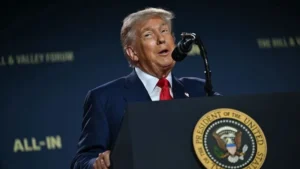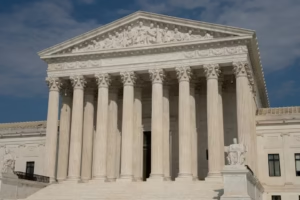

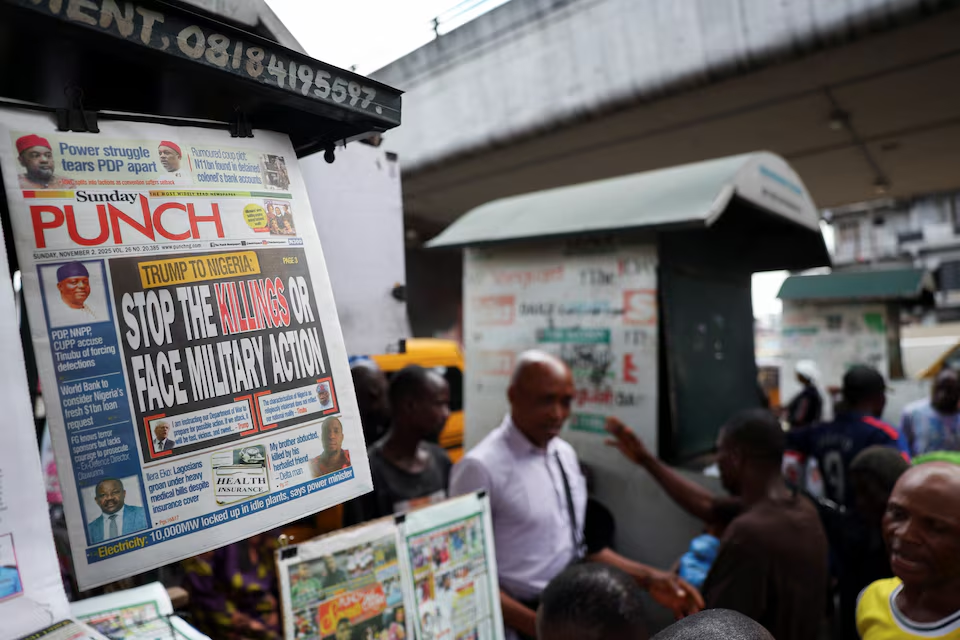
The US President, Donald Trump, warned that he may order military action or airstrikes in Nigeria to stop what he described as the “killing of large numbers of Christians” in the West African nation.
Speaking to reporters aboard Air Force One Sunday evening as he returned to Washington from his Florida residence, Trump said the United States would not stand by while religious violence continues to claim lives in Nigeria.
“Could be. I mean, other things. I envisage a lot of things,” Trump said, asked whether he was thinking of sending in U.S. troops or launching airstrikes. “They’re killing record numbers of Christians in Nigeria … They’re killing them in very large numbers. We’re not going to allow that to happen.”
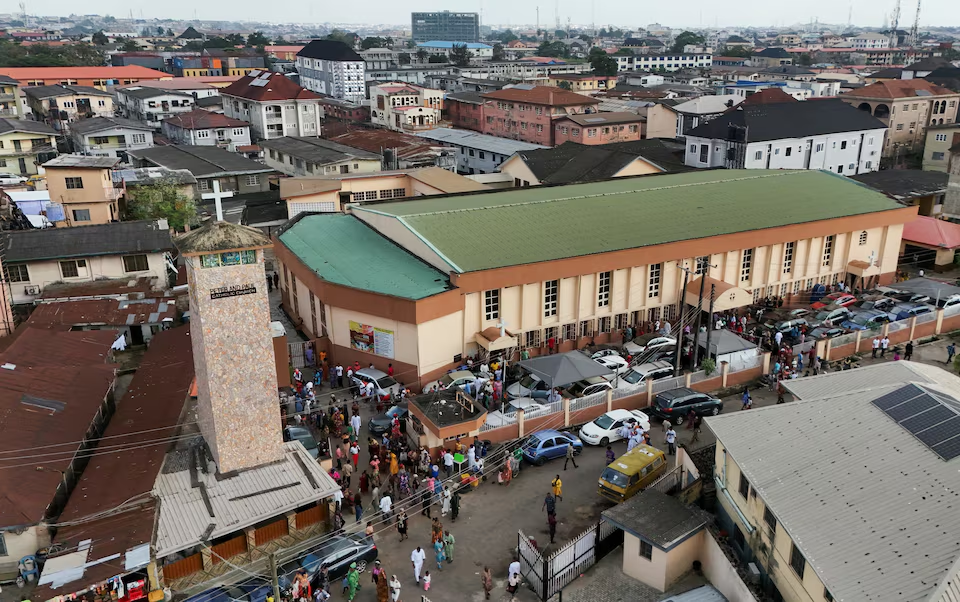
The comments reflect an increased willingness by the Trump administration to use military power and diplomatic pressure as tools in its response to human rights and religious freedom abuses overseas-a willingness that has been both lauded and criticized by international observers.
Nigeria Back on U.S. Religious Freedom Watchlist
Trump uttered those remarks barely a week after his administration had restored Nigeria to the U.S. “Countries of Particular Concern” list, a designation reserved for nations accused of committing or tolerating “systematic, ongoing, and egregious violations of religious freedom.”
Others currently on that list include China, North Korea, Myanmar, Russia and Pakistan – countries frequently criticized for persecuting religious minorities.
Nigeria was removed from the list by the Joe Biden Administration in 2021, a move then criticized by several religious and human rights groups. Trump’s reinstatement of the designation dramatically shifts U.S. foreign policy toward Africa’s most populous country.
“We’re putting Nigeria back on notice,” Trump said earlier on Saturday. “If they can’t protect their people, especially Christians who are being slaughtered, the United States will take action.”
Escalating Violence in Nigeria
For years, the country has been embroiled in a complicated network of religious and ethnic violence, especially within northern and central parts. Attacks by extremist groups such as Boko Haram and Islamic State West Africa Province have targeted Christian communities, whereas long-standing clashes between herders and farmers have also exacted a heavy toll on both Muslim and Christian populations.
Thousands of Christians have been killed in Nigeria in the last decade, and many churches have been burned or destroyed, according to reports by international watchdogs. Rights groups say the violence is part of a deteriorating situation caused by weak law enforcement, entrenched political corruption, and limited access to justice.
The administration of President Bola Tinubu has promised to fight terrorism and religiously inspired attacks but insists the violence cuts across all communities and is not targeted at Christians. Nigerian officials have yet to respond formally to Trump’s latest remarks.
Possible U.S. Intervention and Global Reactions
If President Trump follows through with his warning, it would constitute one of the rare US military interventions in Sub-Saharan Africa with the specific purpose of protecting religious minorities. The US maintains a limited military presence on the continent, mostly conducting counterterrorism operations across the Sahel and Horn of Africa.
Analysts say any U.S. military involvement in Nigeria might have wide-ranging geopolitical consequences, possibly pushing relations with African Union members that oppose foreign interventions.
“Washington needs to tread carefully,” said Dr. Eliza Mensah, an African security analyst at the Center for Global Policy. “Nigeria is a key partner in regional counterterrorism efforts, but external military pressure may inflame nationalist tensions and complicate cooperation.”
The Pentagon has not confirmed whether any operational plans are in consideration yet, but senior defense officials reportedly have been briefed on the president’s statements.
Religious Freedom as a Foreign Policy Tool
The Trump administration has placed religious freedom at the center of its foreign policy, frequently connecting human rights issues to trade negotiations and military alliances. Defending countries that he argues are not doing enough to protect Christians and other religious minorities, Trump characterizes the issue as both a moral and strategic priority for U.S. leadership.
Observers say Trump’s stance on Nigeria may serve both a humanitarian and political purpose, appealing to Christian advocacy groups and the broader constituency of religious voters ahead of his likely re-election campaign.
“This move plays directly to Trump’s core base,” said Michael Harrington, a political analyst with the Washington Institute for Global Affairs. “It’s a combination of moral conviction, political calculation, and his broader narrative of America as a defender of Christian values worldwide.”
While it is still unclear if Trump’s warning will escalate into direct US military involvement, his comments have drawn the attention of the world and once again raised debate over just how far Washington should go to protect religious liberty overseas. With over 230 million Nigerians, the country is roughly divided between Christians in the south and Muslims in the north-a demographic balance that has long influenced its political and social dynamics. As tensions rise, the coming weeks will show if Trump’s remarks were a diplomatic warning shot, or the precursor to a new phase of U.S. engagement in Africa.